 Skip to content
You got through mediation, signed the papers, came home, and now the deal that felt workable a few hours ago suddenly feels heavy.
Maybe you're sitting at the kitchen table rereading a buyout term, wondering whether you can back out because the wording looks sharper than you expected, or because the other side now sounds far more confident than they did in the mediation room. That moment is exactly why Texas has a specific rule for divorce mediation. A Family Code 6.602 mediated settlement agreement in a Texas divorce can become binding very quickly, and once it does, simple second thoughts usually won't undo it.
When a Mediated Deal Suddenly Feels Uncertain
The most common panic point comes after everyone leaves mediation.
You signed a written agreement. The mediator wrapped up the day. Your spouse's lawyer said a final decree would be drafted later. Then you got home and started replaying every compromise. Maybe the house refinance deadline now feels too short. Maybe the business valuation language feels too vague. Maybe you're worried you gave up too much on retirement or possession time with the children.
Why Texas created a special rule for divorce mediation
Texas lawmakers didn't leave this area to general handshake principles. The Legislature created a divorce-specific rule for mediated settlement agreements. A prior Family Code provision had briefly covered both divorce and parent-child cases starting September 1, 1995, then the Legislature repealed that approach and replaced it with Section 6.602 effective September 1, 1997, separating divorce enforcement into its own system (history and timeline).
That matters because the statute wasn't written by accident. It was designed to give separating spouses a faster, more predictable way to lock in a mediated deal when the required formalities are met.
Practical rule: If your mediation agreement satisfies Section 6.602, the fight usually shifts away from "Can I take it back?" and toward "How do we get this into a final decree?"
What's really at stake if someone tries to walk away
For you, this isn't just a paperwork issue. It can affect:
- Your property division if one spouse stalls on signing transfer documents
- Your parenting plan if the agreement includes conservatorship or possession terms
- Your business interests if the deal includes ownership, reimbursement, or valuation language
- Your timeline if you're counting on wrapping up the divorce soon
If you're still trying to understand what happens during the mediation process itself, this overview of what mediators do in a divorce helps put the settlement document in context.
Texas courts have treated a compliant Section 6.602 agreement as unusually final. That means your next steps matter. You need to know whether the agreement is enforceable, how it turns into a decree, what narrow defenses still exist, and what you should do this week to protect the deal you worked hard to reach.
What Family Code 6.602 Actually Says
A lot of post-mediation panic starts with one question: “Did we just sign something final, or was that only a draft?”
Section 6.602 answers that by focusing on form first. The statute gives certain divorce mediation agreements special force if they meet a short, specific checklist. Judges usually begin there, not with who feels regret the next morning.

The plain-English checklist
Section 6.602 works like a lock with a few exact pins. If those pins line up, the agreement gets a much stronger enforcement path under Texas law.
The agreement must come out of mediation.
A settlement reached in a formal mediation session is treated differently from a few emailed proposals, a phone call, or a conversation in the courthouse hall.The agreement must be in writing.
A spoken deal is not enough for this statute. The court needs a written document it can review and enforce.The writing must say, prominently, that it is not subject to revocation.
This warning language matters because the statute puts real weight on it. The exact wording and placement should be checked carefully against the statutory text.Each party must sign the agreement.
The spouses, not just their lawyers, must sign.Any lawyer present when a party signs must sign too.
This point surprises people. If an attorney is there at signing, that attorney's signature is part of the statutory formula.
Why the checklist matters so much
The first court fight after mediation is often narrower than families expect. The judge is usually asking whether the document complies with Texas Family Code 6.602, not whether one spouse now thinks the bargain was a bad one.
That distinction matters because a compliant MSA can put you on the road to a motion to sign judgment, even if one side later refuses to cooperate with the final decree paperwork. In other words, the legal battle often shifts from “I changed my mind” to “Does this document satisfy the statute well enough for the court to render judgment on it?”
Here is the practical way to read the statute. If your MSA checks the required boxes, Texas law gives it unusual force compared with ordinary settlement discussions or informal deal memos.
The document gets its power from statutory compliance, not from how long the mediation lasted or how hard the parties negotiated.
One threshold issue people miss
Families often use the words “agreement,” “mediator's memo,” and “draft decree” as if they mean the same thing. They do not.
A true mediated settlement agreement is the signed writing that came out of mediation and contains the required no-revocation language. A draft decree prepared later is different. So is a term sheet that still says the deal is subject to later approval. That mix-up causes real trouble when one spouse assumes there is still room to renegotiate property language, possession terms, or deed language after mediation has ended.
If you want the larger divorce sequence around this document, How to File for Divorce in Texas: Step by Step explains how the case moves from petition to final decree.
Parenting terms add another layer of confusion. Some mediated agreements cover both property division and parent-child issues in the same document. That is common, but it means the wording needs to be reviewed with extra care, especially if you expect the court to sign a decree later without relitigating the deal.
Why a Compliant MSA Becomes Binding Right Away
You leave mediation believing the hard part is over. Then the next morning your spouse sends a text saying they are backing out, or a lawyer starts marking up terms that were already agreed to. That is the moment many people learn an uncomfortable rule of Texas divorce law. If the mediated settlement agreement complies with Family Code 6.602, the deal can become binding when it is signed, long before the judge signs the final decree.
Signing is the legal turning point
A compliant Section 6.602 MSA has a different effect from ordinary settlement talks, hallway promises, or a rough draft passed back and forth by email. Texas courts have repeatedly treated a compliant MSA as immediately binding and not subject to revocation, which means a spouse usually cannot block judgment later by withdrawing consent before the decree is entered (appellate treatment).
That timing matters. Many clients assume the judge's signature is the moment the agreement becomes real. Under this statute, the judge's later signature usually turns the settlement into an enforceable decree. The parties' signatures on a compliant MSA are often what lock in the settlement itself.
A simple way to view it helps. The MSA is the committed blueprint. The decree is the finished order built from that blueprint.
What the courts have said
In Hall v. Hall, the court of appeals explained that Section 6.602 "definitely and deliberately created a procedural shortcut" for enforcing mediated settlement agreements in divorce cases (Hall discussion).
The Texas Supreme Court later discussed the same statutory design in In re Stephanie Lee. As noted in Hall, the Legislature separated divorce MSAs from the earlier framework and gave compliant agreements independent force when the required formalities are present.
That is why these cases can feel so abrupt. The emotional reality is, "we signed papers at the end of a long day." The legal reality is often, "we signed a binding settlement that the court can later turn into judgment."
Why the statute has this much force
Section 6.602 works because the statute puts weight on formality. The law is trying to reduce the usual post-mediation fight where one side agrees in the room, regrets it later, and refuses to finish the case.
Three features do most of the work:
- The no-revocation statement shows the parties agreed the deal is not subject to being pulled back later.
- The parties' signatures show assent to the written terms.
- The attorneys' signatures, if present, help confirm the agreement was executed in the mediation setting with counsel involved.
Once those pieces are in place, the court usually must render judgment on the agreement, subject to a narrow group of recognized challenges such as illegality, fraud, duress, coercion, or other dishonest means (court analysis of enforcement and exceptions).
That last point is where people get tripped up.
"I changed my mind" is usually not a defense. "I was tricked into signing" or "the agreement is illegal on its face" raises a different kind of issue, but those defenses are limited and fact-specific.
The practical consequence after mediation
This immediate binding effect shapes what happens next, even before a decree is drafted. If one spouse starts delaying, refusing to approve decree language, or claiming there was never a final deal, the question often becomes whether the signed MSA met Section 6.602 when everyone left mediation. If it did, the enforcement road usually stays open.
That does not mean every document signed at mediation gets this treatment. A missing no-revocation clause, unclear language showing further approval was required, or problems with signatures can change the analysis. That is why a line-by-line review of the signed MSA matters. Small wording problems can decide whether you have a binding settlement now or a fight about whether a settlement was ever finished.
Turning Your MSA Into a Binding Decree
You leave mediation believing the hard part is over. Then a week later, your spouse stops returning edits to the decree, objects to language that tracks the signed deal, or says they will not sign anything else until they "have time to think." That moment causes a lot of anxiety, especially if you assumed the MSA would automatically become the divorce decree on its own.
It does not.
A mediated settlement agreement is the blueprint. The final decree is the court order that uses that blueprint to end the marriage, divide property, and set out any custody or support terms in enforceable form.
A clear visual helps.
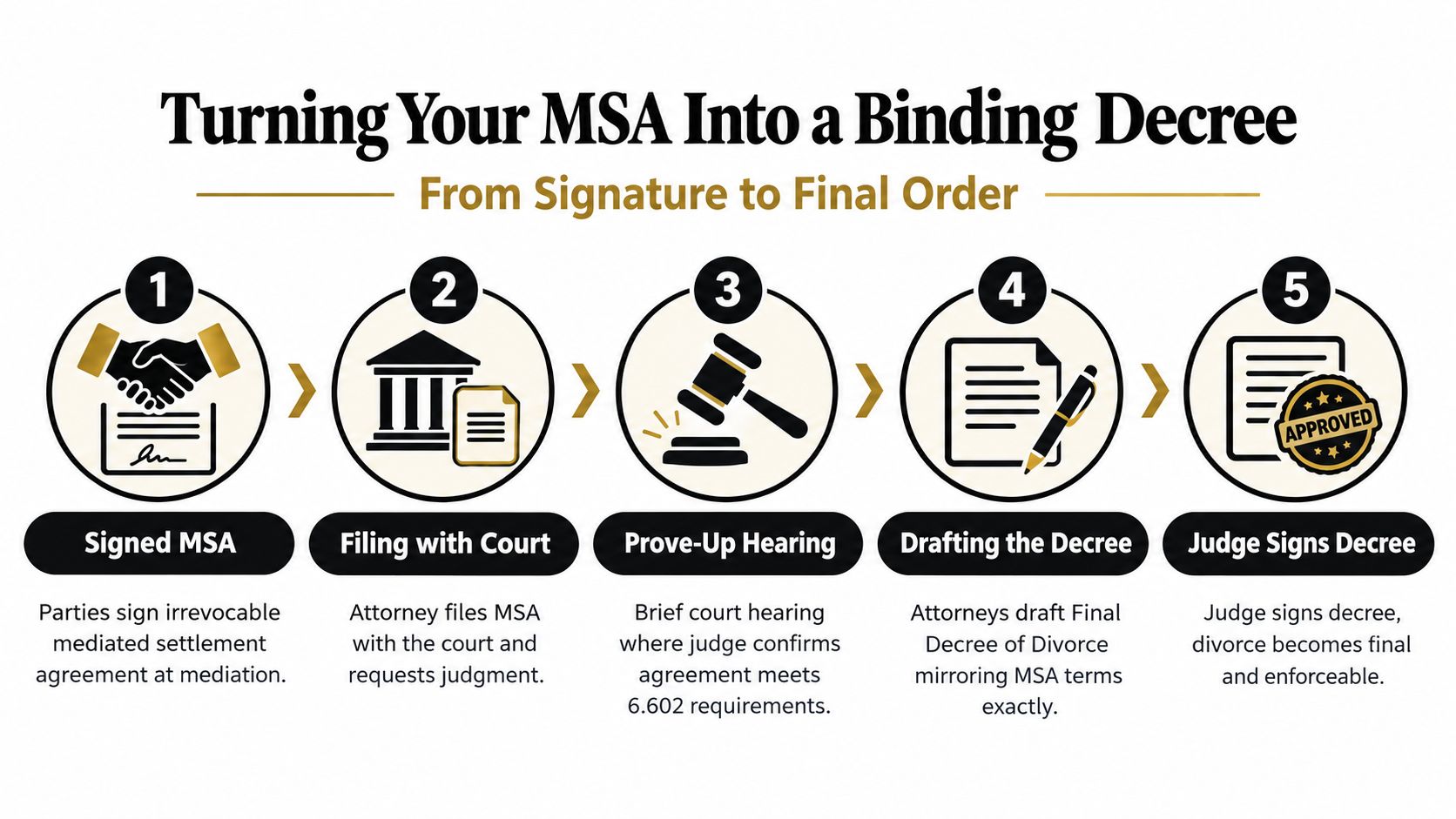
The path from signed MSA to signed decree
In a typical case, the sequence looks like this:
- The parties sign the MSA at mediation.
- One side drafts the final decree to match the settlement terms.
- The draft is reviewed line by line for accuracy, omitted details, and wording problems.
- The case waits out any remaining statutory timing requirement.
- The court signs the decree once the case is procedurally ready.
Step 4 catches families off guard. Texas Family Code Section 6.702 generally prevents a court from granting a divorce before the 61st day after the petition is filed, so even a same-day settlement at mediation does not let the judge finalize the divorce immediately (waiting period summary).
That waiting period creates a common trap. Spouses settle, assume the case is basically over, and then treat the decree phase casually. In reality, that gap is where drafting fights, delay tactics, and preventable mistakes tend to appear.
What can go wrong after mediation
The post-mediation problem is often not whether there was a deal. The problem is whether the proposed decree says what the MSA says.
For example, an MSA may award one spouse the house and require a refinance by a certain date. The decree still has to spell out the deed language, possession date, who pays taxes during the transition, and what happens if the refinance does not occur on time. If the draft decree adds terms nobody agreed to, or leaves out terms needed to carry out the deal, a dispute starts there.
The same issue shows up in parenting cases. An MSA might settle conservatorship and possession in broad terms, but the decree has to translate that into a usable order with dates, exchange details, holiday language, and child support provisions that fit the signed agreement.
For a closer look at how decree language should track the mediated terms, this guide on a settlement agreement in a Texas divorce is a helpful companion.
If the other side refuses to sign the decree
A refusal to sign the decree does not necessarily stop the case.
Texas Law Help explains that when the MSA is binding, a party can ask the court to enter judgment on that agreement through a motion to sign judgment if the other spouse will not approve the final papers (post-mediation procedure). In plain English, you are asking the judge to decide whether your proposed decree correctly carries out the settlement already made.
That hearing is usually not a second mediation. It is not a chance to renegotiate who keeps the retirement account or whether someone now wants a different possession schedule. The question is narrower. Does the decree match the MSA?
Here is a brief walkthrough from a Texas family law perspective:
What to bring if a motion to sign judgment becomes necessary
Treat that hearing like a proof problem. The cleaner your paperwork, the stronger your position.
You usually want:
- The complete signed MSA
- Each draft decree exchanged after mediation
- Marked changes or comments showing where the dispute started
- Notice of hearing and proof of service
- Any mediation paperwork or correspondence that helps show timing, signatures, and whether the decree language tracks the agreement
A useful comparison is a contractor working from approved plans. If the plans call for three windows, the builder cannot decide to install four because four now sounds better. But the builder still has to specify measurements, materials, and installation details so the approved plan can become a finished structure. A divorce decree works much the same way. It must implement the MSA without rewriting it.
One final caution. If your case settles early in the 60-day waiting period, do not assume delay is harmless because "we already have the agreement." Use that time to get the decree drafted, reviewed, corrected, and ready to present as soon as the court can sign it. That is often the difference between a smooth finish and a last-minute enforcement fight.
Defenses That Can Still Beat an Otherwise Binding MSA
People want a simple yes or no answer. The honest answer is narrower than most expect.
Yes, a compliant MSA is binding. No, it isn't impossible to challenge. But the defenses that work are limited, and regret alone won't carry the day.
The narrow defenses courts recognize
Texas appellate authority recognizes exceptions where enforcement can fail if the agreement is illegal or was procured by fraud, duress, coercion, or other dishonest means (appellate authority on exceptions).
That means the court looks for a real legal defect, not disappointment. A spouse who says, "I wish I hadn't agreed to that buyout," is in a very different position from a spouse who can present admissible evidence that the other side hid accounts, lied about a major asset, or used pressure that overrode voluntary choice.
Defenses vs. Reality What Actually Beats a 6.602 MSA
| Defense | Evidence Required | Real-World Success Rate |
|---|---|---|
| Fraud or misrepresentation | Admissible proof of specific false statements or concealment tied to the agreement | Limited |
| Duress or coercion | Admissible evidence showing pressure severe enough to overcome free choice | Limited |
| Illegality | Proof that the agreed term itself is unlawful | Limited |
| Mutual mistake | Strong evidence that both parties shared the same material mistake | Limited |
| Simple regret or bad bargain | Usually not enough by itself | Very low |
The key point is evidence. Courts don't usually undo these agreements because someone felt stressed, upset, or dissatisfied after the fact. Divorce mediation is stressful by nature.
If you're trying to understand how this interacts with ordinary agreement rules, this explanation of Rule 11 in Texas family law helps show why Section 6.602 is treated differently.
Child-related terms get extra scrutiny
When children are involved, courts remain sensitive to the child's welfare. Even in a mediated case, child-related provisions can invite closer review than property terms if serious concerns are raised. That's one reason custody and possession language needs careful drafting.
Don't confuse a hard day in mediation with a legal defense. Courts expect hard emotions. They still require actual proof.
In practice, the spouse trying to resist enforcement usually needs more than a broad claim like, "I was overwhelmed." The stronger argument is document-based and specific. What was concealed? What false fact was presented? What pressure was applied, by whom, and how did it affect the signature?
What You Should Do Next to Protect Your Settlement
You leave mediation with a signed MSA. By that evening, your spouse is already second-guessing parts of the deal, a lender wants refinance documents, and someone says, "We can fix it later in the decree."
That is the moment to slow down and get organized. A signed MSA can bind the parties before the divorce is final, but the period after mediation is where avoidable problems show up. The usual trouble spots are decree language that drifts from the MSA, early property transfers that create confusion, and waiting-period delays that make one side think the agreement somehow stopped mattering.

Your first five moves
Start with document control. If there is a dispute later, the signed MSA is the anchor for everything that follows.
- Secure the signed agreement. Keep the final signed version in a safe place and save clear digital copies.
- Gather the full mediation paper trail. Save drafts, attorney emails, marked-up versions, and any mediator paperwork you received.
- Check the signing details. Make sure the no-revocation language appears in the document and that all required signatures are there.
- Review every proposed decree line by line. The decree should carry out the MSA, not revise it.
- Be careful in texts and emails. Angry messages, loose promises, or comments about changing terms can create side fights you do not need.
A good way to think about the decree is this: the MSA is the blueprint, and the decree is the house built from it. If the builder starts changing room sizes, the problem is not small. It can lead to hearings, redrafts, and a motion to sign judgment.
The timing issue that catches families off guard
A binding settlement does not always mean an immediate divorce hearing.
Texas has a waiting period in most divorce cases, so a family may sign a fully enforceable MSA and still be unable to finish the divorce right away if the case was filed recently. That gap confuses people. They assume the delay means the deal is still open for debate. Usually it is not.
Use that waiting period wisely. Get the decree drafted. Review deeds, QDRO language, refinance deadlines, and parenting details. If one spouse goes quiet during this stage, the other spouse may need to ask the court to move the case toward judgment rather than waiting indefinitely for cooperation.
Protect the parts of the deal that are easiest to mishandle
Some terms are more likely to create post-mediation conflict because they require follow-up documents or precise wording.
- Parents: Check holiday schedules, exchange times, pickup locations, school decision-making language, and child support start dates.
- Business owners: Confirm who signs transfer documents, how debts tied to the business will be handled, and whether tax language matches the actual deal.
- High-asset spouses: Review retirement division terms carefully, along with deeds, liens, reimbursements, tracing recitals, and deadlines for sale or refinance of real property.
Do not start transferring major assets based on memory or hallway conversations. Use the signed MSA and the draft decree together. If they do not match, fix that before signatures and prove-up.
If cooperation breaks down, act early
One common mistake is waiting too long because everyone assumes the other side will eventually sign the final decree. Sometimes that happens. Sometimes it does not.
If your spouse refuses to approve a decree that accurately reflects the MSA, talk with your lawyer about the next procedural step, which may include setting a hearing and asking the court to sign judgment based on the mediated settlement. That is the enforcement roadmap many people miss. Question after mediation is often not whether the MSA is binding, but how quickly you convert it into a court order that can be enforced cleanly.
A Texas family law attorney can also spot narrow issues before they become bigger ones, especially if a party is hinting at fraud, duress, mistake, or a child-related concern. Law Office of Bryan Fagan, PLLC handles Texas divorce, custody, mediation, and enforcement matters, and families often seek that kind of review before property is transferred or parenting changes are put into effect.
Key Takeaway
Treat the days after mediation like the closing phase of a major transaction.
Preserve the signed MSA, press for a decree that matches it exactly, watch the waiting-period calendar, and respond quickly if the other side stops cooperating. That is how you protect the settlement you already reached.
Frequently Asked Questions About 6.602 Agreements
Can I revoke a signed MSA the next day?
Usually not, if the agreement complies with Section 6.602. A compliant agreement is designed to be non-revocable once signed. The issue is rarely whether you changed your mind. The issue is whether a recognized defense can be proved.
If the MSA is binding, why isn't my divorce already final?
Because a binding MSA and a final decree do different jobs. The MSA can lock in the settlement terms, while the decree is the court order that formally ends the marriage. Texas also has a statutory waiting period before a court may grant most divorces.
What if my spouse won't sign the final decree?
That doesn't automatically destroy the settlement. In some cases, a party may ask the court to sign judgment based on the MSA even if the other spouse refuses to cooperate with follow-up paperwork.
Do both spouses need lawyers for a valid MSA?
No. The statute requires signatures by any attorney present at execution. The key question is whether the agreement meets the statutory formalities that apply to the actual signing.
Are mediation communications confidential?
Many parts of mediation are treated as confidential, which is one reason people can negotiate candidly there. But when enforcement becomes contested, the court can still examine the signed MSA itself and other admissible evidence relevant to enforcement or a claimed defense.
Are child custody terms treated the same as property terms?
Not always. Courts remain alert to children's interests. Parenting terms should be drafted with care, because child-related provisions can draw closer review than a pure property division dispute.
What should I do this week if I already signed?
Start with the basics. Secure the signed document, gather your mediation records, review the decree draft line by line, and get legal advice quickly if the other side is stalling or claiming the deal changed.
If you're dealing with a signed mediation agreement and aren't sure whether it's enforceable, how to turn it into a decree, or what to do when your spouse won't cooperate, the attorneys at Law Office of Bryan Fagan, PLLC help Texas families work through those exact problems. You can schedule a free consultation to review your MSA, identify any enforcement issues, and map out the next step toward a final decree with clarity and confidence.


