 Skip to content
You may be lying awake wondering whether your dog or cat will still be part of your daily life after the divorce, especially if your spouse says the pet belongs to them.
Introduction When Your Pet Feels Like Family During Divorce
You and your spouse may have adopted the pet together, shared veterinary bills, and built routines around walks, feeding, and care. Now that the marriage is ending, the thought of losing that relationship can feel as painful as losing a home or personal keepsake. If children are involved, the concern can become even more intense because your pet may be part of their sense of stability.
Texas law gives you a legal framework, even when the situation feels personal. A court generally treats a pet as property, not as a child. That means the court doesn't use the same conservatorship, possession, and access rules that apply to children under Texas Family Code Chapter 153. Instead, the court analyzes ownership and awards the animal through the property-division process. You can review the basic Texas approach in this Texas Law Help explanation of pets in family law cases.
There is an important modern nuance, however. Texas has a statute allowing a court to award sole or joint possession and use of a companion animal and to consider the animal's best interest. Older summaries often say that courts can never address shared possession, so you shouldn't rely on an outdated “pets are only property” answer without discussing the current statute and the facts of your case.

This guide explains how Texas classifies a pet, what documents can help establish ownership, how caregiving evidence may support your position, and how to negotiate practical terms. You'll also learn how the divorce process works from filing through the final decree, including temporary orders, mediation, and enforcement.
The most secure outcome usually comes from a clear written agreement, supported by reliable ownership and care records.
Whether you live in Houston, Dallas–Fort Worth, Austin, San Antonio, or another Texas county, preparation gives you more control than leaving every detail to a contested hearing. Your pet matters, and your strategy should reflect that reality while staying grounded in Texas law.
How Texas Law Treats Pets in Divorce
The first question is usually not “Who loves the pet more?” It is what kind of property is the pet under Texas law? That classification can affect who receives the animal when you and your spouse can't reach an agreement.
Separate property and community property
Texas generally divides property into two categories:
- Separate property: A pet owned before the marriage, or received by one spouse as a gift or inheritance, will usually remain that spouse's separate property if the spouse can prove the origin.
- Community property: A pet acquired during the marriage is generally community property, even if only one spouse's name appears on some records.
The timing and source of acquisition matter. If you adopted your dog before the wedding and kept the adoption contract, early veterinary records, and registration information, those documents may help trace the pet to your separate property. If your spouse gave you the cat as a birthday gift, messages, cards, or witnesses may help show that the animal was intended as a gift.
For community property, the court applies the broader property-division framework in Texas Family Code Chapter 7. The judge divides the community estate in a manner that is “just and right,” rather than automatically splitting every item down the middle. You can learn more about the broader framework in this guide to whether Texas is a community property state.

Why Chapter 153 doesn't work like a pet-custody statute
Texas Family Code Chapter 153 governs conservatorship, possession, and access for children. Those child-custody concepts don't automatically apply to animals. A judge deciding a traditional property dispute won't create a child-style parenting schedule because both spouses want regular time with the pet.
That older description isn't the entire current picture. Texas now has a companion-animal possession statute that may allow sole or joint possession and use and may permit consideration of the animal's best interest. The practical availability and wording of relief depend on the case, the pleadings, the court, and whether the parties are asking for an agreed arrangement or a contested order.
If you want the divorce process explained from the document that starts the case through the final decree, the Original Petition for Divorce in Texas is the filing that sets out the divorce and related requests. Pet terms should be addressed deliberately rather than assumed to arise automatically.
An agreed decree can include pet-care provisions even when the spouses would otherwise fight over ownership. That may include who keeps the animal, whether the other spouse has agreed possession, who pays expenses, and how major veterinary decisions will be handled. A judge deciding disputed property, however, will focus on legally supported ownership and the statutory authority available in that case.
What Influences Who Keeps the Pet
When a pet is community property, the judge may need to decide which spouse receives it if negotiation fails. You should present facts that connect the animal to ownership, daily care, financial responsibility, and a stable future home. Emotional attachment matters to you, but emotional statements alone may not establish a legal entitlement.
National family-law data show why these disputes deserve careful attention. The American Academy of Matrimonial Lawyers reported that 27% of surveyed lawyers saw an increase in pet-custody disputes over a five-year period, and the same survey reporting identified dogs in 88% of disputed-pet matters, cats in 5%, and horses in 1%. Those figures are reported by Kiplinger in its discussion of pets and divorce.

The facts that can strengthen your position
Acquisition evidence comes first. Adoption agreements, purchase receipts, breeder contracts, and dated registration records can show who obtained the pet and when. A record in one spouse's name isn't always conclusive, but it can become important when combined with other proof.
Daily caregiving can support the practical story. Keep evidence showing who feeds the pet, handles walks, schedules grooming, administers medication, and takes the animal to appointments. A calendar, messages with a dog walker, photographs, or testimony from a neighbor can make your account more concrete.
Financial contributions help establish responsibility. Veterinary bills, food purchases, grooming receipts, licensing records, and pet-insurance documents may show who has consistently paid for the animal's needs. Payment isn't the only factor, but it can help distinguish a regular caregiver from a spouse making a last-minute claim.
Stability, children, and safety
A court or mediator may consider where the pet has lived, whether your housing permits the animal, and whether your schedule allows continued care. If you travel often, work extended shifts, or move between homes, explain how you would maintain feeding, exercise, medication, and veterinary routines.
Children's attachment may affect settlement discussions, especially when you can design a plan that keeps the pet with the children during their time with you. It doesn't automatically create a Chapter 153 custody right to the animal. Any claimed neglect, abuse, unsafe housing, or failure to provide medical care should be supported with reliable records rather than speculation.
Use the Texas family-law video about pet disputes as a general educational resource, but treat your own documents and case-specific legal advice as the foundation for a court presentation.
Building Your Evidence and Documentation for Pet Ownership
A persuasive pet-ownership file should let someone unfamiliar with your marriage understand the story in chronological order. Start with the document that answers the basic question, how did this animal come into the family? Then add records showing what happened afterward.
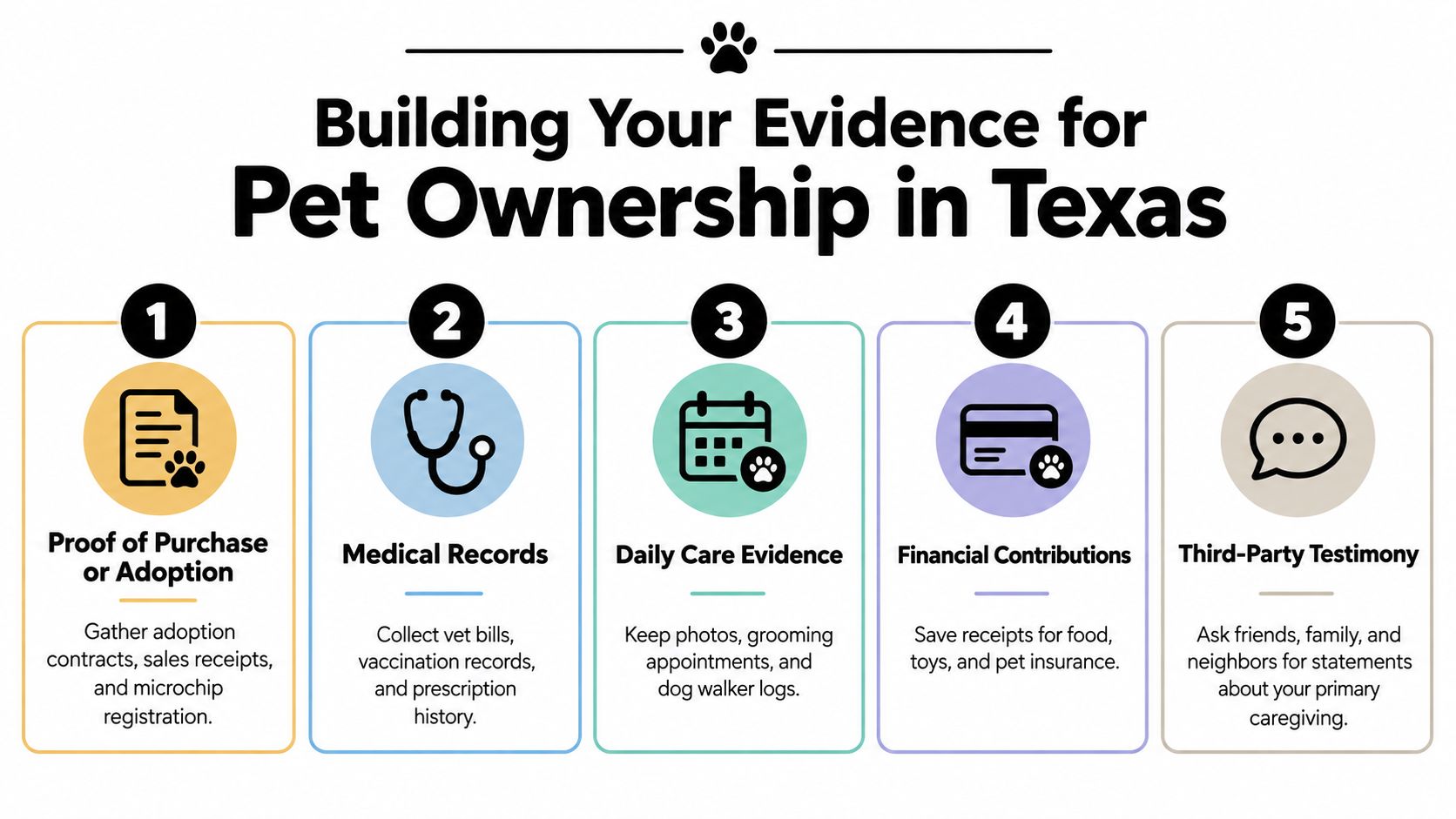
Create an ownership folder
Gather these materials in their original form whenever possible:
- Adoption or purchase records: Save adoption contracts, breeder or seller documents, receipts, and messages about who obtained the pet.
- Premarital or gift proof: Collect evidence showing that you owned the animal before marriage or received it as a gift or inheritance.
- Identification records: Include microchip registration, city or county licensing, and registration information.
- Medical history: Keep veterinary invoices, vaccination records, prescriptions, and treatment notes.
- Routine-care records: Add grooming appointments, boarding records, dog-walker communications, training invoices, and photographs that show ongoing care.
- Payment history: Preserve bank records, card statements, pet-insurance records, food receipts, and other proof of regular expenses.
Don't edit screenshots or alter documents to make them look more favorable. Keep the full message thread when possible, preserve dates, and label each file with the date and what it proves. A short timeline can help your attorney or mediator see the relationship between acquisition, marriage, caregiving, and separation.
Connect your records to the divorce timeline
Texas divorce has a mandatory waiting period of at least 60 days from the date the original petition is filed, and the earliest practical finalization date is the 61st day after filing. The clock starts when the petition is filed, not when the other spouse is served, as explained in this Texas divorce timing guide.
That period gives you time to organize records, but it shouldn't encourage delay. Begin gathering documents before filing if you can do so safely. Your evidence may be exchanged during discovery, presented during mediation, attached to settlement discussions, or used in a hearing if the dispute remains contested.
The firm's guide to what evidence matters most in a Texas divorce case can help you think beyond the pet itself. A pet dispute may connect with the marital home, bank accounts, business records, reimbursement claims, and other property issues, so keep your files organized as part of the larger divorce case.
Negotiating Pet Arrangements and Settlement Options
You don't have to choose between an emotional courtroom fight and giving up your relationship with your pet. Many spouses negotiate a written arrangement that recognizes one person as the owner while addressing practical contact, expenses, and decision-making.
Compare the available paths
| Arrangement Option | Best When | Key Terms to Include |
|---|---|---|
| Sole ownership | One home clearly offers greater stability, or ongoing contact would create conflict | Owner, transfer date, identification records, veterinary authority, and expense responsibility |
| Agreed shared possession | You and your spouse communicate well and live close enough to maintain the pet's routine | Exchange locations, notice, travel rules, holiday periods, and what happens if someone moves |
| Right of first refusal | One spouse needs backup care during travel, hospitalization, or work demands | Notice method, response time, care conditions, and limits on third-party boarding |
| Shared expense plan | Both spouses want to contribute after one spouse receives possession | Food, grooming, routine care, emergency treatment, insurance, reimbursement deadlines, and receipts |
| Pet with the children's schedule | The adults want the pet to remain connected to the children | Whether the arrangement is voluntary, transportation, care responsibility, and the effect of a future move |
A schedule should be realistic, not symbolic. Dogs may need consistent routines, cats may react poorly to repeated moves, and animals with medical needs may require one person to maintain uninterrupted care. If shared possession creates repeated conflict, sole ownership with a carefully defined communication plan may protect the animal better.
Put the agreement into the decree
A vague promise such as “we'll share the dog” leaves too many questions unanswered. A stronger provision identifies the pet by name, species, breed, color, microchip information, and current location. It should state who receives ownership or possession, how exchanges occur, who makes routine and emergency medical decisions, and how expenses are handled.
Mediation can help you discuss these details with a neutral professional instead of asking a judge to choose between incomplete positions. The firm's resource on mediation in a Texas divorce explains why negotiated terms can be useful when you need a customized result.
Texas law also allows temporary orders while the divorce is pending. Those orders can address immediate issues such as custody, support, use of the marital home, and attorney's fees, according to this Texas temporary-orders overview. Although pet terms require careful drafting under the applicable law, temporary relief may help prevent unilateral removal, protect access to the home, or establish responsibility for care while negotiations continue.
Temporary Orders Enforcement and Special Cases to Plan For
A pet dispute can become urgent before the final decree. Your spouse may move the animal, stop paying for treatment, refuse to provide records, or change the pet's living conditions. Tell your attorney promptly, preserve evidence, and ask whether temporary relief is appropriate under the facts of your case.
Enforcement depends on the order's wording
A clear final order is easier to enforce than an informal conversation. If the decree awards ownership or possession in definite language, a court may have a clearer basis to address noncompliance. An informal promise about visitation may be harder to enforce because pet arrangements don't operate exactly like child-possession orders.
The Texas child-custody framework illustrates the distinction. Chapter 153 uses conservatorship, possession, and access rules for children, but those concepts don't automatically apply to pets. The statutory text is available through the Texas Family Code Chapter 153 resource. Your lawyer should evaluate the exact companion-animal statute, pleadings, decree language, and enforcement remedy available in your case.
Plan for animals with special value or needs
Service animals and emotional support animals can involve disability-related concerns, housing rules, and daily reliance that go beyond an ordinary ownership dispute. Bring supporting records and explain how separation would affect care and function.
If your pet is bonded to your children, raise that concern during settlement discussions and connect it to a practical arrangement. The bond may support an agreement, but it doesn't automatically transform the animal into a child under Chapter 153.
High-value animals require additional planning. A purebred dog, competition animal, or horse may involve purchase records, breeding rights, medical expenses, insurance, transportation, boarding, and valuation questions. Business owners and spouses with substantial estates should also consider whether the animal connects to a ranch, professional operation, trust, or other property issue. Those matters can affect the larger “just and right” division and should be analyzed with the rest of the estate, not treated as an isolated emotional dispute.
What to Do Next to Protect Your Pet and Your Future
You can take practical steps today:
- Collect ownership proof. Find adoption or purchase records, microchip information, veterinary files, licensing, and evidence of a premarital gift or inheritance.
- Build a care timeline. Record feeding, medication, appointments, grooming, transportation, and payment responsibilities without exaggerating your role.
- Assess the living arrangement. Consider housing, work schedules, travel, children, medical needs, and whether shared possession would remain calm.
- Discuss a written agreement. Decide whether sole ownership, agreed shared possession, backup-care rights, or shared expenses best protects the pet.
- Address immediate risk. Ask about temporary orders if your spouse may remove the animal, deny necessary care, or interfere with access to the marital home.
- Prepare for the full divorce. Parents should coordinate pet terms with child-possession plans. Business owners and spouses with high-value estates should include pet-related assets and expenses in the broader property analysis.
If you need process guidance, you can review how to file for divorce in Texas step by step and uncontested divorce in Texas as part of your preparation. A negotiated decree often gives you more control than asking a court to resolve every disputed detail, but the agreement must be specific enough to work after the divorce is final.
Your concern is understandable, and you don't have to handle it alone. The Law Office of Bryan Fagan, PLLC can review your ownership evidence, discuss mediation or temporary orders, and help draft pet terms that fit your broader Texas divorce strategy.
Schedule a free consultation with the Law Office of Bryan Fagan, PLLC to discuss who should keep your pet, what evidence supports your position, and how to address ownership, caregiving, and expenses in a Texas divorce decree. You can receive guidance specific to your family, property, and immediate concerns before an avoidable dispute becomes harder to resolve.


