 Skip to content
A Texas Family Code § 4.102 partition or exchange agreement is a written, signed contract between spouses that allows them to reclassify community property as separate property, either before or during a divorce, without needing court approval. It can cover property you already own or expect to acquire, giving you and your spouse a private way to define ownership rather than leaving every property question to ordinary divorce rules.
You may be looking at the same home, business, accounts, or investments you built together and wondering whether there's a way to divide them fairly while keeping more control over the process. Divorce is already difficult. Having a judge decide the character and ownership of major assets can make the financial uncertainty even harder.
A properly prepared agreement under Texas Family Code § 4.102 can serve as a strategic property-planning tool. It is not just a promise to split assets later. It can change whether an asset, or income connected to that asset, is treated as community property or separate property between spouses. The result can affect negotiations, mediation, litigation, and the final property division.
When Divorce Makes You Rethink Your Property
You and your spouse may have spent years building a life together. Perhaps you purchased a home, opened a family business, saved for retirement, and invested in real estate. Now divorce is approaching, and you both want a fair result without surrendering every important decision to the court.
One couple might agree that one spouse should retain the business while the other receives a greater interest in the home and investment accounts. Another couple might want to separate ownership of a business before its value changes further. In either situation, the central question is not only, “Who gets what?” It's also, “What is the legal character of each asset before we divide it?”
That distinction matters because Texas generally treats property acquired during marriage as community property. Section 4.102 gives spouses a way to alter that default by partitioning or exchanging all or part of their community property. The transferred property becomes the separate property of the spouse who receives it, subject to the agreement's terms and the requirements for enforceability.

Why the distinction matters in a divorce
A divorce settlement divides property as part of ending the marriage. A partition or exchange agreement addresses ownership itself. That difference can shape how you negotiate, which assets remain under your control, and how future growth or income is treated.
The agreement may be especially relevant when you own a closely held business, inherited assets, a valuable home, or investments that produce income. Tax consequences also deserve separate review. For a useful discussion of how property ownership decisions can affect tax planning, you can review this resource on divorce settlement tax basis.
A § 4.102 agreement won't make an emotionally difficult divorce easy. It can, however, replace uncertainty with documented choices. Your attorney should examine the agreement alongside deeds, account records, business documents, estate planning instruments, debts, and any proposed divorce settlement.
What Is a Partition or Exchange Agreement Under Texas Law
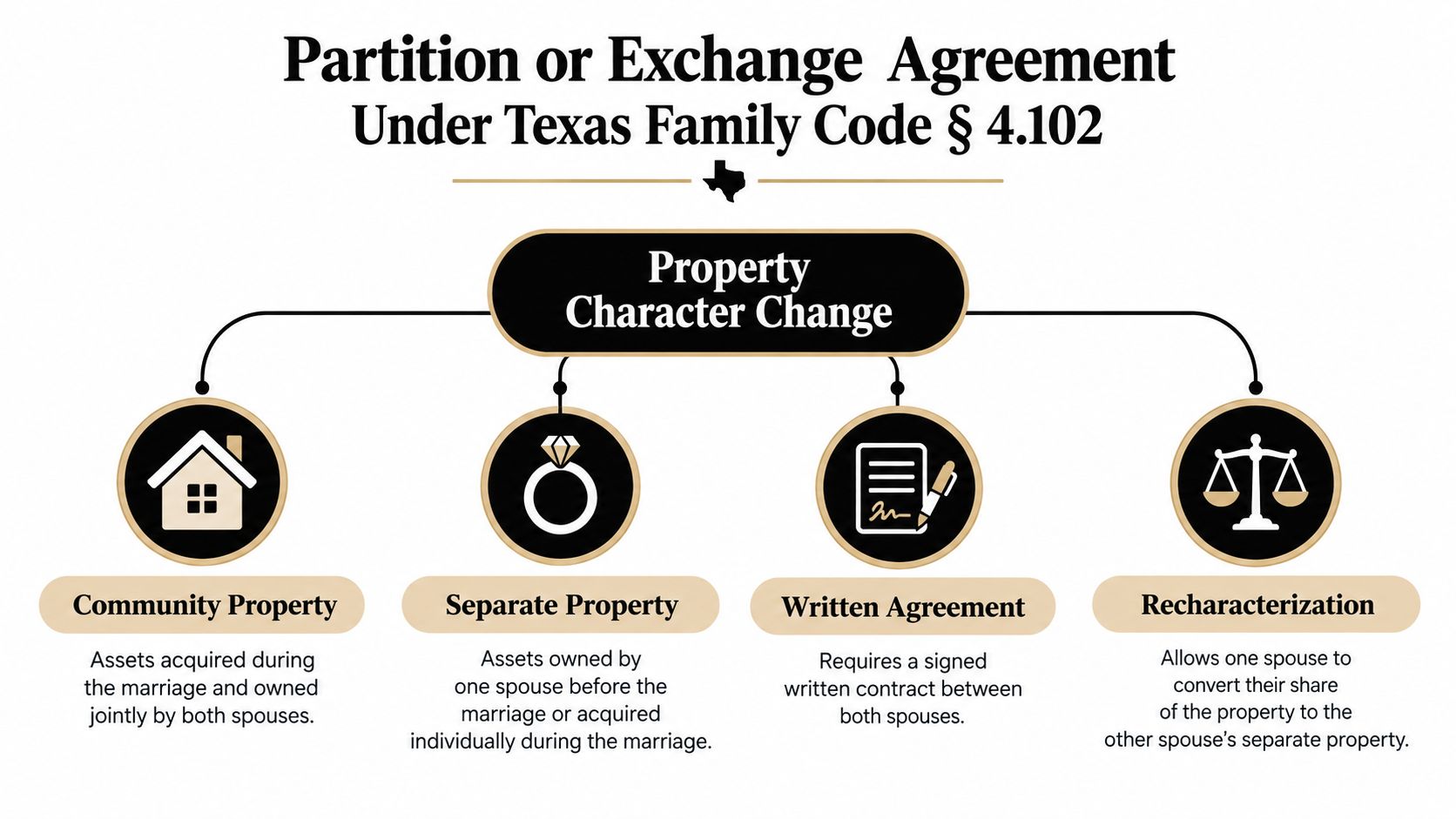
A partition or exchange agreement is a contract between spouses that changes the character of community property. Under Texas Family Code § 4.102, spouses may partition or exchange all or part of their community property, whether it already exists or will be acquired later. Property transferred under the agreement becomes the separate property of the spouse who receives it. The statute appears in the Texas Family Code property agreements provisions.
The agreement can operate in two basic ways:
- Partition property. You and your spouse divide an existing community asset or assign each spouse a defined interest.
- Exchange property. You trade one spouse's interest in an asset for an interest in another asset.
The statute requires the agreement to be in writing and signed by both spouses. It is enforceable without consideration, so the agreement doesn't need a separate payment or exchange of value merely to satisfy that requirement.
The importance of the agreement's language
A significant statutory change took effect on September 1, 2005. Texas Bar materials explain that agreements made under the amended law may also provide that future earnings and income from transferred property remain the separate property of the owning spouse. That provision can matter greatly to a business owner, investor, or professional whose property may produce continuing income.
You shouldn't assume that transferring an asset automatically transfers every future financial benefit connected to it. The document should identify the asset, explain the ownership change, and state how future earnings, income, appreciation, proceeds, replacements, and related property will be treated.
The default community-property rules can be difficult to apply when accounts are mixed, businesses grow, or spouses use shared funds. A careful agreement creates a written roadmap. For broader context on the just-and-right division of community property, review the firm's explanation of how property is divided in a Texas divorce.
The agreement doesn't decide child custody, possession, or support. Those issues are handled under the child's best-interest standards and the applicable family-law procedures. It also doesn't replace legal advice about the presumption that property acquired during marriage is community property, which you can read about in this explanation of Texas Family Code § 3.003 and the community-property presumption.
The Legal Requirements and Enforceability
The formal requirements are straightforward, but the consequences are serious. A § 4.102 agreement must be written and signed by both spouses. It doesn't require court approval to be effective between the spouses, and the statute makes it enforceable without consideration.
Those formalities are the starting point, not the entire analysis. A spouse may later challenge the agreement by arguing that the signature wasn't voluntary or that the agreement was unconscionable in circumstances involving inadequate disclosure. Texas law uses marital-agreement defenses that make the circumstances surrounding negotiation and execution important.
Three questions your attorney should answer
Was the agreement voluntary? Pressure, threats, deception, or an inability to understand the document can create serious problems. A spouse should have time to review the proposed terms and understand the assets being affected. Signing immediately before a major court event can create an avoidable record of pressure.
Was the financial information adequate? Each spouse should understand the property, income, debts, business interests, and obligations being addressed. Financial schedules, account statements, business records, appraisals, and tax documents can help demonstrate that the parties made an informed decision.
Are the terms clear enough to enforce? A description such as “the business” or “our investments” may be too vague for a contested case. The agreement should identify ownership interests, property descriptions, account information, income rights, replacement assets, and responsibility for related obligations.
Practical rule: Treat disclosure as part of the agreement, not as paperwork added after the real negotiation is over.
A court reviewing a challenge may examine what each spouse knew, what was disclosed, how the document was explained, and whether the signing reflected a real choice. Separate legal counsel can help each spouse understand the consequences, although the statute's core formalities remain the writing and signatures.
Don't confuse a partition agreement with an agreement incident to divorce. A document intended to settle divorce claims may have a different purpose and should be analyzed under the rules governing the divorce process. You can review the distinction in this discussion of Texas Family Code § 7.006 agreements incident to divorce.
How It Compares to Other Marital Property Tools
The right agreement depends on the decision you're trying to make. A partition or exchange agreement focuses on changing the character of community property. A divorce settlement focuses on resolving claims in the divorce. A broader marital property arrangement may address ownership questions during the marriage without providing the same treatment for a particular asset.
These tools can overlap, but they aren't interchangeable.
| Agreement Type | Primary Purpose | Timing | Court Approval Needed |
|---|---|---|---|
| Partition or exchange agreement | Reclassify community property as one spouse's separate property | At any time, including before or during divorce planning | No |
| Community property agreement | Establish agreed treatment of specified marital property | During the marriage | Depends on the agreement and its purpose |
| Marital settlement agreement | Resolve property and other divorce-related claims | During a pending divorce or settlement process | Court involvement may be required to incorporate or approve the result |
A partition agreement is not merely a settlement
In Hopkins v. Hopkins, the appellate court distinguished § 4.102 from divorce-related property division rules and emphasized that the statute applies “at any time.” That makes the agreement different from a document used only to settle a pending divorce. Texas appellate decisions have repeatedly recognized partition and exchange agreements as a method for converting community property into separate property.
The timing can be strategic. You might use a § 4.102 agreement after a business begins growing, after an inheritance, during reconciliation, or while preparing for a possible divorce. You might also use it in negotiations to define ownership before discussing the final division of the marital estate.
What the agreement doesn't accomplish by itself
The agreement doesn't automatically resolve reimbursement claims, valuation disputes, tax questions, creditor issues, or the ownership of every related asset. A home may have a complicated payment history. A business may own real estate, equipment, intellectual property, or accounts that need separate treatment.
A careful attorney should review whether the agreement works with your larger property plan. For example, a reimbursement claim involving separate and community contributions may require separate analysis under Texas Family Code § 3.402.
If divorce is already filed, mediation may provide a practical setting for resolving related property issues. If the case proceeds to trial, the agreement can become important evidence, but it won't prevent a court from deciding whether the document is enforceable or how unresolved property should be divided.
Real-World Examples and Practical Use Cases
A family business often exposes the difference between ownership and value. Suppose you and your spouse own a business acquired during marriage. A § 4.102 agreement might assign one spouse's interest as that spouse's separate property while giving the other spouse specified property in exchange. The document should identify the business entity, the ownership interest, the effective date, and the treatment of later income.
That arrangement can reduce uncertainty, but it doesn't eliminate the need for valuation, tax advice, or business-law review. A business may have debts, minority interests, intellectual property, or compensation arrangements that the agreement must address carefully.
Common planning scenarios
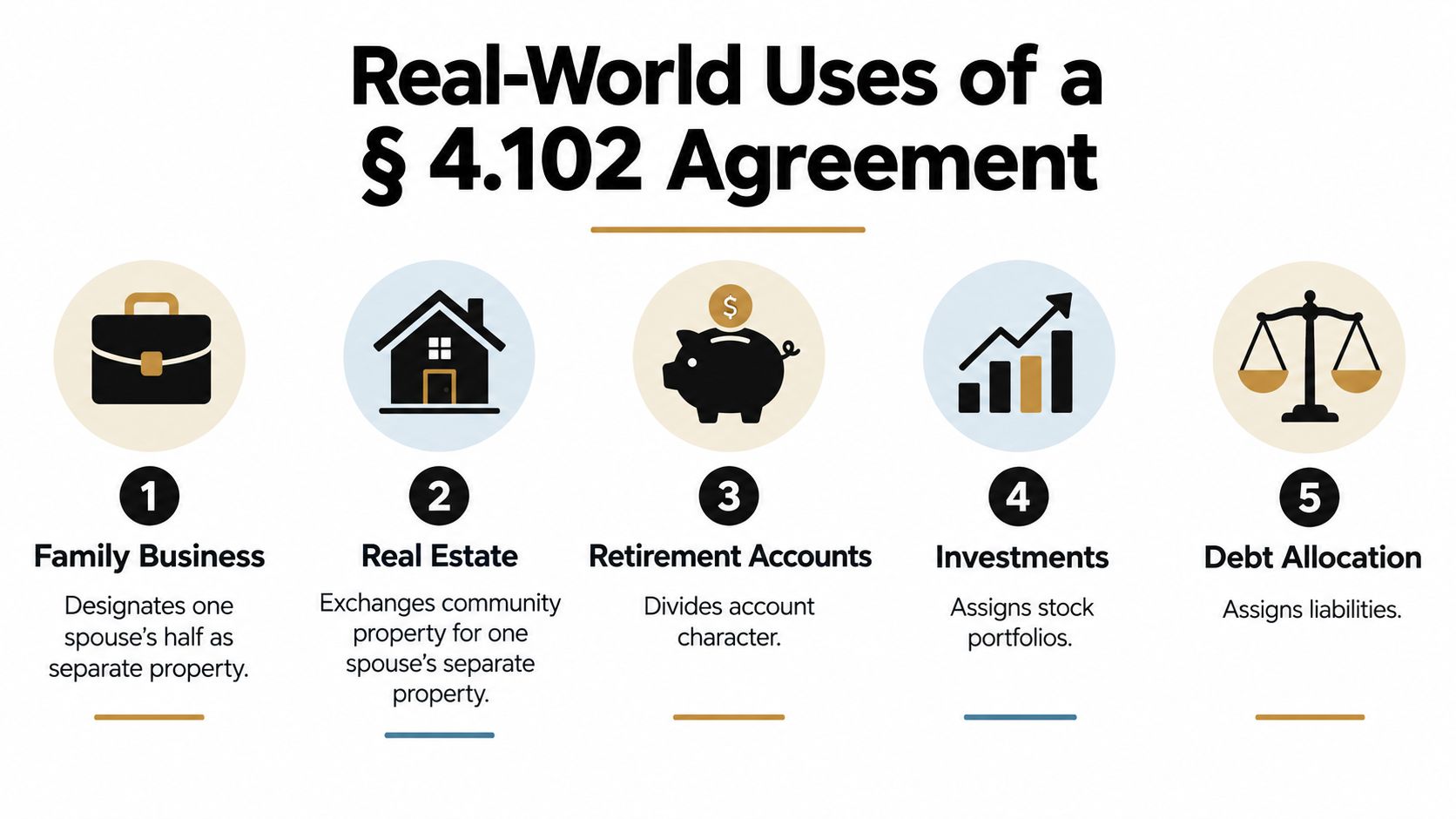
A family business. You may designate one spouse's interest as separate property and provide another asset or defined interest in exchange. If future business income is meant to remain separate, the agreement should say so expressly.
A high-value investment account. You and your spouse might exchange one spouse's interest in an investment account for the other spouse's interest in the marital home. The agreement should identify the account and explain how later deposits, withdrawals, replacements, and earnings will be treated.
Real estate. A partition can address a home, rental property, or other real estate interest. Deeds, liens, mortgage obligations, and the property's description should be reviewed together with the agreement.
Retirement interests. Ownership characterization and division may involve federal plan rules and separate transfer requirements. A marital agreement alone may not complete every action needed for a retirement account.
Future earnings. If transferred property produces income, the agreement may state whether that income is separate property. The September 1, 2005 statutory change makes this language especially important for agreements governed by the amended rule.
Sample drafting concept
A lawyer might structure a provision along these lines:
“The community-property interest identified in Schedule A is partitioned and transferred to the owning spouse as that spouse's separate property. Earnings and income arising from that property will be treated according to the terms stated in this agreement.”
That isn't a usable form clause. The actual language must match the asset, the parties' intent, the transaction, and any related obligations. A vague sentence can create more uncertainty than it resolves.
For owners of closely held companies, a detailed valuation and ownership review should happen before signing. You may also need to coordinate the agreement with operating agreements, buy-sell provisions, estate plans, beneficiary designations, and business records.
Common Pitfalls and Misconceptions
A partition or exchange agreement is powerful, but it isn't a shield against every risk. The most serious misconception is that changing property character between spouses eliminates creditor rights. It doesn't.
Texas court materials and practitioner references emphasize that a § 4.102 agreement affects how spouses characterize and divide property between themselves. It does not eliminate the rights of creditors, particularly where an agreement is used to interfere with existing creditor claims. Review the creditor-rights discussion in the Texas Board of Legal Education materials before relying on the agreement for any debt-related strategy.
Mistakes that create avoidable disputes
Using a generic form. A form may not identify your business interests, accounts, real estate, income rights, or replacement assets with enough precision.
Assuming title controls everything. The name on a deed or account may not answer every characterization question. Your attorney should examine how the property was acquired, funded, managed, and documented.
Leaving income unaddressed. Transferring an asset without explaining the treatment of earnings can create a later dispute about whether income is separate or community property.
Signing without meaningful disclosure. A spouse who doesn't understand the financial picture may later challenge the agreement. Disclosure also helps both spouses negotiate from accurate information.
Ignoring the divorce process. A partition agreement isn't a substitute for a final divorce decree. You still need to address community assets, debts, custody, support, and enforcement through the appropriate court or settlement process.
Assuming the agreement is only for wealthy couples. The tool can help any couple who needs clear ownership rules. The complexity depends on the property and the agreement's purpose, not only on the size of the estate.
You should also preserve the final signed version, financial schedules, supporting records, and any documents showing how the property was handled afterward. Separate accounts and consistent records can make the agreement easier to apply when emotions are high and memories differ.
Next Steps and When to Consult an Attorney
Start with your objective. Do you want one spouse to own a business separately? Do you want to exchange an investment interest for the home? Do you need future income from transferred property addressed? Or are you already in a divorce and trying to settle ownership disputes before mediation?
Your answer determines whether § 4.102 is the right instrument and whether you need additional agreements. A partition or exchange agreement may be useful before litigation, during settlement negotiations, or as part of broader marital property planning. It shouldn't be signed until you understand what you're giving up and what you're receiving.
A practical preparation checklist
- Gather the records. Collect deeds, account statements, tax returns, business documents, loan records, retirement information, and evidence of inheritances or gifts.
- List the intended assets. Identify exactly what will be partitioned or exchanged, including ownership interests and related income.
- Discuss future treatment. Decide how appreciation, earnings, rents, dividends, proceeds, replacement property, and new contributions should be handled.
- Review enforceability concerns. Make sure the negotiations are voluntary, the disclosure is meaningful, and both spouses have a real opportunity to obtain legal advice.
- Coordinate the divorce case. If a divorce is pending, connect the agreement with mediation, temporary orders, discovery, settlement documents, and the final decree.
- Address the children separately. A property agreement cannot decide custody or support in place of a best-interest determination. Parenting schedules, conservatorship, child support, and enforcement require their own legal analysis.

The need for legal advice becomes stronger when you own a business, have a high-value estate, share real estate, have a blended family, or face a contested divorce. An experienced Texas family law attorney can help you distinguish a property-character agreement from a divorce settlement, identify gaps in the asset schedule, prepare for mediation, and protect your position if enforcement becomes disputed.
If you're facing divorce in Houston, Dallas-Fort Worth, Austin, San Antonio, or another Texas county, you don't have to make these decisions alone. A focused review before signing can help you understand the trade-offs, protect your rights, and approach the next stage with greater confidence.
Key Takeaway
A Texas Family Code § 4.102 partition or exchange agreement can give you and your spouse meaningful control over how community property is characterized. It can cover existing or future property, may address future income from transferred property, and doesn't require court approval or consideration. But the agreement must be written and signed, and its enforceability depends on voluntary consent, clear drafting, and adequate financial transparency.
If you're considering a partition or exchange agreement, schedule a free consultation with the Law Office of Bryan Fagan, PLLC to discuss property characterization, business interests, mediation, custody, support, or enforcement concerns. The firm can help you evaluate your options and prepare a strategy designed for your Texas divorce, so visit Law Office of Bryan Fagan, PLLC to take the next step.


