 Skip to content
The ten-year marriage requirement for Texas spousal maintenance is a statutory gateway under Texas Family Code § 8.051, not an automatic guarantee of support. Even after a marriage reaches 10 years, you must still prove financial need, insufficient resources, and an inability to earn enough income despite diligent efforts.
You may have spent years raising children, supporting a spouse's career, or managing a household while your own career stalled. Reaching the ten-year mark can feel like a clear answer to an uncertain future, but Texas courts apply a broader test. Your property division, budget, health, education, work history, caregiving responsibilities, and realistic employment options may matter just as much as the length of your marriage.
Does a Ten-Year Marriage Guarantee Alimony in Texas?
At the settlement table, a spouse who has been married for ten years may expect monthly support as a matter of right. Relying on that assumption can distort negotiations, especially if the expected payments are part of a plan to keep the home, cover ordinary expenses, or retrain for work.
Texas law treats the ten-year marriage requirement for Texas spousal maintenance as a gateway to eligibility, not a promise of an award. Under Texas Family Code § 8.051, the requesting spouse generally must show that the property available after divorce will not meet minimum reasonable needs and that sufficient income cannot be earned despite diligent efforts to work or develop necessary skills.

Why the milestone matters
The ten-year threshold gives a spouse a statutory route to request court-ordered maintenance when the financial and employability requirements are also supported by evidence. A shorter marriage may not qualify through this route, though other statutory exceptions can apply. For a broader discussion, see Spousal Maintenance in a Texas Divorce, and review Texas alimony eligibility requirements.
The court will examine the financial position created by the divorce. A substantial property award, separate property, income-producing assets, or a realistic ability to return to work may weaken the request. A spouse who left the workforce for caregiving may have a persuasive explanation for limited current income, but the explanation must be supported with evidence about work history, skills, health, and practical employment options.
A negotiated support provision is different from court-ordered maintenance. Spouses may structure settlement terms around financial needs in ways that differ from what a judge could order under the statutory framework. The ten-year mark permits the argument. It does not establish financial need, inability to earn enough, or the amount and duration of any payment.
Practical rule: Treat ten years as permission to make the legal argument, not as proof that the argument will succeed.
Understanding the Legal Test for Spousal Maintenance
A maintenance request usually turns on several connected questions. The marriage's length gets your claim through one doorway, but the court still has to decide whether your financial circumstances justify an award.
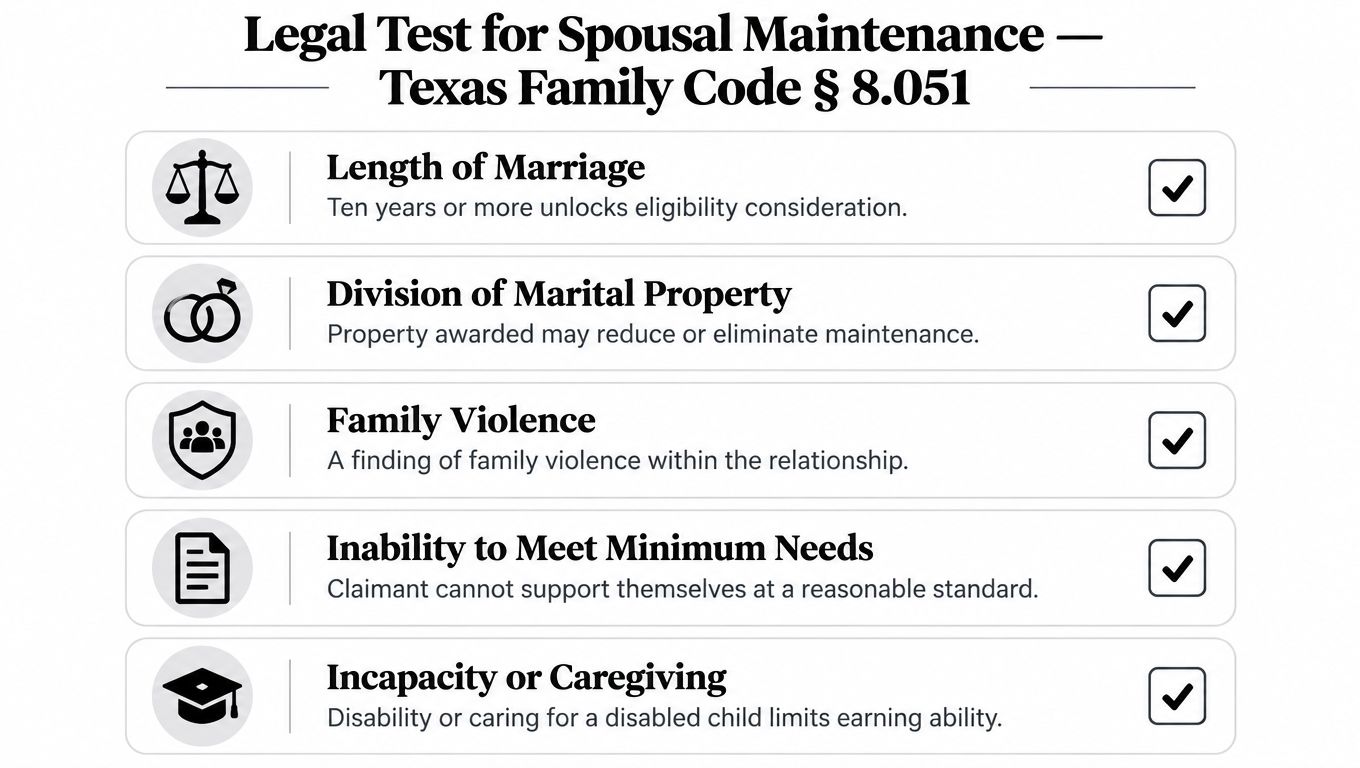
The statute places the practical burden on the spouse requesting maintenance. You should prepare your case around these core issues:
Length of the marriage. For the long-marriage pathway, the marriage must have lasted at least 10 years. The date of marriage and the date the marriage legally ends can become important, particularly when the relationship is close to the threshold. A marriage lasting less than ten years may still qualify under a different statutory ground.
Available property. You must show that the property available after divorce, including separate property, isn't sufficient to provide for your minimum reasonable needs. The court considers the proposed division of community property and the resources you'll control after the decree. Property that looks valuable on paper may not produce usable income, and liquid assets may affect the analysis differently from a residence or closely held business interest.
Ability to earn. You must address whether you can earn enough to meet your needs. The question isn't just whether you're employed today. Your work history, education, health, age, marketable skills, childcare duties, and realistic retraining options may all matter.
Evidence that supports the request
A persuasive file connects the numbers in your budget to your actual circumstances. Useful evidence may include bank records, recurring bills, employment applications, résumés, professional licensing information, medical documentation, education records, and proof of childcare or caregiving responsibilities.
You'll also need to explain your diligence. Texas law can create a presumption that maintenance isn't necessary when a claimant hasn't made reasonable efforts to find work or build marketable skills. A theoretical job possibility isn't always enough. The court may ask whether the work is realistically available given your qualifications, health, location, and responsibilities.
Property division is part of this analysis, not a separate issue. Texas community property is divided in a manner that is just and right, which doesn't necessarily mean an equal split, while separate property generally remains with its owner. The assets awarded to you may directly affect whether maintenance is needed. You can review spousal maintenance eligibility in Texas while gathering documents and discussing your circumstances with counsel.
Exceptions to the Ten-Year Marriage Rule
The ten-year pathway isn't the only way to seek Texas spousal maintenance. A spouse in a shorter marriage may still have a claim when a separate statutory ground applies. These exceptions don't eliminate the need to prove financial insufficiency and other required elements. They provide a different route into eligibility.
| Eligibility Path | Marriage Duration | Key Requirements |
|---|---|---|
| Long-marriage pathway | At least 10 years | You lack sufficient property for minimum reasonable needs and, after diligence, can't earn enough income or develop necessary skills. |
| Family violence pathway | May be shorter than 10 years | The paying spouse committed qualifying family violence within the applicable statutory period, with the required legal findings. |
| Recipient disability pathway | May be shorter than 10 years | You have a qualifying physical or mental disability that prevents sufficient earning capacity. |
| Caregiver pathway | May be shorter than 10 years | You care for a child with a disabling condition, and that responsibility prevents sufficient income. |
How the exceptions change the analysis
A spouse married for fewer than ten years shouldn't assume the case is over before reviewing the facts. Medical records, disability findings, custody evidence, and documentation of family violence may become central. The legal question is whether the facts fit the statutory ground, not whether the marriage reached the ordinary duration threshold.
Family violence cases require careful attention to the applicable timing and legal record. Allegations alone may not establish the maintenance pathway. If safety is an issue, your divorce plan may also require protective relief and a strategy for communicating with the other spouse.
Caregiving cases deserve the same focused preparation. You should document the child's condition, the care required, available services, and why those responsibilities limit your ability to earn. Temporary relief can also matter while the divorce is pending. Temporary Orders During a Texas Divorce addresses how the court sets rules during that period.
A shorter marriage isn't an automatic bar, and a longer marriage isn't an automatic award.
Duration and Limits on Spousal Maintenance
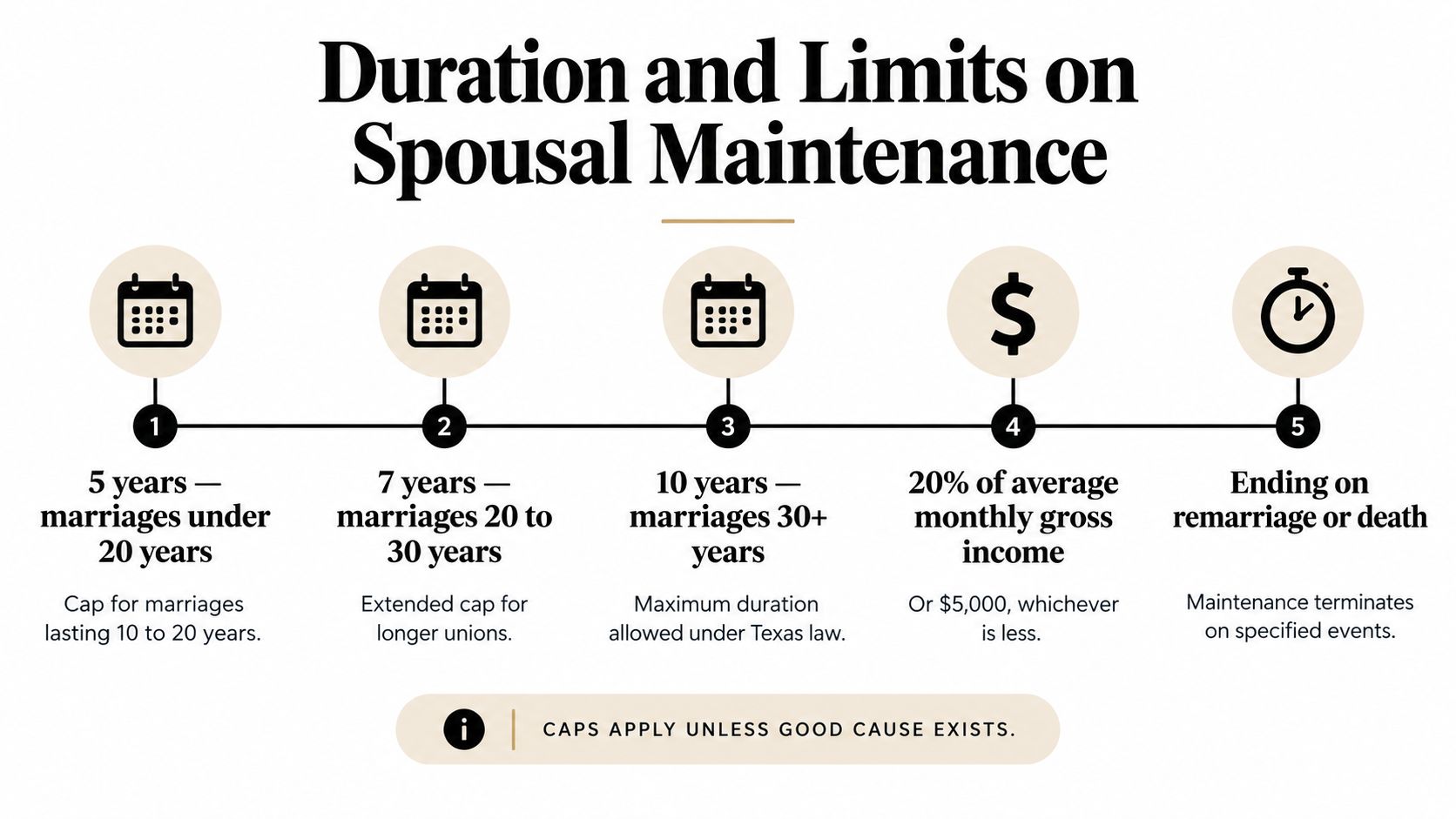
Eligibility and duration are separate questions. Even if you satisfy the ten-year pathway and prove need, the court must determine how long support is reasonably necessary. Texas law directs courts to use the shortest reasonable period that allows the recipient to obtain sufficient income for minimum reasonable needs.
For marriages lasting at least 10 years but no more than 20 years, the statutory maximum is 5 years. For marriages lasting at least 20 years but no more than 30 years, the maximum is 7 years. For marriages lasting 30 years or more, the maximum is 10 years. These limits come from Texas Family Code § 8.054, and they're ceilings, not promises.
Duration affects settlement planning
A court may order less than the maximum when the evidence shows that you can become self-supporting sooner. Training, employment prospects, health, age, and the effect of the property division can influence the period. Conversely, disability-related circumstances and caregiving for a disabled child may require a different statutory analysis.
The amount is also regulated. Texas law places statutory limits on court-ordered maintenance, so you shouldn't build a post-divorce budget around a desired amount before reviewing the current statute and your financial evidence. Contractual support negotiated in a settlement can involve different terms, but the agreement must be drafted carefully and incorporated into the final divorce documents.
For business owners and high-value estates, this distinction is especially important. A business interest may have substantial value without producing predictable personal income. The court may need to examine compensation, distributions, retained earnings, debts, real estate, investments, and the proposed property division before assessing need and ability to pay.
You can review spousal support duration in Texas when considering whether a negotiated resolution or litigation strategy better fits your long-term plans.
How Courts Evaluate Minimum Reasonable Needs
A court doesn't decide minimum reasonable needs by looking at the marriage's length alone. You'll need to present a credible picture of your post-divorce life, including the expenses you must pay, the resources you'll receive, and the income you can realistically earn.
Start with a detailed budget. Separate recurring necessities from optional spending, identify debts, and explain expenses that may change after divorce. Housing, transportation, insurance, healthcare, food, utilities, taxes, and employment-related costs may all require documentation. The budget should match the property and support structure you're asking the court to approve.
The factors that shape the decision
Your work history can show whether you have an established earning path or a prolonged absence from the workforce. Education and professional credentials may suggest available employment options, but the court can also consider whether those options are practical after years away from the field.
Health matters in two ways. A medical condition may limit your work capacity or create ongoing expenses. You should support that position with appropriate records rather than relying on a general statement that you're unable to work.
Age, homemaking contributions, and childcare responsibilities add context. A stay-at-home parent who managed the household while the other spouse built a career may need retraining and a structured transition. That history doesn't guarantee maintenance, but it can help explain why immediate self-support isn't realistic.
Evidence beats labels. “I can't support myself” is a conclusion. A budget, employment history, medical records, and documented job-search efforts show the court why.
Parents should coordinate the maintenance analysis with custody and child support issues. A possession schedule, school transportation, medical care, and childcare duties may affect work availability. Business owners and spouses in high-asset cases should preserve records early because compensation and asset values may be disputed. The court may distinguish between income that is available for personal support and value that remains invested in a company or property.

Procedural Steps to Request or Defend Maintenance
Maintenance should be addressed early in the divorce, not added casually at the end. The procedure generally follows the broader Texas divorce process, but your financial evidence can determine whether the request receives serious consideration.
A practical sequence
Raise the issue in the pleadings. Your petition or answer should address spousal maintenance when the facts may support it. If you're responding to a request, you should identify the legal and factual grounds you dispute.
Request temporary relief when necessary. Temporary orders can address support, use of property, payment of expenses, and household rules while the case is pending. Temporary maintenance doesn't guarantee a final award, but failing to request needed relief can leave you without a workable short-term plan.
Exchange financial information. Gather budgets, account statements, tax records, payroll information, business documents, property records, debts, employment materials, and medical evidence. A spouse defending the claim should examine whether the proposed budget is accurate and whether available assets or employment options have been omitted.
Use negotiation or mediation thoughtfully. Mediation can help you trade certainty for control. You might negotiate property, contractual support, a transition period, or other terms that address risk without leaving every issue to a judge. A M&N divorce mediation guide can help you understand the settlement process before mediation.
Prepare for trial if needed. If settlement fails, witnesses and documents should connect the legal elements to specific facts. The requesting spouse must prove need and diligence. The responding spouse may challenge the claimed expenses, available property, earning capacity, or the sufficiency of the job search.
A final decree should state the agreed or ordered terms clearly. The divorce isn't finished until the court signs the decree, and later enforcement or modification questions may depend on the language used.
When to Contact a Texas Spousal Maintenance Attorney
You should seek advice before filing, responding to a maintenance request, signing a property settlement, or agreeing to temporary orders. The ten-year threshold may be easy to identify, but the evidence surrounding need, employability, property, and caregiving is rarely simple.
Bring organized information to your consultation. Include the marriage and separation dates, recent budgets, account and debt records, employment history, education and licenses, medical limitations, childcare responsibilities, business ownership documents, real estate information, and any prior support orders. You don't need a perfect file before speaking with counsel, but the more accurately you describe the finances, the more practical the guidance can be.
Situations that require early planning
Early legal review is especially important when:
You're close to the duration boundary. The legal significance of the marriage period can change when the marriage is near the statutory threshold. You shouldn't delay a divorce solely to pursue possible maintenance without weighing debt, conflict, safety, and other consequences.
You left work for caregiving. Your employment gap, retraining needs, and parenting responsibilities need a coherent evidentiary explanation.
You own a business or significant assets. Valuation, income characterization, and property division may affect both sides of the maintenance analysis.
You face family violence or disability issues. These matters may create separate eligibility pathways and may also require protective or medical evidence.
You want to settle. Mediation can offer more control than trial, but you need to understand what rights you're giving up and whether the agreement addresses enforcement, duration, and future changes.
The Law Office of Bryan Fagan, PLLC handles Texas divorce, property division, custody, mediation, spousal maintenance, and enforcement matters through in-person and virtual consultations. A focused review can help you separate what the ten-year rule allows from what your evidence can prove.
Key Takeaway
The ten-year marriage requirement opens a potential path to Texas spousal maintenance, but it doesn't decide your case. Your property, income, employability, health, caregiving duties, diligence, and the terms of the divorce all matter. Build the evidence before you negotiate, and don't assume that either requesting or opposing maintenance can be handled with a single rule.
The Law Office of Bryan Fagan, PLLC offers consultations and representation for Texas spouses addressing maintenance, property division, custody, mediation, and enforcement. Schedule a free consultation to review your ten-year marriage issue, organize the financial evidence, and plan a practical path toward your divorce resolution.


