 Skip to content
You're staring at a divorce filing and wondering how you'll rebuild your income, support your children, or protect the life you've worked hard to create. The question feels simple, but how long spousal maintenance lasts in Texas depends on several legal decisions made in sequence, not just the number of years you were married.
Texas Family Code § 8.054 establishes maximum durations for most court-ordered spousal maintenance. Those limits are important, but they don't automatically tell you how long payments will continue. Your eligibility, available property, earning ability, health, caregiving responsibilities, and realistic path toward self-support can all affect the final order.
What Duration Caps Mean for Your Texas Divorce
Maria, a San Antonio teacher, had been married for fifteen years when divorce papers arrived. Her immediate question was practical: would spousal maintenance last long enough for her to retrain for another career?
That question can arise after years spent caring for children, supporting a spouse's career, or losing access to regular income. It can also concern the higher-earning spouse who needs to understand how long payments might be required. The answer begins with the cap, then turns to the shorter period a judge may find reasonable.
Court-ordered spousal maintenance is not permanent alimony. Under Texas Family Code § 8.054, most awards have maximum durations:
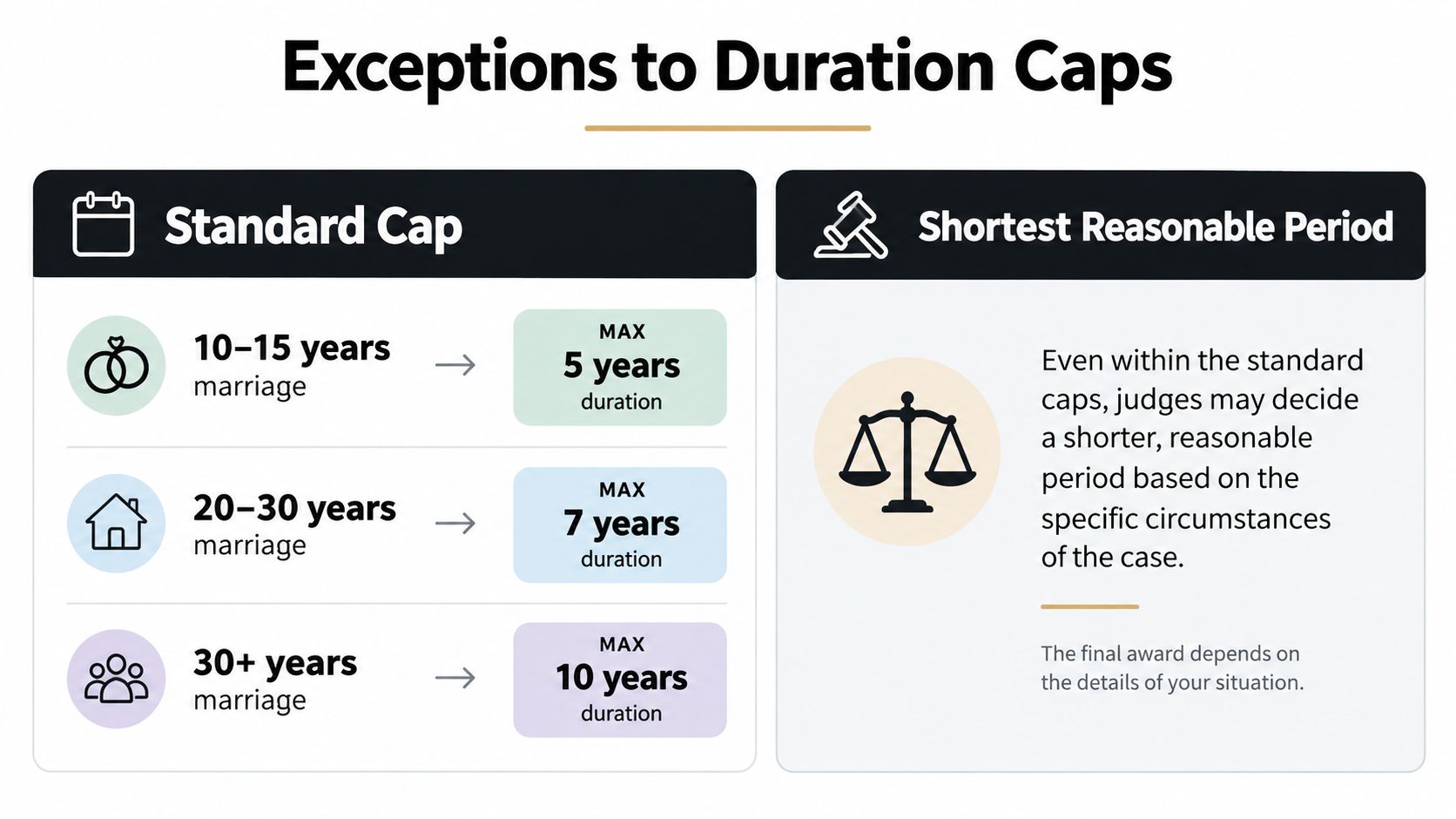
- Five years for a marriage lasting at least ten years but fewer than twenty years.
- Seven years for a marriage lasting at least twenty years but fewer than thirty years.
- Ten years for a marriage lasting thirty years or more.
These are outer limits, not automatic payment periods. The court generally must order the shortest reasonable period that allows the recipient to obtain sufficient income for minimum reasonable needs. A qualifying spouse may therefore receive an award well below the applicable cap.
For example, a fifteen-year marriage falls within the five-year tier, but a decree might provide a shorter period if the evidence shows that retraining, employment, or available resources can address the recipient's needs sooner. A twenty-two-year marriage reaches the seven-year cap, yet the same shortest-period rule still applies. A thirty-year marriage reaches the ten-year tier, but ten years remains a ceiling, not a promise.
The practical rule: A duration cap answers, “What is the longest period the court may generally order?” It does not answer, “How long will your specific award last?”
The Original Petition for Divorce in Texas identifies the relief requested. Financial records, evidence of earning capacity, a retraining plan, and documentation of ongoing needs can shape negotiations, mediation, or trial. Keep those materials organized so the proposed duration can be compared with the language of the final decree.
Separate two questions: do you meet the eligibility requirements, and, if so, what is the shortest reasonable period? For more detail, see this guide to spousal support duration in Texas.
How Eligibility and the 60-Day Waiting Period Set the Stage
A long marriage by itself doesn't guarantee spousal maintenance. Texas Family Code § 8.051 generally requires the spouse seeking maintenance to lack sufficient property, including separate property, to provide for minimum reasonable needs after the divorce. That spouse must also satisfy an additional statutory pathway.
The recognized pathways include circumstances involving:
- Family violence, when the required statutory conditions are met.
- An incapacitating physical or mental disability affecting the spouse seeking maintenance.
- A child of the marriage with a disability, when the requesting spouse provides the substantial care required.
- A marriage lasting at least ten years, combined with a diligent but unsuccessful effort to earn sufficient income or develop the skills needed for self-support.
The statute's eligibility framework appears in Texas Family Code Chapter 8. Meeting one pathway opens the door to consideration. It doesn't require the judge to award the maximum duration, and it doesn't remove the minimum-needs analysis.
The divorce timeline matters too
Texas generally requires at least sixty days to pass after the divorce suit is filed before the court may grant the divorce, subject to specific family-violence waivers. The waiting period begins on the filing date, not on the date the other spouse receives service. The rule appears in Texas Family Code § 6.702.
That waiting period isn't a promise that maintenance payments begin after sixty days. It is a minimum period before the divorce may be granted. During the case, the court may address temporary financial needs through temporary orders, while the final maintenance decision is resolved in the decree or settlement.
A typical case may proceed in this order:
- One spouse files the divorce petition.
- The other spouse receives notice or files a response.
- The parties exchange financial information and address temporary needs.
- The spouses negotiate or attend mediation.
- Unresolved issues proceed to hearings or trial.
- The judge signs the final decree, or the parties present an agreed decree.
The Texas divorce 60-day waiting period is only one part of that process. Early records collection helps you evaluate maintenance, property division, custody, and support options before positions harden.
The 5, 7, and 10-Year Tier Structure Explained
House Bill 901 changed the earlier general three-year ceiling into graduated caps tied to marriage duration. The legislative analysis describes the change as creating maximum periods of five, seven, and ten years for the principal marriage-length categories. You can review that history in the House Bill 901 legislative analysis.
The current structure is easier to understand if you treat each tier as a ceiling on a courthouse wall. Your facts determine whether you can reach the wall at all. The judge then decides how close your award should come to it.
| Marriage Length | Maximum Duration Cap | Key Exception |
|---|---|---|
| At least 10 years but fewer than 20 years | 5 years | The order still must last only as long as reasonably necessary |
| At least 20 years but fewer than 30 years | 7 years | Individual facts may justify a shorter period |
| 30 years or more | 10 years | Disability, caregiving, or another recognized impediment may affect duration |
| Fewer than 10 years | Generally no eligibility through marriage length alone | A qualifying family-violence route may carry a 5-year maximum |
The five-year family-violence route for a marriage lasting fewer than ten years is narrow. It applies when eligibility is based on the relevant family-violence provision in § 8.051. A short marriage does not automatically qualify just because the relationship was difficult or financially unequal.
What the tiers don't mean
The statutory maximum isn't an entitlement. A fifteen-year marriage falls within the five-year category, but the judge may order less if the recipient can become self-supporting sooner. A twenty-five-year marriage falls within the seven-year category, but the court still evaluates employability, health, assets, retraining needs, and other evidence.
You should also avoid treating the tier as a prediction of the monthly amount. Duration and amount are separate decisions. The court may find that a person qualifies for maintenance but needs support for only the period reasonably required to secure income for minimum reasonable needs.
For a plain-language discussion of the marriage-length requirement, review the ten-year marriage requirement for Texas spousal maintenance. A careful analysis should then connect the marriage length to the actual evidence, rather than stopping at the table.
Exceptions That Can Shorten or Extend the Award
The phrase “shortest reasonable period” is the part many people miss. Texas law doesn't tell a judge to award the full cap whenever a spouse qualifies. It tells the court to limit maintenance to the shortest reasonable period that permits the recipient to obtain sufficient income for minimum reasonable needs.
A judge may examine the recipient's education, work history, marketable skills, health, job-search efforts, retraining plan, and realistic employment opportunities. Property division matters too. Separate property and community property awarded in the divorce can affect whether the recipient has enough resources to meet minimum reasonable needs.
Consider two people in the same marriage-length tier. One has current certifications, recent work experience, and a credible job offer. The other has a serious medical condition, a long employment gap, or daily responsibility for a child whose disability requires substantial care. The legal ceiling may be the same, but the evidence supporting duration can be very different.
Circumstances that change the analysis
- Earning capacity: A recipient with usable skills and a realistic path back to work may receive a shorter transition period.
- Health limitations: A physical or mental disability may substantially or totally diminish the ability to become self-supporting.
- Caregiving duties: Caring for an infant, young child, or child with a disability can create a serious impediment to full-time employment.
- Family violence: A qualifying family-violence route can allow a marriage of fewer than ten years to fall within the five-year maximum, subject to the statute's requirements.
- Other compelling impediments: The court may consider circumstances that make sufficient employment income unrealistic.
A six-month order and a full-cap order can both be legally possible within the same tier. The difference comes from the proof of need, the property available, and the time realistically required to obtain adequate income.
Three Marriage-Length Scenarios Walked Through
The numbers below are illustrations of how the statute operates, not promises about what a judge will order. The final result depends on eligibility, evidence, property division, and the court's individualized assessment.
Scenario one
A couple was married for six years. The spouse requesting maintenance can establish the qualifying family-violence basis under § 8.051. The marriage-length route isn't available because the marriage lasted fewer than ten years, but the family-violence route may create a five-year maximum under § 8.054.
That doesn't mean five years is likely or automatic. If the recipient has current employment, accessible training, and modest documented transition needs, the judge could order a materially shorter period. If health effects from the violence interfere with work, the evidence may support a longer transition within the statutory limit.
Scenario two
A couple was married for twelve years. The requesting spouse has no qualifying family-violence claim or disability, but has made a diligent, unsuccessful effort to earn enough income and develop necessary skills. This marriage falls within the five-year maximum category.
Suppose the recipient has marketable skills but needs time to renew a credential and return to a profession. A documented retraining plan may support maintenance for the period reasonably necessary to complete that transition. The court isn't required to use the entire cap.
Scenario three
A couple was married for twenty-eight years. The marriage falls within the seven-year maximum category. If the recipient has an incapacitating disability or provides substantial care for a child of the marriage with a disability, those circumstances may support a duration that differs substantially from an ordinary rehabilitation case.
The recipient still needs reliable medical, caregiving, financial, and expense records. A long marriage alone doesn't decide the result.
| Scenario | Marriage Length | Key Facts | Statutory Cap | Likely Duration |
|---|---|---|---|---|
| Family-violence pathway | 6 years | Qualifying family-violence basis, employment capacity varies | 5 years | Shorter or longer within the cap, based on proof |
| Career reentry | 12 years | Eligible through marriage length and unsuccessful efforts to become self-supporting | 5 years | Often tied to the documented retraining or reentry period |
| Long marriage with impediment | 28 years | Disability or demanding caregiving responsibilities | 7 years | May approach the cap when the impediment prevents self-support |
These examples also show why you shouldn't negotiate maintenance in isolation. Parents must consider custody and support responsibilities. Business owners must account for income that may not appear in a simple paycheck. Families with high-value estates need accurate tracing and valuation because available assets can affect both eligibility and duration.
Evidence and Records to Gather Before Mediation or Trial
The court can't measure a transition period from general statements alone. If you want the judge to understand why you need time to retrain, recover, work, or provide care, organize records that connect your circumstances to a realistic timeline.
Start with the basic relationship and case documents. Preserve the marriage certificate, divorce pleadings, prior orders, protective orders, and any records showing the date the case was filed. The filing date matters because the Texas divorce waiting period runs from filing, and the final decree may address maintenance, property, custody, and support together.
Financial records
Gather records that show both need and available resources:
- Income records: Pay statements, employment contracts, benefit statements, and documentation of irregular income.
- Tax materials: Returns and supporting schedules that show income sources and deductions.
- Account records: Bank statements, brokerage statements, retirement balances, and transfers.
- Property information: Deeds, loan balances, business records, valuations, and documents tracing separate property.
- Expense proof: Housing, utilities, food, transportation, insurance, medical costs, and other minimum-needs expenses.
A business owner should preserve company financial statements, compensation records, distributions, ownership documents, and records of personal expenses paid by the business. A spouse with a high-value estate should identify whether assets are liquid, income-producing, restricted, or difficult to sell. Nominal value doesn't always equal immediately usable income.
Employability and health records
Keep a written job-search log, applications, interview records, licensing materials, certifications, school information, and communications with potential employers. If retraining is necessary, collect program details, expected completion requirements, and evidence explaining why the plan is realistic.
For disability or caregiving issues, request medical records, physician notes, functional limitations, treatment information, therapy records, and documentation describing the care a child requires. The useful question is not merely whether a condition exists. It is how that condition affects the person's ability to work and the amount of time needed to meet minimum reasonable needs.
Family-violence evidence may include police reports, protective orders, criminal case records, photographs, medical records, messages, and witness information. Use lawful methods to preserve evidence and protect your safety.

Don't wait until the mediation date to begin. The sixty-day waiting period is only a minimum before the divorce may be granted, not a complete case schedule. Discovery deadlines, mediation settings, temporary-order hearings, and trial preparation can arrive while records are still incomplete.
A well-organized file helps you compare settlement options and present a clear final-decree proposal. It can also reveal weaknesses early, such as missing account statements, unsupported expenses, or an employment plan that doesn't explain how self-support will be reached.
Modifications, Enforcement, and When to Call an Attorney
A signed decree doesn't always end the legal work. Court-ordered maintenance may later be reviewed when circumstances materially and substantially change, subject to the statutory limits and the language of the order. A significant income change, a serious health development, or a substantial improvement in the recipient's ability to earn may require a court filing rather than an informal agreement.
The party requesting a change generally must present updated evidence. That may include current income records, tax documents, medical information, employment records, and a clear explanation of what changed since the original order. A court may adjust an order within the legal framework, but a person shouldn't assume that a private conversation changes the decree.
Termination and enforcement issues
Court-ordered maintenance can end before the scheduled duration when recognized termination events occur, including remarriage, cohabitation in a qualifying relationship, or the death of either party. The specific legal requirements and the wording of the decree matter, particularly when cohabitation is disputed. The Texas Family Code § 8.054 text should be read alongside the applicable order and other Chapter 8 provisions.
If payments stop, don't just wait and hope the issue resolves. Preserve payment records, bank statements, messages, and the decree. Depending on the order and circumstances, enforcement may involve wage withholding, a motion for enforcement, contempt proceedings, or other court remedies.
Protect your position: Never rely on an oral promise to postpone, reduce, or replace a court-ordered payment. Put changes in writing and obtain appropriate court approval when required.
You should obtain legal guidance promptly if:
- You're unsure whether the order is statutory maintenance or contractual support.
- The decree contains unclear duration, modification, or termination language.
- Your income, disability status, or caregiving responsibilities have changed.
- Your former spouse has remarried, begun a qualifying cohabitation relationship, or stopped paying.
- You own a business, have significant separate property, or suspect assets were not fully disclosed.
- Custody, child support, property division, and maintenance affect one another.
- Mediation is approaching and you don't know whether the proposed decree protects you.
The financial order also affects the emotional and practical life of your family. If you're co-parenting, a resource such as co-parenting after divorce teen perspective can help you think about how financial conflict and communication affect children.
The Law Office of Bryan Fagan, PLLC handles Texas divorce, spousal maintenance, custody, property division, mediation, modification, and enforcement matters, including cases involving business ownership and complex estates. Schedule a free consultation through Law Office of Bryan Fagan, PLLC to review your eligibility, evidence, proposed decree, and the duration issues that may affect your financial future.


