 Skip to content
You open a notice and see a balance you can't explain, or you realize your child's other parent hasn't paid support for years. In Texas, ignoring that balance rarely makes it disappear. It usually gives the state more time to withhold wages, intercept refunds, file liens, suspend licenses, or ask a judge to enforce the order.
What Back Child Support Means in Texas
Back child support is the unpaid portion of a court-ordered support obligation after its due date. Lawyers and agencies often call this amount arrears. It's different from current support, which is the amount due going forward under the existing order.
Consider a parent who checks the official payment history after a child has become an adult and discovers years of missed payments. The child's age may end current support under the order, but it generally doesn't erase installments that were already due. The Texas Office of the Attorney General, through its Child Support Division, may continue collecting the unpaid balance.
The OAG is the collection agency most parents encounter in practice. It can process payments, maintain payment records, issue income-withholding notices, pursue administrative remedies, and coordinate enforcement. A custodial parent may also pursue enforcement in court, while the parent alleged to owe support can challenge inaccurate accounting, seek modification, or defend against contempt.
Practical rule: Treat the payment ledger as evidence, not as an unquestionable final answer. Compare it with your orders, pay records, and documented credits.
The national scale explains why agencies treat missed support seriously. In 2022, approximately 4.7 million custodial parents had a legal or informal agreement and were supposed to receive support. The average annual amount due was $6,390, or about $533 per month. Parents were owed approximately $29.9 billion, but received $19.2 billion, leaving a $10.7 billion gap for that year, according to the U.S. Census Bureau report. These figures measure payments due and received during 2022, not every older arrearage balance.
Texas families also need practical, trustworthy communication when explaining support and enforcement issues. Attorneys and firms developing public education can review SimpleLab Digital's Facebook ad tips for ideas about reaching people who need clear legal information.
The rest of your strategy depends on which side of the dispute you're on. If you're owed money, you need an accurate balance and an enforceable plan. If you're accused of nonpayment, you need to determine whether the balance is correct, whether you could pay, and whether a modification should have been requested earlier.
How Arrears Accrue and Why the Balance Keeps Changing
Arrears build when an ordered installment becomes due and the required payment isn't credited. The balance may change because of partial payments, payment allocation, interest, fees, medical support, public-assistance debt, or corrections to the agency record.
Start with the official accounting
Request the OAG payment history before disputing the amount. Then compare it with:
- The controlling order: Confirm the monthly obligation, effective date, medical-support terms, and payment method.
- Modification orders: Check whether a later order changed the amount or effective date.
- Payment proof: Gather wage-withholding records, money orders, bank statements, and receipts.
- Allocation records: Determine whether payments were applied to current support, arrears, interest, fees, or another case.
- Interstate notices: If either parent moved, obtain records from each involved state and identify which state initiated enforcement.
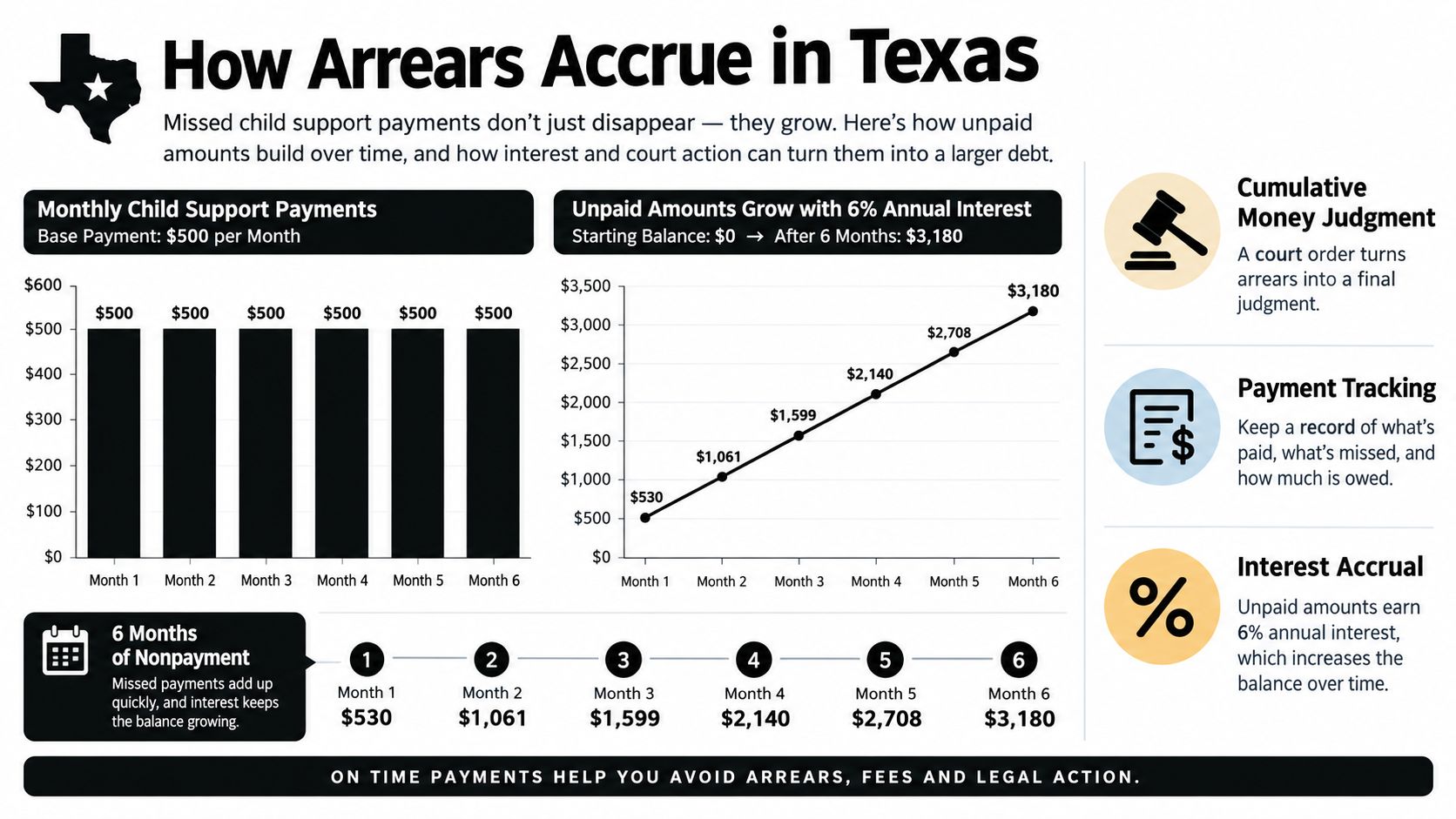
Texas law permits a court confirming arrears to enter a cumulative money judgment under Texas Family Code §157.263. That judgment includes unpaid support not previously confirmed, remaining balances from earlier judgments, and interest on arrears. It also states that the judgment is cumulative. The court is confirming what is owed, not casually rewriting the underlying support order. You can review the statutory framework through this Texas courts reference on cumulative arrearage judgments.
Why small shortfalls matter
A parent who pays something every month may still fall behind if the payment is less than the ordered amount. For illustration, a $500 monthly shortfall produces the following simplified principal amounts before applying the actual legal accounting in a particular case:
| Months Unpaid | Monthly Shortfall | Estimated Interest (6%) | Approximate Balance |
|---|---|---|---|
| 1 | $500 | Qualitative estimate | About $500 plus interest |
| 3 | $500 | Qualitative estimate | About $1,500 plus interest |
| 6 | $500 | Qualitative estimate | About $3,000 plus interest |
The exact balance depends on the order, payment dates, applicable interest, credits, and agency calculations. Don't use a generic table as a substitute for the official ledger.
Turning eighteen doesn't automatically eliminate past-due support. The Texas OAG explains that it may continue collecting unpaid support after adulthood, and interest may increase the amount owed. The agency's noncustodial parent handbook also makes clear why you should review the official payment history before disputing the balance.
For a broader understanding of how custody, support, and parenting time are decided, see Divorce With Children in Texas. Support is part of the larger family-law order, not an isolated accounting problem.
Texas Enforcement Tools the State Uses Every Day
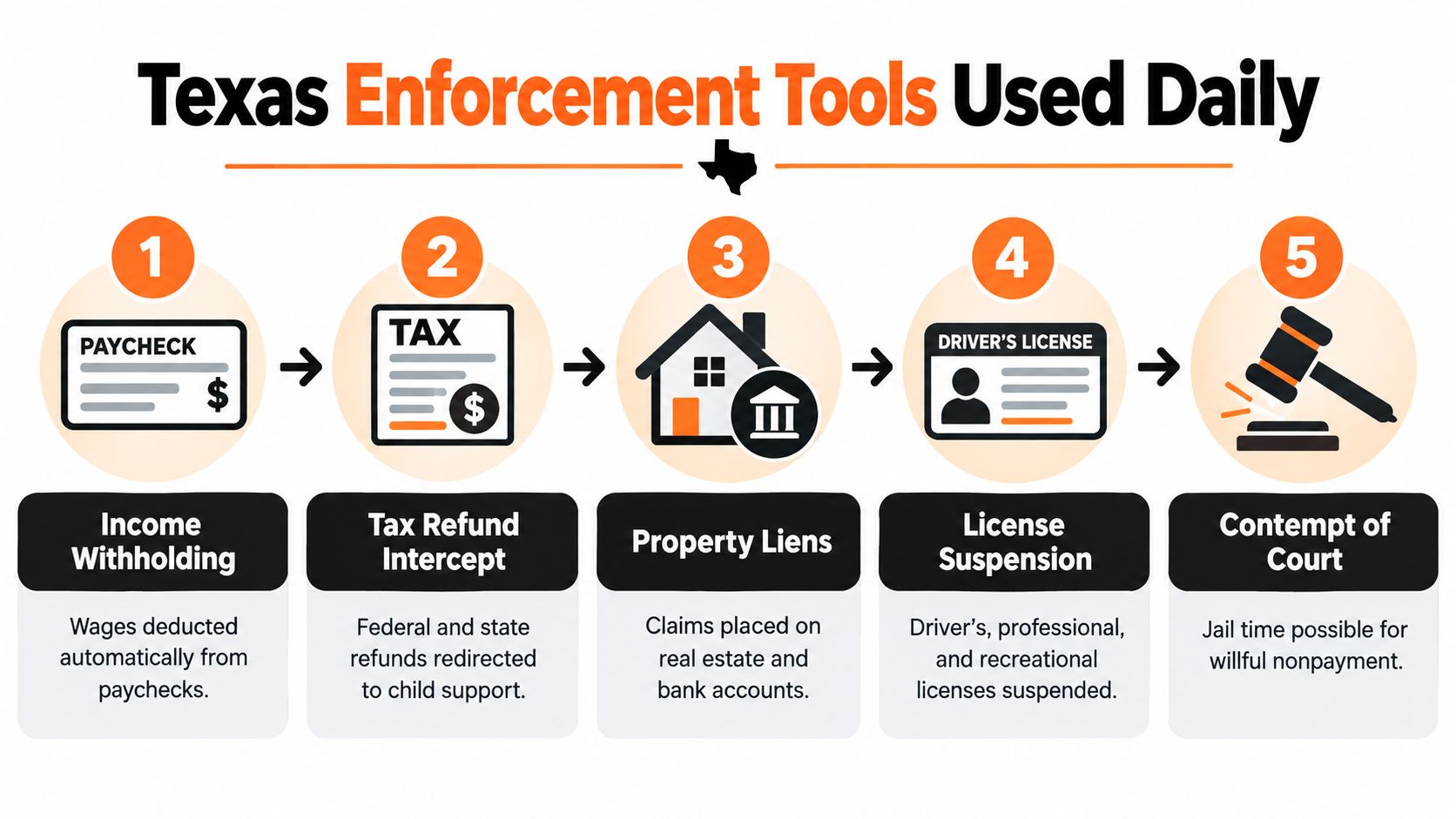
Most Texas enforcement begins administratively, not with a dramatic courtroom scene. The OAG and courts use a sequence of collection tools designed to reach income, refunds, property, licenses, and, when necessary, the court process.
1. Income withholding
An Income Withholding for Support order directs an employer or other income source to deduct support from earnings. The withholding can cover current support and an additional amount toward arrears. If the deduction looks wrong, compare the notice with the current order, the effective date, and your pay stub. An employer may be following an old order, a duplicate notice, or an amount that doesn't reflect a later modification.
2. Tax refund interception
A qualifying delinquency can lead to federal or state tax refunds being redirected toward support. That can produce a large payment without the parent writing a check, but it may also create disputes when parents file jointly, change addresses, or believe the balance was already paid. If a refund is intercepted, preserve the notice and request an updated ledger showing how the payment was credited.
You can also review this Texas child-support tax intercept resource for a focused explanation of the process.
3. Liens against assets
The OAG may file liens against property, bank accounts, retirement plans, life-insurance plans, personal-injury claims, insurance settlements, or other assets. A lien can interfere with refinancing, selling property, accessing funds, or resolving a personal-injury claim. Business owners and high-asset parents should not assume that keeping wages low prevents enforcement. The state may look beyond payroll.
4. License suspension
The OAG works with more than 60 licensing agencies and may request suspension of a delinquent parent's driver's, professional, hunting, or fishing license, as described in its Texas enforcement guidance. A license notice is not something to set aside. Determine the deadline, ask what payment or review will prevent suspension, and document every communication.
5. Court enforcement
Administrative remedies may lead to a court proceeding. A judge can confirm arrears and impose remedies permitted by law. Contempt is a separate and more serious process because it can involve personal liberty.
A short video can help you understand how the system works in practice:
Responding quickly is your best protection against a preventable escalation. If you believe a lien, withholding order, or license action is inaccurate, gather the records and raise the issue through the correct agency or court procedure. An informal conversation with the other parent usually won't cancel an existing order.
Contempt of Court and Passport Denial
Contempt is not just another collection notice. It's a court action alleging that you violated a clear order and had the ability to comply. The court generally must be able to identify the order, the missed obligation, and a basis to find that nonpayment was intentional or occurred despite the ability to pay. Evidence of unemployment, disability, incarceration, or an inadequate income may matter, but you must present it properly.
A judge may impose coercive or punitive consequences allowed by law, including a commitment to jail in an appropriate case. A warrant or enforcement hearing requires immediate attention. Don't assume that making a small payment automatically prevents a contempt finding.
A private enforcement action may be filed through a Texas motion to enforce child support. The pleading should identify the order, each alleged violation, the requested relief, and the supporting records. Your defense or response should address both the accounting and your ability to comply.
Passport denial follows a different path. Federal child-support enforcement can certify a seriously delinquent case to the U.S. State Department, which may deny or restrict passport services. The process focuses on certification of the delinquency, not a Texas judge deciding contempt at a hearing.
| Issue | Contempt of Court | Passport Denial |
|---|---|---|
| Trigger | Alleged violation of a clear support order | Federal certification of serious delinquency |
| Process | Court pleading, notice, hearing, and judicial findings | Administrative action involving federal passport authorities |
| Main question | Did you violate the order, and could you comply? | Has the case met federal certification requirements? |
| Likely outcome | Payment terms, enforcement remedies, or possible incarceration | Passport denial, restriction, or delayed issuance |
| Best response | Obtain counsel, records, and evidence of ability or inability to pay | Contact the enforcement agency and address certification promptly |
Your response should match the threat. A passport problem may restrict international travel, but it isn't a substitute for resolving the underlying balance. Contempt can place your liberty at risk, so missing the hearing is especially dangerous.
Steps to Collect Back Child Support in Texas
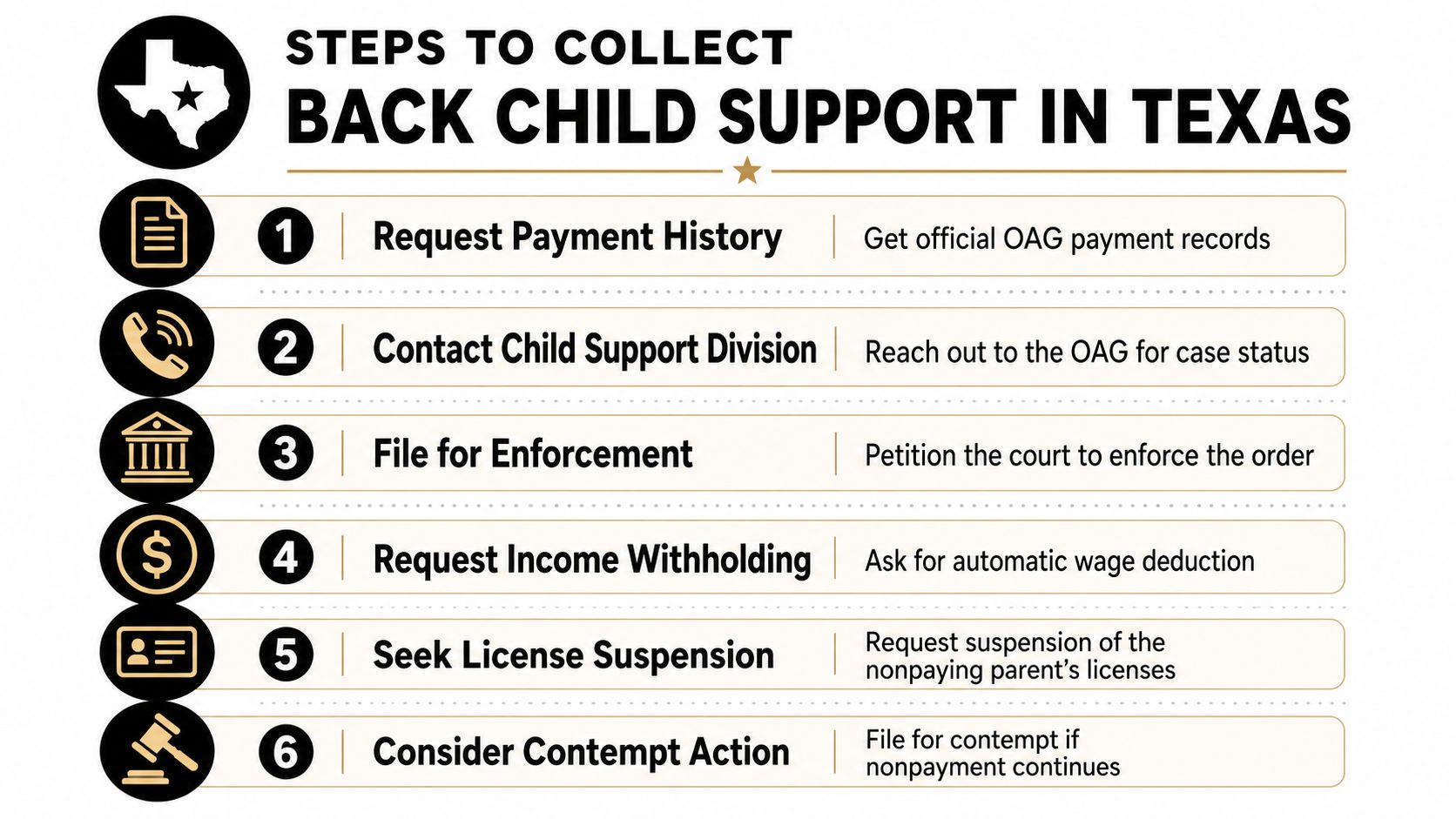
If you're owed support, move from frustration to documentation. The strongest collection effort starts with a reliable accounting and a clear request for relief.
1. Request the payment history
Get the official OAG record and compare it with your own evidence. Mark every missing payment, partial payment, returned payment, and unexplained credit. Separate current support from arrears and identify interest, medical support, fees, or public-assistance debt.
2. Contact the Child Support Division
Ask for the case status and the enforcement action already underway. The OAG may already have an income-withholding order, lien process, refund intercept, or license remedy in progress. Coordination prevents you from assuming nothing is happening or duplicating an action that won't solve the actual problem.
3. Consider a Motion to Enforce
A private court action may be appropriate when administrative collection isn't producing results, the balance is disputed, or you need a judicial remedy. A Texas court can confirm arrears through a cumulative money judgment, which gives the unpaid balance a stronger legal form for collection.
4. Request income withholding
If the other parent has identifiable employment or another reachable income source, ask whether withholding is active and accurate. An employer can only deduct under a valid notice, so verify that the order reflects the current obligation.
5. Pursue available administrative remedies
License suspension and liens can create pressure, but use them strategically. If the parent depends on a professional license to earn income, a payment arrangement may collect more over time than a remedy that cuts off the income source.
6. Prepare for court
Bring the order, payment ledger, receipts, communications, wage records, prior enforcement orders, and evidence of payments made directly. Don't rely on memory. A successful enforcement case usually requires a clean timeline that lets the judge see what was due, what was paid, and what remains.
The OAG may be effective for administrative collection, but it generally doesn't act as your private attorney. A private lawyer can examine accounting errors, plead for a judgment, request enforcement remedies, and present your evidence in court. Timelines depend on docket availability, service, disputes, and the parent's assets or income. Expect a process, not an instant payment.
When a Parent Truly Cannot Pay
Enforcement doesn't always produce money. A parent may be unable to pay because of unemployment, incarceration, disability, informal work, or an order set above actual income. Federal child-support research recognizes that most arrears are owed by low-income parents, and the National Child Support Enforcement Association reports more than $115 billion in outstanding arrears in fiscal year 2024, while approximately $7.5 billion was collected and distributed toward arrears, leaving approximately 93% uncollected according to its arrears compromise publication.
That doesn't excuse willful nonpayment. It does mean you must distinguish refusal from inability. A parent who hides income or spends available money while ignoring the order presents a different case from someone whose wages disappeared and who promptly sought relief.

Act before the balance grows
If your income changes, seek a formal modification promptly. A later modification generally doesn't erase installments that became due before the effective date. Waiting while hoping the other parent will accept less can leave you with an enforceable balance that no informal promise can undo.
A useful hardship package should include termination notices, disability records, incarceration dates, job applications, pay information, bank statements, and a realistic budget. A resource such as this effective hardship letter sample can help you organize a written explanation, but it doesn't replace a court filing.
If you're owed support, a payment plan may be better than a collection strategy that destroys the other parent's ability to work. If you owe support, propose a legally recognized plan and keep making documented payments. An informal agreement between parents generally doesn't replace or modify the court order.
For a formal change based on qualifying circumstances, review how to modify child support in Texas. The goal is not to excuse the past. It's to establish an amount that can be paid while preserving support for the child.
When to Talk to a Texas Family Law Attorney
Call a Texas family law attorney before the problem becomes a crisis if you receive a warrant, lien notice, license-suspension notice, tax-refund intercept notice, or enforcement hearing date. You should also get legal advice when the OAG balance doesn't match your records, multiple states are involved, or a business or property sale is at risk.
An attorney can do work the OAG generally doesn't perform as your private advocate. That may include filing a Motion to Enforce, requesting a cumulative money judgment, challenging an inaccurate accounting, seeking a stay when legally available, defending against contempt, or pursuing a modification. The right approach depends on whether you're trying to collect, defend, correct the ledger, or establish a payment you can maintain.
Bring these records to the consultation
- Orders and judgments: Include the original support order, modifications, enforcement orders, and divorce decree.
- Payment evidence: Bring bank statements, pay stubs, withholding records, receipts, and money-transfer confirmations.
- Agency notices: Include OAG letters, refund-intercept notices, lien documents, license notices, and warrant information.
- Financial records: Provide income proof, tax records, business information, debts, medical records, and evidence of changed circumstances.
- A short timeline: List the order date, major payment changes, moves between states, employment changes, and prior court hearings.
The Law Office of Bryan Fagan, PLLC handles Texas family-law matters involving child support, enforcement, modification, custody, divorce, mediation, and complex property issues. The firm offers free consultations, including in-person and virtual options, so you can discuss the balance, enforcement risk, and next legal step with a Texas family law team.
What to do next: Don't wait for the next notice. Gather your payment history and court orders, identify the immediate enforcement risk, and get advice before a deadline passes.
If back child support is affecting your wages, license, property, passport, or freedom, the Law Office of Bryan Fagan, PLLC can review the records, explain your enforcement or defense options, and help pursue modification or collection in the proper Texas court. Schedule a free consultation so you can replace uncertainty with a concrete plan.


