 Skip to content
Under Texas Family Code § 9.302, a former spouse's pre-divorce beneficiary designation generally becomes ineffective when the divorce decree is rendered. That protection doesn't always control ERISA-governed employer plans or public pension systems, so your divorce may end without changing who receives the money.
You may have just signed your final decree, divided the property, and started planning the next chapter. Then a plan administrator, insurer, or family member raises a question you thought the divorce had already answered: Who is still listed as the retirement beneficiary?
That question matters because a divorce decree, a property award, and a beneficiary form do different legal work. Texas law can revoke certain former-spouse designations, but federal plan rules and public retirement system procedures may produce a different result. If you treat the decree as a universal reset button, your family may face an avoidable dispute at the worst possible time.
The Hidden Trap in Your Divorce Decree
A widower once receives paperwork showing that his deceased spouse's retirement account is payable to a former spouse. He remembers that the divorce decree divided the retirement assets and assumed the former spouse had been removed from every account. The plan administrator, however, is looking at the beneficiary record and the rules governing that plan, not just at the family history or the parties' expectations.
That situation can leave you confused and grieving at the same time. You may believe the decree settled everything, while another person argues that the plan documents control. The dispute can involve the former spouse, children, alternative beneficiaries, the employer, and the financial institution.

What the Texas statute does
Texas Family Code § 9.302 provides an important default rule. When one spouse named the other as beneficiary before the divorce, that designation generally becomes ineffective after the divorce or annulment decree for covered plans. The statute can protect you from unintentionally leaving retirement or employee-plan proceeds to an ex-spouse.
But the protection has boundaries. It doesn't automatically resolve every retirement account, employer plan, insurance contract, or public pension. Federal law may govern an employer plan, and a public retirement system may apply its own statutes, forms, and approval process.
Practical rule: Your final decree is a critical legal document, but it isn't a substitute for reviewing the beneficiary record held by every plan administrator.
Your divorce process still matters from the beginning. You file the petition, provide legally sufficient notice or obtain a waiver, address temporary issues such as support or property protection, exchange financial information, negotiate or mediate, and obtain a final decree. The decree should address retirement ownership and any beneficiary obligations with precision.
If you have children, you should also coordinate retirement instructions with your broader child custody and support plan. A beneficiary designation for the benefit of a child may have a different purpose from a direct property award to your former spouse. That distinction becomes especially important when the estate includes a business, deferred compensation, or substantial retirement savings.
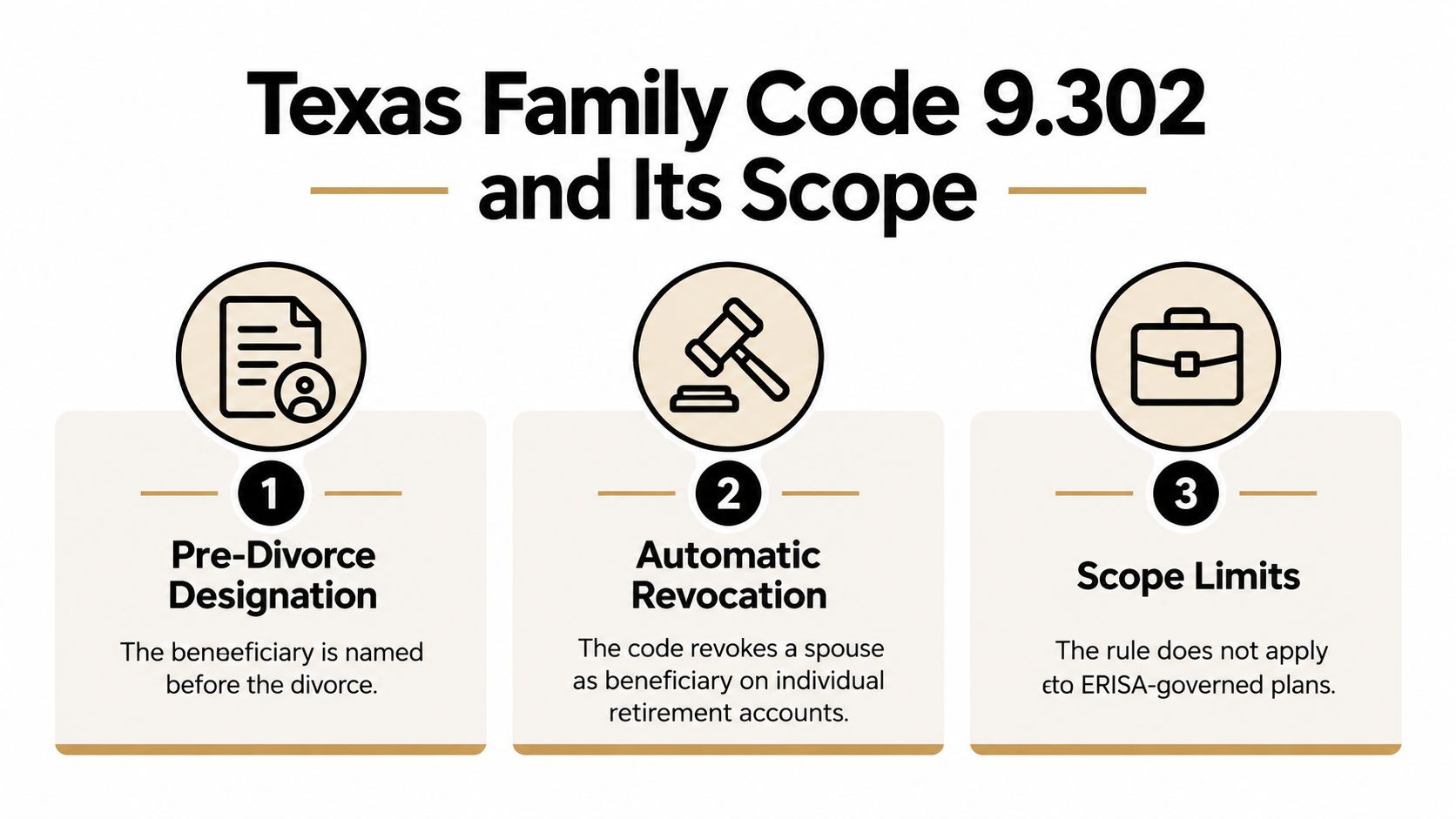
Understanding Texas Family Code 9.302 and Its Scope
Section 9.302 applies to certain beneficiary designations made before divorce. In plain English, if you named your spouse before the divorce and the decree later ends the marriage, the former spouse generally stops being the effective beneficiary under the covered designation.
The statute identifies several types of plans and arrangements, including:
- Individual retirement accounts: A pre-divorce designation may become ineffective after the decree.
- Employee stock-option plans: The statute addresses covered employee financial arrangements.
- Savings, bonus, and profit-sharing plans: These plan types are expressly included.
- Other employee financial plans: The exact plan language and governing law still matter.
The statute also provides three circumstances in which the former spouse can remain the beneficiary:
- The decree expressly designates the former spouse. Your final order can preserve that beneficiary status.
- You redesignate the former spouse after the decree. A post-divorce beneficiary form can make your intent clear.
- The former spouse receives the proceeds for a child or dependent. The designation may be structured in trust for, on behalf of, or for the benefit of a child or dependent of either former spouse.
If none of those exceptions applies, payment generally goes to the plan's named alternative beneficiary. If no alternative beneficiary exists, the statute provides for payment to the former participant who made the designation. The statute also creates potential liability for certain payors that distribute benefits under an ineffective former-spouse designation to the wrong recipient. See the text of Texas Family Code § 9.302 for the operative language.
What the statute excludes
Section 9.302 expressly excludes benefits from public retirement systems governed by Texas Government Code § 802.001. That exclusion is important for public employees, educators, and other workers whose retirement benefits are administered through a government system.
You also need to separate beneficiary status from ownership. Section 9.302 doesn't erase a former spouse's community-property interest or a retirement share awarded in the decree. For a practical overview of dividing retirement assets, review Dividing Retirement Accounts in a Texas Divorce.
The same careful analysis applies to support issues. Spousal Maintenance in a Texas Divorce concerns when Texas courts award post-divorce spousal maintenance, while § 9.302 concerns certain beneficiary designations. One issue cannot be used as a shortcut for the other.
How Federal ERISA Laws Override State Divorce Rules
The most dangerous assumption is that Texas's automatic revocation rule controls every employer retirement plan. It doesn't. An employer plan governed by the Employee Retirement Income Security Act, commonly called ERISA, may be subject to federal rules that require the administrator to follow the beneficiary designation maintained under the plan's records.
That can create a sharp conflict. Your Texas decree may require you to remove your former spouse, or it may award part of the account to you. Yet the plan administrator may still evaluate the claim under federal law, the plan document, the beneficiary form, and any qualifying domestic relations order.
The practical result is that a state court's intent may not automatically change the plan's payment obligation. The person named in the plan's records may remain central to the payout dispute, even if both former spouses believed the divorce paperwork had settled the issue.
The two systems side by side
| Texas Family Code § 9.302 | ERISA-governed employer plan |
|---|---|
| Generally makes certain pre-divorce former-spouse designations ineffective after the decree | May require the plan administrator to follow the designation recognized under federal plan rules |
| Includes specific exceptions for decree language, post-divorce redesignation, and benefits for a child or dependent | Requires careful review of the plan document and any qualifying domestic relations order |
| Excludes public retirement systems governed by Texas Government Code § 802.001 | Applies to covered private employer benefit plans, subject to the plan's governing rules |
A QDRO, or qualified domestic relations order, may create or recognize an alternate payee's right to part of a retirement benefit. It is different from merely telling your former spouse to remove a beneficiary designation. For more detail about the order process, review QDROs in a Texas Divorce.
You should also understand how financial information is gathered before settlement or trial. The Discovery Process in a Texas Divorce addresses how financial information is exchanged before settlement or trial, including the documents needed to identify plans, forms, account balances, and ownership claims.
What works and what fails
A decree alone may not protect you when the plan requires separate administrative action. A completed beneficiary form, accepted by the plan after the divorce, is usually more reliable for expressing your current intent than an assumption that the administrator will infer your wishes from a court order.
The same principle applies if you want your former spouse to remain the beneficiary. State the intent clearly in the decree, complete the post-divorce designation where the plan permits it, and confirm acceptance with the administrator. Do not leave the plan with conflicting documents and hope the conflict resolves itself later.
Navigating Public Pension Systems and Domestic Relations Orders
Public pensions require a separate review because Texas Family Code § 9.302 excludes public retirement systems governed by Texas Government Code § 802.001. A divorce decree may award your former spouse an interest in a pension, but the retirement system may require a domestic relations order before it can recognize or pay that interest.
The Texas Teacher Retirement System, or TRS, requires a DRO when a decree awards the nonparticipant spouse an interest in TRS benefits. TRS then decides whether the order qualifies under its requirements. A judge's award in the decree does not, by itself, authorize TRS to make direct payments to an alternate payee.
The Employees Retirement System of Texas, or ERS, similarly requires the signed divorce decree and a judge-signed, county-clerk-certified QDRO. The order must match the decree and receive approval as valid before ERS can pay an alternate payee.
A practical public-pension sequence
Identify the system first. Confirm whether the benefit belongs to TRS, ERS, a military retirement system, or another public plan. The correct administrator determines the required order and forms. For military benefits, a separate review of military pension division in a Texas divorce may be necessary.
Define the right being awarded. Your decree should distinguish a property share from a survivor benefit and from a beneficiary designation. A formula that works for one benefit may not work for another.
Prepare the DRO or QDRO. The order must track the decree and satisfy the retirement system's administrative requirements. TRS, for example, must determine whether the order qualifies before direct payment can occur.
Obtain signatures and certification. For ERS, the judge-signed order must be county-clerk-certified. Do not treat an unsigned draft or an uncertified copy as a completed transfer.
Submit the order for review. The retirement system must review and approve the order before paying an alternate payee. Payment generally begins only when a benefit becomes payable to the participant, such as at retirement, withdrawal of accumulated contributions and interest, or death.
Confirm the result in writing. Keep the approved order, correspondence, and any confirmation from the system with your final decree and estate documents.
A certified divorce decree may revoke a former spouse's beneficiary status for certain TRS active-member death benefits or retiree survivor benefits. It doesn't revoke a former spouse's designation for certain continuing optional retirement annuity benefits, including options 1 through 5. That distinction can change the result after a death, even when everyone believes the divorce removed the former spouse from the plan.
A court order establishes the parties' rights. The retirement system still decides whether the order qualifies for administration.
Public-sector families should also consider whether a broader retirement resource, such as this guide to splitting super on divorce, helps explain retirement division concepts. It doesn't replace Texas-specific advice, but it can clarify why plan rules and court orders must work together.
Procedural details matter throughout the case. Serving Divorce Papers in Texas addresses how the other spouse is served and the deadline to answer. Those early steps affect how quickly you can reach a decree, but they don't eliminate the separate plan-approval work that may follow.
Separating Property Division from Beneficiary Designations
A beneficiary designation answers one question: Who does the plan identify for payment after death? Property division answers another: What interest did the court award to each spouse? Those answers can differ.
Texas Family Code § 7.001 requires the court to divide the community estate in a manner it considers just and right, rather than automatically awarding each spouse exactly half. Chapter 7 also requires the court to determine each spouse's rights in pensions, retirement plans, annuities, individual retirement accounts, employee benefits, and similar plans. Review the statutory framework in Texas Family Code Chapter 7.
Suppose your former spouse is no longer the effective beneficiary under § 9.302. That does not necessarily eliminate a community-property interest or a retirement share awarded in the decree. If your former spouse owns a portion of the benefit, the plan may still require a DRO or QDRO to transfer or pay that portion.
Why high-value estates need more detail
You need to identify and characterize more than the retirement account's current balance. The analysis may include:
- Community and separate portions of retirement accounts
- Stock options and restricted compensation
- Deferred compensation
- Business interests
- Tracing records showing separate-property claims
- Survivor benefits and payment options
A business owner may need to coordinate the retirement analysis with valuation and cash-flow planning. A person with a high-value estate may need the decree, beneficiary forms, trusts, and business documents to point in the same direction. Children from an earlier relationship may also need protection through carefully drafted ownership and beneficiary instructions.
The designation itself should be deliberate. A helpful resource on how to name beneficiaries can explain the general mechanics, but your Texas divorce documents must still address the legal rights created by the marital estate and the applicable plan rules.
Your settlement should identify whether the former spouse receives a property share, a survivor benefit, or a beneficiary designation. Those terms aren't interchangeable. A vague decree may force the parties to return to court or litigate with the plan administrator when a precise order could have prevented the uncertainty.
Essential Steps to Protect Your Assets After Divorce
Signing the final decree feels like the finish line. For retirement and beneficiary issues, it's often the point at which your implementation checklist begins.
Audit every account and policy
Start with a complete inventory. Review individual retirement accounts, employer plans, public pensions, life insurance, annuities, stock plans, and any account with a beneficiary feature. Include older accounts you rarely access. A forgotten designation can matter just as much as the account you review every month.
Then compare each account with the decree. Ask whether the document creates a property award, requires a beneficiary change, preserves a former spouse's interest, or requires a separate order. Don't assume similar-looking accounts follow identical rules.
Obtain the administrator's forms
Contact each plan administrator or insurer and request the current beneficiary and transfer forms. Ask what documents the institution requires after divorce and whether it needs a certified decree, a QDRO, a DRO, or additional approval.
For a public pension, coordinate the order with the retirement system before submitting it. A judge-signed, county-clerk-certified document may be necessary, and the system may reject language that doesn't match the decree or its rules.
Submit, confirm, and preserve
Complete the forms carefully and submit them through the administrator's approved process. Save copies of every form, confirmation, letter, and online submission record. If the administrator says the change is complete, keep that confirmation with your estate-planning documents.
You should also update related documents, including your will, powers of attorney, trusts, and insurance records. If you have children, review whether your new plan supports your custody and support obligations. If you own a business, coordinate beneficiary changes with buy-sell arrangements, deferred compensation, and successor planning.
Check the result instead of relying on hope
A common failure occurs when someone signs the decree, fills out a beneficiary form, and never verifies that the plan accepted it. The form may be incomplete, rejected, or inconsistent with the plan's requirements. You need a closed loop, meaning submission, acceptance, and retained proof.
What to do next: Treat every retirement benefit as three separate tasks: determine ownership, qualify the order, and confirm the beneficiary record.
Texas divorce cases may also involve mediation, temporary orders, child custody, support, or later enforcement. A mediated settlement can resolve the parties' agreement, but the plan administrator still needs documents it can administer. If a former spouse or plan refuses to follow the decree, enforcement may require prompt legal action rather than an informal request.
The Law Office of Bryan Fagan, PLLC helps Texas clients review retirement ownership, beneficiary designations, DROs, QDROs, property division, mediation, and post-divorce enforcement. Schedule a free consultation by visiting Law Office of Bryan Fagan, PLLC so you can identify the gap between your decree and your plan records before it becomes a family dispute.


