 Skip to content
You're staring at the calendar, waiting for a spousal-maintenance payment that still hasn't arrived, while bills keep coming due.
A Texas maintenance order is supposed to provide financial stability, but a monthly payment can become stressful when it depends entirely on your former spouse remembering to send a check. Family Code § 8.101 income withholding for spousal maintenance in Texas can offer a more dependable collection method by directing money from the paying spouse's income before it reaches their hands.
The important questions are practical ones. Does the order qualify? What happens if the requested deduction is too large? How do child support and maintenance compete for available funds? Can withholding reach Social Security or disability benefits? What must an employer do when an order exceeds the legal limit? You'll find those answers below, along with steps for reviewing an order, responding to missed payments, and protecting your rights.
Why Your Spousal Maintenance Order May Need a Paycheck Shortcut
Maria has a signed Texas divorce decree awarding her periodic spousal maintenance. Her former spouse has a regular job, and the order clearly states the amount due. Still, the payment arrives late one month, not at all the next, and only after several uncomfortable messages does the money appear. Maria isn't trying to punish anyone. She's trying to pay for housing, food, and ordinary household expenses without negotiating for each payment.
That's where income withholding can change the practical experience of enforcement. Instead of relying on the obligor, the spouse who must pay, to write and send a check, a court-authorized withholding order directs an employer or other payor to deduct the required amount from disposable earnings and send it through the designated payment process.
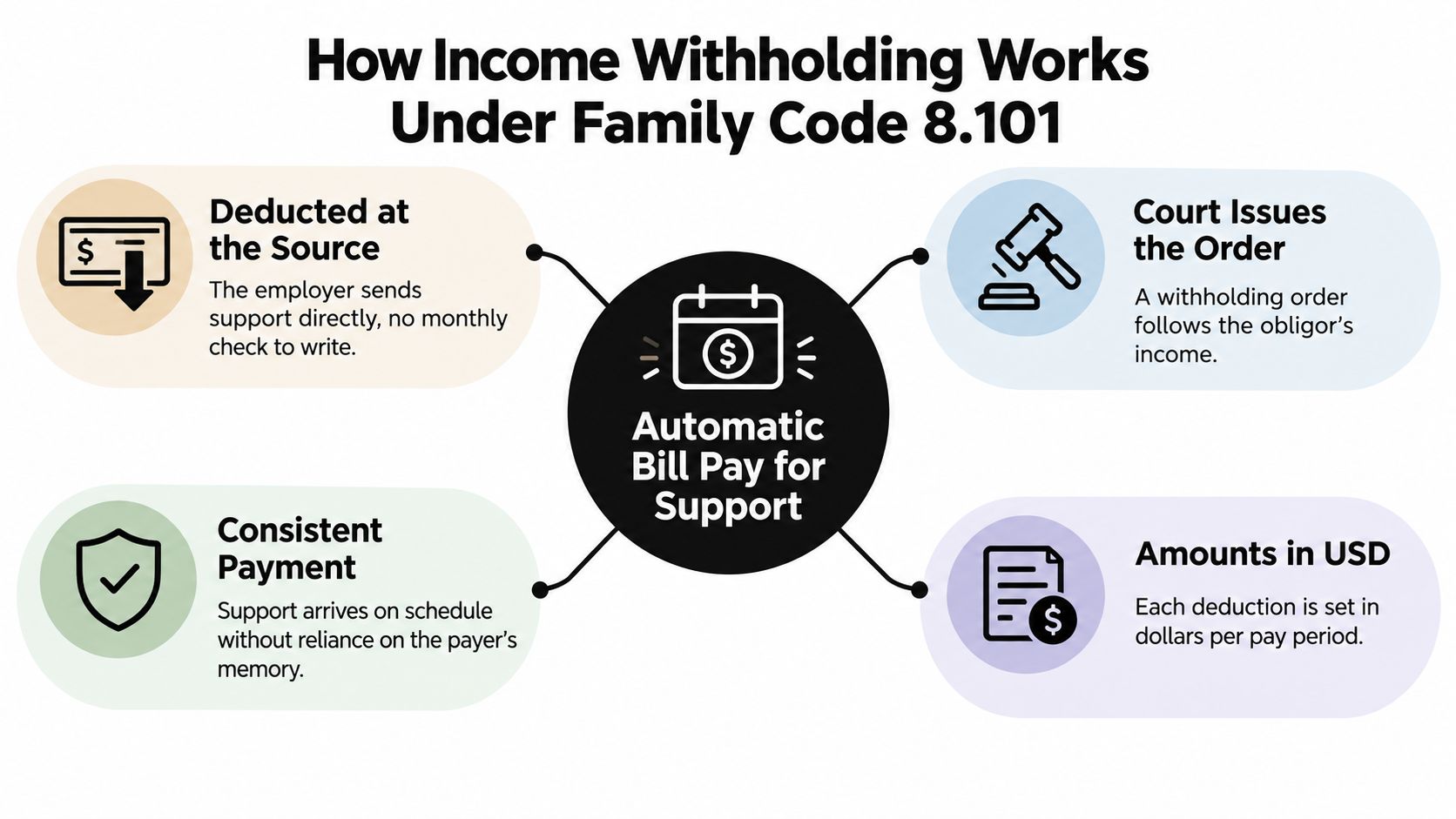
You can think of it as automatic bill pay created by a court order. The payment source handles the deduction, so the recipient doesn't have to chase the payer every month. The process still has legal boundaries, and it doesn't automatically make every private support promise eligible for withholding.
If payments have already stopped, keep your decree, payment history, bank records, messages, and any prior enforcement filings together. Those documents can help an attorney determine whether you need a withholding order, an enforcement action, a modification, or more than one remedy. You can also review this guide to spousal support enforcement in Texas for related enforcement concepts.
The rest of the process becomes easier when you separate four questions:
- Authority: Does Texas law permit withholding for this obligation?
- Amount: How much can be deducted from current income?
- Priority: Does child support get paid before maintenance?
- Income source: Is the obligor paid through wages, retirement benefits, disability benefits, or another source?
A valid maintenance award is important, but it's only the starting point. The order's wording, the source of income, existing child-support obligations, and statutory limits can determine what you receive.
What Family Code 8.101 Actually Does
Texas Family Code § 8.101 establishes the basic authority for income withholding when periodic spousal-maintenance payments are ordered, modified, or enforced. That means withholding can be relevant when maintenance is first awarded, when a court changes an existing award, or when the court takes action because the obligation isn't being paid. The statute concerns deductions from the obligor's disposable earnings, rather than serving as a way for a recipient to take money without a court process. Texas Family Code § 8.101
A familiar analogy is automatic bill pay. You could ask someone to remember a payment every month, or you could arrange for the payment to be taken from the account where income arrives. Withholding uses the second approach. The court's order tells the employer or payor what to deduct and where the money should go.
The basic sequence
- A court recognizes the maintenance obligation. The obligation may be part of an initial award, a later modification, or an enforcement proceeding.
- The order identifies the periodic payment. The amount and payment terms need to be clear enough for the payor to calculate deductions.
- The withholding direction follows the income. The employer or other payor receives the order and processes deductions from covered disposable earnings.
- The payment is remitted through the required channel. The receiving spouse should be able to track payments without depending on direct contact with the former spouse.
Section 8.101 also recognizes a court-approved agreement. If spouses voluntarily agree to periodic maintenance under Chapter 8 and the court approves that agreement, withholding may be ordered. But agreement doesn't allow the parties to bypass statutory limits. An agreed withholding order can't enforce an amount greater than the periodic support a Texas court could have awarded under Chapter 8, and it can't extend beyond the legally permissible maintenance period.
Why the label matters
Texas law generally treats statutory spousal maintenance differently from purely contractual alimony. A private promise may be enforceable as a contract, but it usually doesn't become eligible for Chapter 8 withholding merely because the parties wrote it into a settlement. The legal classification of the obligation is therefore critical before you assume an employer can deduct money.
The statute was added by the Texas Legislature in 2001, effective September 1, 2001, and amended in 2013, effective September 1, 2013. Its central function is straightforward:
Family Code § 8.101 lets a court connect periodic statutory maintenance payments to the obligor's income, but it doesn't let private agreements exceed the limits Texas law places on court-ordered maintenance.
If your decree uses the words “contractual alimony,” “spousal maintenance,” or both, don't rely on the label alone. Read the operative provisions, identify the source of the obligation, and have the order reviewed before asking an employer to begin deductions.
When Courts Can Order Withholding and When They Cannot
Withholding generally comes through one of two paths. First, a court can order withholding alongside a statutory spousal-maintenance award, or later when the award is modified or enforced. Second, spouses can agree to periodic maintenance under Chapter 8, after which the court approves the agreement and authorizes withholding within the statutory boundaries.
The key limitation is that consent doesn't create unlimited statutory maintenance. Suppose two spouses privately agree that one will pay an amount equal to twice what a Texas court could have awarded under Chapter 8. They may have created a contractual obligation, depending on the decree and agreement, but a withholding order under § 8.101 cannot collect the excess as though it were court-ordered statutory maintenance. The same problem arises if the agreement demands payments beyond the legally permissible maintenance period.
Statutory maintenance versus contractual alimony
The distinction affects both negotiation and enforcement. Statutory maintenance is governed by Chapter 8 and can use statutory enforcement tools when the order qualifies. Purely contractual alimony is a private promise. It may offer more flexibility, but its enforcement path can be different, and income withholding under § 8.101 may not be available.
That's why you should ask these questions before signing a divorce settlement:
- Is the payment identified as statutory spousal maintenance under Chapter 8?
- Has the court approved the agreement as periodic maintenance?
- Does the amount stay within what a court could have awarded?
- Does the duration stay within the legally permitted period?
- Does the decree explain what happens if a payment is missed?
For a broader explanation of when Texas courts award post-divorce support, see Spousal Maintenance in a Texas Divorce. If you're comparing statutory maintenance with private payment terms, understanding the difference between garnishment rights and legal limits can also help you avoid treating every debt as interchangeable with a support obligation.
A judge may approve an agreement, but the order still has to fit the law. If the wording is unclear, an employer may not know what to deduct, and the recipient may spend months trying to enforce a provision that was never eligible for withholding.
Practical rule: Before negotiating the payment amount, decide whether you're building statutory maintenance, contractual alimony, or a combination of financial terms. The enforcement consequences can be very different.
How a Withholding Order Is Issued and What Employers Must Do
The withholding process is easier to understand as a chain of events. The court creates the authority, the order reaches the employer or payor, and the payor calculates and sends deductions. Each link matters. A recipient may have a valid maintenance award but still experience delays if the employer never received the order or the order doesn't identify the payment terms clearly.
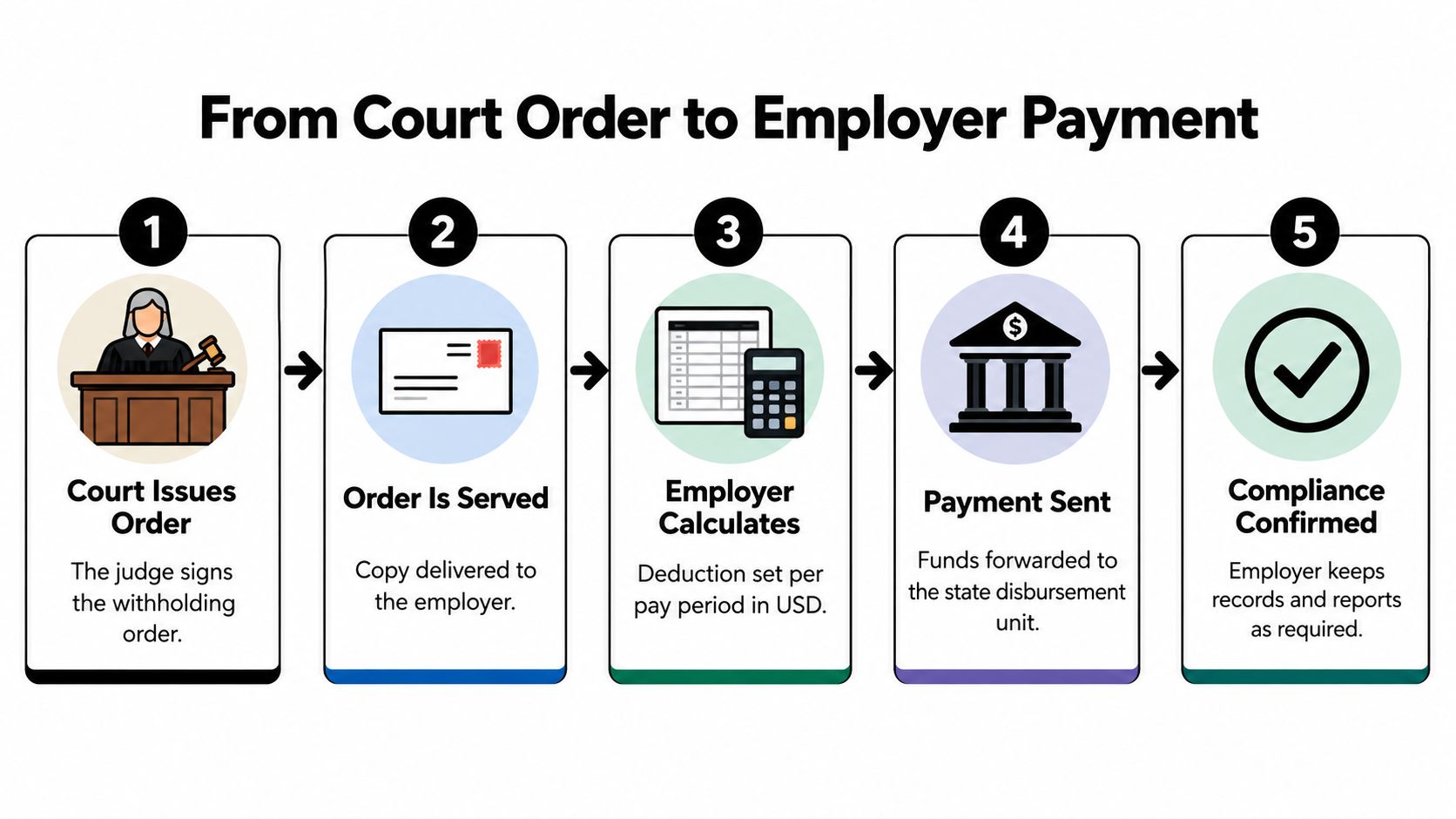
The order's path
First, the court issues the order. The judge signs a withholding direction connected to the maintenance obligation. The order should identify the obligor, the obligee, the payment amount, and the income source or payor information available to the court.
Next, the order is served. The employer or other payor needs an official copy through the required process. Sending an informal email to a payroll department may not create the legal duty to deduct.
Then, the employer calculates the deduction. Payroll personnel review the order, determine the covered disposable earnings, and apply the amount and limits stated by law. They aren't free to rewrite the order because they disagree with the divorce outcome.
After that, funds are remitted. The employer sends the withheld money to the designated state disbursement unit or other authorized recipient. The receiving spouse should monitor the payment record rather than assuming that a deduction automatically means the money has arrived.
Finally, records are maintained. The employer should follow reporting and recordkeeping requirements and communicate when employment ends or the income source changes.
What happens after a job change
A withholding order is tied to the support obligation, not just to one particular workplace. If the obligor changes jobs, the recipient should provide updated employer information through the appropriate court or agency process. Don't assume a new employer will discover the order automatically.
Employers and agencies also shouldn't start or stop deductions based only on a phone call from either spouse. A payroll department normally needs a valid court order, an official notice, or a legally recognized update. If the maintenance amount changes, the parties should obtain a modified order rather than asking payroll to improvise.
If you're the recipient, verify the following:
- Order details: The names, case number, payment amount, and effective date are accurate.
- Service: The employer or payor received the order.
- Payment route: Funds are going to the correct disbursement unit or recipient.
- Employment changes: The court or agency knows about a new employer or income source.
- Payment records: You keep bank statements and disbursement histories for missed or partial payments.
If you're the obligor, review your first pay statement after withholding begins. Confirm that the deduction matches the order and legal limits, and raise an immediate objection through the proper court process if the amount appears wrong. You can learn more about the related process of garnishing wages in Texas, but remember that support withholding has its own rules.
Calculating the Withholding Amount and the Limits Most People Miss
A maintenance order can state one amount while the payroll deduction produces another. That doesn't necessarily mean the employer made a mistake. Texas state-employer guidance says current spousal-maintenance deductions are generally capped at the lesser of $5,000 or 20% of the employee's average monthly gross income. Arrearages may be withheld in addition when the order defines them. Texas state-employer garnishment guidance
The cap acts as a limit on current maintenance deductions. If the order requests more than that ceiling, payroll cannot take the requested amount just because the decree says so. The difference may become an issue for enforcement, modification, payment planning, or arrears, depending on the order and the facts.
When child support is collected too
A combined order must identify current maintenance and arrears separately. Withheld funds are then applied in a prescribed sequence:
- Current child support
- Current spousal maintenance
- Child-support arrears
- Spousal-maintenance arrears
That priority rule can surprise a recipient who sees a valid maintenance award but receives less than expected. The problem may not be eligibility. It may be that current child support consumes available withholding capacity before maintenance arrears are reached.
How withheld funds are applied in priority order
| Payment Category | Priority Order | What It Covers |
|---|---|---|
| Current child support | First | The current support obligation for the child |
| Current spousal maintenance | Second | The ongoing maintenance payment |
| Child-support arrears | Third | Past-due child-support amounts identified in the order |
| Spousal-maintenance arrears | Fourth | Past-due maintenance amounts identified in the order |
Consider a combined order that calls for current child support, current maintenance, and arrears for both obligations. The obligor's income may not support every requested deduction within the applicable cap. Payroll first applies available funds to current child support, then current maintenance. Only remaining capacity can reach child-support arrears and, after that, maintenance arrears.
This is why you shouldn't judge compliance solely by comparing the decree's monthly maintenance figure with the amount deposited. Review the withholding order, the income calculation, the child-support balance, and the payment sequence. A consultation about how much alimony is in Texas can help place the payment amount in context, but the withholding cap and priority rules still control the actual deduction.
If you're a business owner or self-employed obligor, the calculation may require closer review because income doesn't always appear as a simple payroll number. If you're the recipient in a high-value divorce, property division and other income sources may also matter, but you still need to distinguish the maintenance award from separate assets or contractual payments.
Withholding From Social Security Disability and Retirement Benefits
Your former spouse may not receive a conventional paycheck. Retirement, disability, or other program payments can create a different collection question, but the absence of an employer doesn't automatically end the analysis.
Social Security guidance interpreting Texas law states that, after a 2011 statutory change, a Texas court may order withholding of Social Security benefits to enforce a spousal-maintenance obligation. The guidance distinguishes between two uses of benefits. Benefits may be treated as disposable earnings for enforcement, even though they may not be included in the same way when calculating the obligor's underlying maintenance liability. Social Security guidance on Texas withholding
That distinction matters. A benefit may be reachable to collect an obligation already ordered, while the same benefit may be treated differently when the court originally determined the amount of maintenance. You shouldn't assume that “counted for enforcement” means “counted identically for every part of the case.”
Review the payment source carefully
A withholding order involving benefits should be checked for:
- Payment type: Social Security retirement, disability, or another benefit program may have different processing considerations.
- Current maintenance: Confirm what amount is due for the present period.
- Arrears: Determine whether past-due support is listed separately and whether the order addresses additional withholding.
- Legal limits: Check whether the requested deduction fits the applicable cap and payment rules.
- Agency handling: Confirm which agency or payment administrator received the order.
Military households and federal employees may also have retirement or benefit structures that require careful coordination. For broader planning involving federal benefits and property issues, you may find this complete TSP divorce resource useful, though it doesn't replace review of the specific Texas maintenance order.
If circumstances change, a court may modify or terminate withholding through a proper order. Don't ask the agency to stop deductions merely because you and your former spouse reached an informal understanding. If payments stop or the order is ignored, possible remedies can include enforcement proceedings, a judgment for arrears, or a corrected withholding order, depending on the facts.

What to Do Next About Your Spousal Maintenance Order
You don't have to solve a withholding problem by guessing. Start with the signed decree, any separate withholding order, recent payment records, and information about the obligor's current employer or benefit source. A family-law attorney can then compare the documents and identify whether the problem involves eligibility, calculation, service, priority, or nonpayment.
Questions that often arise
What happens if the order exceeds the legal limit? The employer should apply the statutory limit rather than deducting an unlawful amount. The unpaid difference may need to be addressed through a corrected order, arrears enforcement, or another legal remedy. Don't tell payroll to choose a number without court guidance.
What if the employer refuses to comply? Keep written proof that the employer received the order, including delivery information and payroll communications. Then ask the court or appropriate agency to address the failure. The remedy depends on whether the order was properly served and whether the employer had a legal basis for questioning it.
Can withholding continue after the maintenance period ends? It shouldn't continue beyond a legally permissible maintenance period merely because payroll still has an old order. Obtain and provide the proper termination or modification order, and verify that deductions stop through official channels.
What if you and your former spouse agree to change the payment? Put the change through the court when the obligation is statutory or withholding is active. An informal agreement may not give an employer authority to alter deductions.
You're also dealing with the emotional weight of separation, not just payroll mechanics. Support from a qualified counselor, including resources about healing after separation with therapy, can help you manage the personal side while your legal team handles the order.
Key takeaways
- Eligibility matters: Section 8.101 supports withholding for qualifying periodic statutory maintenance that is ordered, modified, or enforced.
- Agreements have limits: Court approval doesn't allow agreed maintenance to exceed what Chapter 8 permits.
- The cap matters: Current maintenance deductions are generally limited to the lesser of $5,000 or 20% of average monthly gross income, subject to the governing order and circumstances.
- Priority affects payment: Current child support comes before current maintenance, followed by child-support arrears and maintenance arrears.
- Benefits may be reachable: Certain Social Security benefits can be withheld for enforcement even though benefit income may be treated differently when calculating the original maintenance obligation.
- Orders control payroll: Employers and agencies shouldn't start, stop, or change deductions without proper legal authority.
Every maintenance case has its own wording, income sources, payment history, and family circumstances. Schedule a free consultation with The Law Office of Bryan Fagan, PLLC so an attorney can review your decree, withholding order, arrears, and benefit or employment information. You deserve a clear explanation of what you're owed and a practical plan for enforcing or correcting the order.
The Law Office of Bryan Fagan, PLLC can review your Texas spousal-maintenance order, address withholding caps and payment priority, and pursue enforcement or modification when appropriate. Visit Law Office of Bryan Fagan, PLLC to request a free consultation and discuss the next step for your situation.


