 Skip to content
You see a message from the person covered by your protective order, or you notice the restrained person outside your workplace, and your stomach drops. In Texas, the next steps can affect safety, criminal charges, custody, and future court proceedings, so you need a clear plan instead of assumptions.
When a Protective Order Gets Broken in Texas
You may have read the order carefully when it arrived, perhaps even keeping it where you could find it quickly. Then life became busy. A former partner sent a text, appeared at a child's school event, or showed up near a listed address. Whether you're the protected person or the respondent, that moment creates the same urgent question: what counts as a protective order violation in Texas, and what happens next?
Start with the written order. Its exact terms control. A restriction against contact is different from a geographic restriction, and a firearm prohibition is different from a counseling or payment requirement. Don't rely on what someone told you the order means. Read the signed document and preserve the complete version.
If you're trying to understand the difference between protective orders and other court restrictions, this guide to protective orders versus restraining orders in Texas provides useful context. If the restrained person has been arrested or expects an arrest, information about bail and protective order conditions may also help you understand the immediate release process.
Practical rule: If you believe there's an immediate threat, get to a safer location and call 911. Don't negotiate with the person who may have violated the order.
The rest of your response should be disciplined. Preserve messages, call records, photographs, surveillance, and witness information. Report the conduct accurately. Avoid creating new contact that could produce a counter-allegation. Texas law can treat the same incident as a criminal matter, a contempt proceeding, or both, depending on the order and the conduct.
The consequences range from a Class A misdemeanor to felony exposure, including substantial prison time for qualifying violations. The best next step for you depends on whether you're seeking protection, defending an accusation, or trying to protect your position in a custody or enforcement case.
What Texas Law Calls a Protective Order Violation
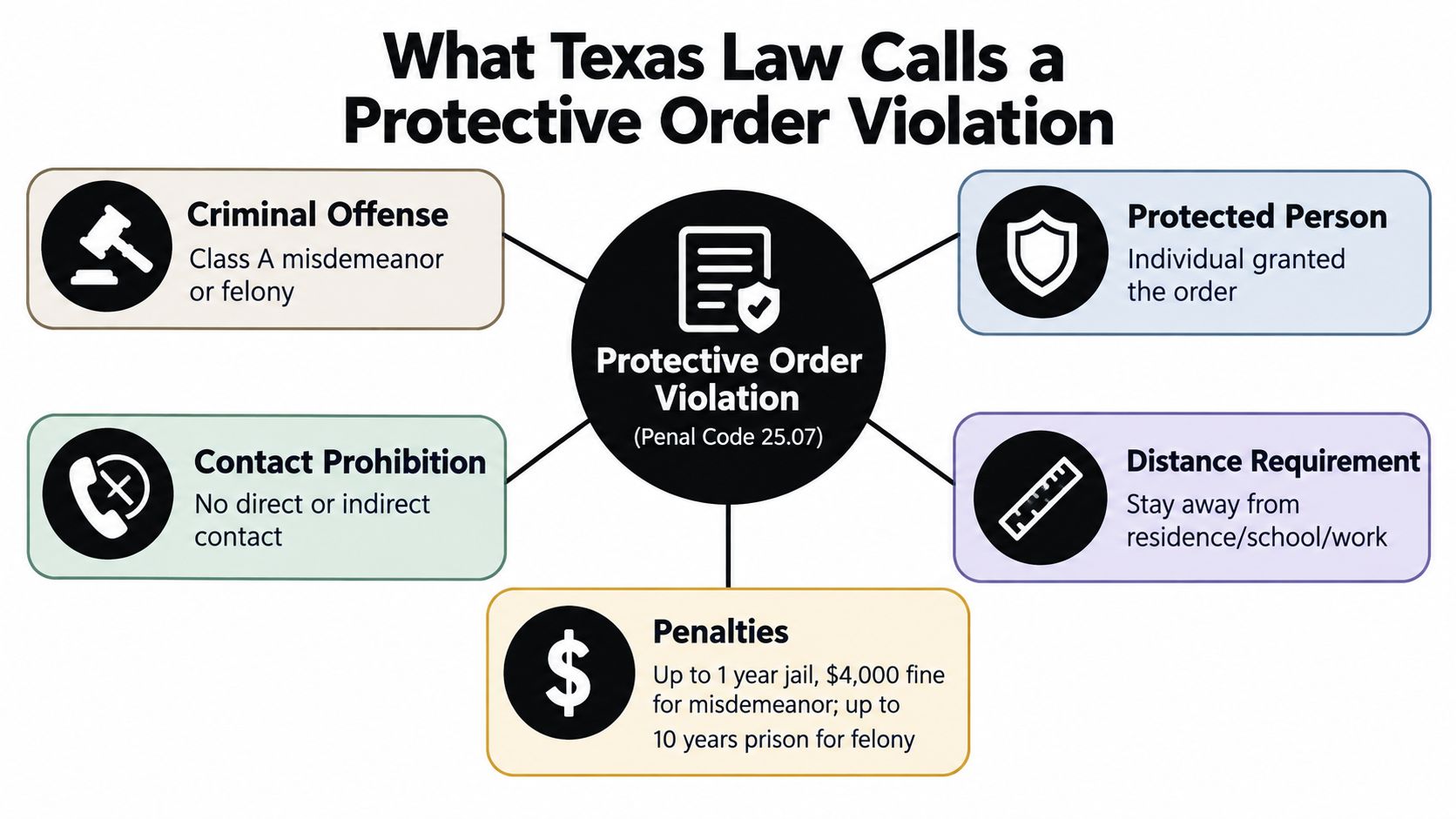
Texas Penal Code §25.07 makes knowingly or intentionally violating specified protective-order terms a criminal offense. The statute can apply to orders issued under Texas Family Code Chapters 83 and 85, a magistrate's emergency-protection order, qualifying bond conditions, and certain out-of-state orders recognized under Texas law. The conduct must connect to a specific operative term in the order.
The written terms come first
Common prohibited conduct can include:
- Family violence: Committing conduct barred by the order, including prohibited assaultive behavior.
- Stalking: Following, monitoring, or engaging in conduct the order specifically forbids.
- Communication: Calling, texting, emailing, or contacting the protected person when the order bars that contact.
- Restricted locations: Going to a residence, workplace, school, or another location identified in the order.
- Firearms: Possessing a firearm when the order prohibits possession.
The mental state matters. The statute addresses conduct done knowingly or intentionally, so investigators and prosecutors must connect the person's conduct to the order and establish the required state of mind. That's why the complete signed order, proof of service or notice, and reliable digital records matter.
A Texas peace officer may arrest without a warrant when there's probable cause to believe a person violated §25.07. An officer must make an arrest when the violation occurs in the officer's presence. That authority doesn't mean every report produces an immediate conviction. It does mean you should treat the order and the evidence seriously from the start.
Specialized orders can follow different rules
A sexual-assault protective-order violation is separately addressed under Penal Code §38.112 and is a Class A misdemeanor, while contempt may also be available. An Article 7B protective-order violation isn't itself a criminal offense under the Texas Judicial Branch materials, although contempt and potential federal firearm consequences may still matter depending on the order and its findings.
For a separate overview of the full divorce sequence from petition through final decree, see How to File for Divorce in Texas: Step by Step. Divorce, custody, and protective-order issues often overlap, but you shouldn't assume that a divorce filing changes the restrictions in an existing order.
The Two Enforcement Tracks in Texas
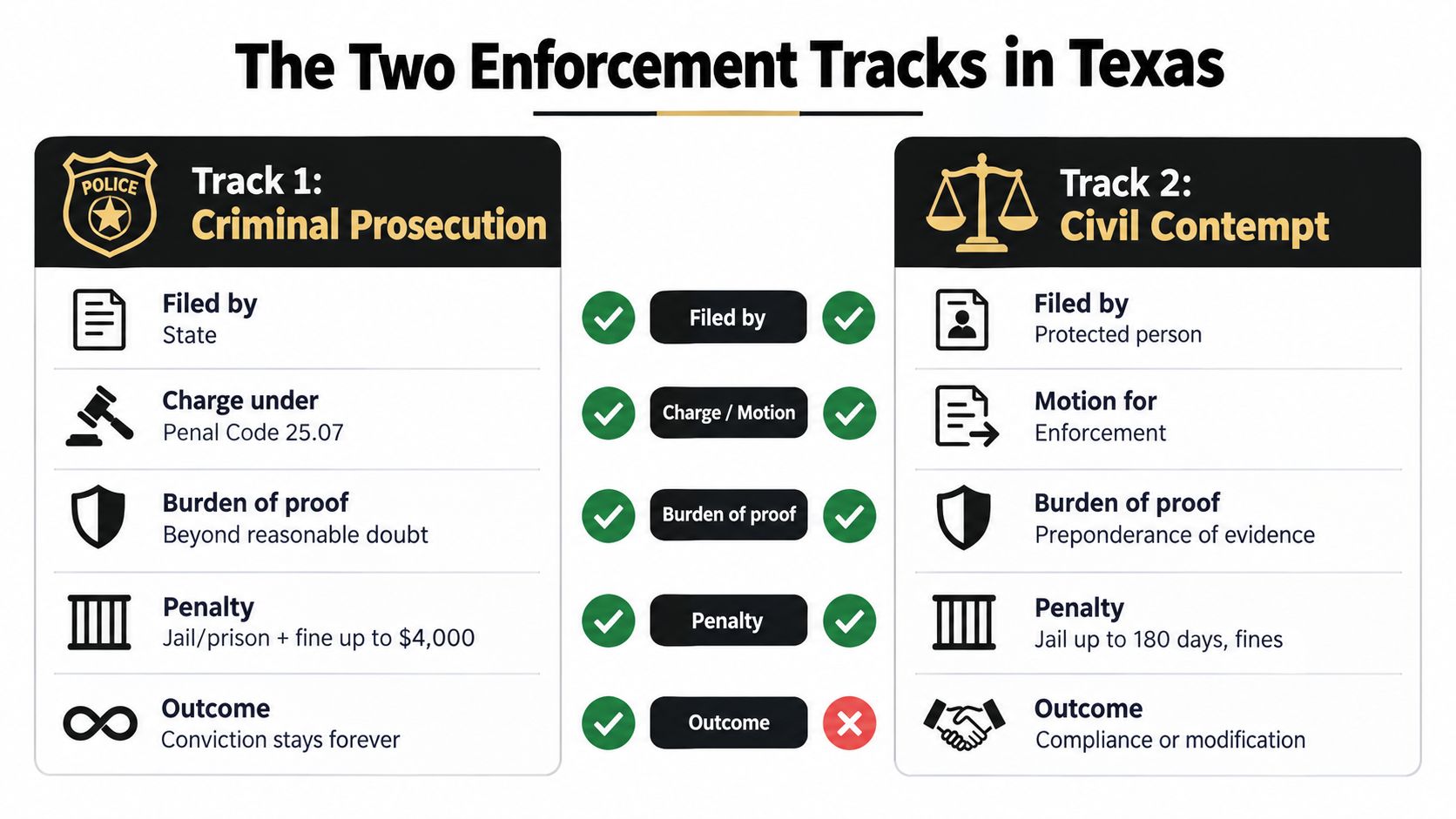
Texas protective-order enforcement has two distinct paths. Criminal prosecution is handled by the state. Contempt enforcement takes place in the court connected to the order and addresses violations that may not be criminally enforceable under the statute.
Criminal prosecution under Penal Code §25.07
A violation of Texas Penal Code §25.07 is generally a Class A misdemeanor. The offense can be enhanced to a third-degree felony when the conduct involves assault, stalking, or at least two prior convictions under the statute, as explained by the Texas State Law Library's protective-order enforcement guidance.
The Texas Office of Court Administration summarizes felony exposure for qualifying violations as a fine of up to $10,000 and 2 to 10 years in state prison. The precise classification depends on the order, the alleged act, the person's record, and the evidence. A family-violence act may also be prosecuted separately, and the Texas Supreme Court's protective-order materials state that a separately prosecuted felony involving family violence may carry at least 2 years of prison confinement.
Contempt in the issuing court
Some provisions are enforced through contempt rather than a criminal charge. Texas judicial materials describe contempt exposure of up to a $500 fine, confinement for up to 6 months, or both. Counseling, payment, or other compliance terms may fall into this category when they aren't criminally enforceable under §25.07.
The same conduct can create parallel proceedings. A prohibited contact may support a criminal case and a contempt motion if the order and facts allow both remedies. The burden, procedure, and possible result differ, so you need to identify the track before deciding how to respond.
The practical question isn't only whether a rule was broken. It's which written term was violated, what kind of order issued it, and what remedy Texas law permits for that term.
Immediate Safety Steps if the Order Was Violated
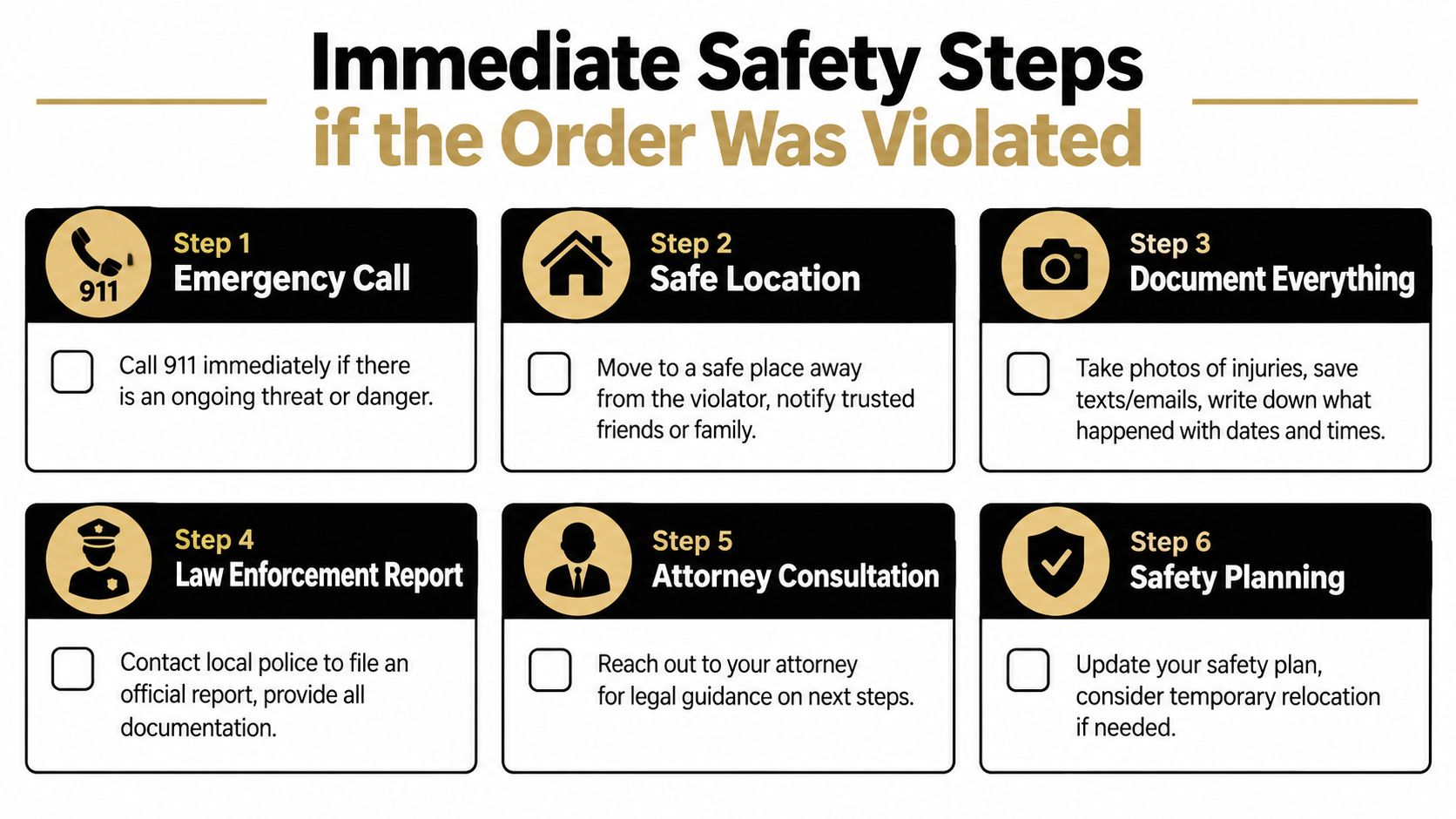
If the violation is happening now, put physical safety ahead of paperwork. Call 911, tell the dispatcher that a protective order may be violated, and move away from the person if you can do so safely. Don't meet the person to discuss what happened.
Your first response
- Call 911: Use emergency services when there's an ongoing threat or immediate danger.
- Move to safety: Go to a secure location and tell trusted people what's happening.
- Preserve the scene: Photograph damage, injuries, vehicles, or other relevant conditions when it's safe.
- Save communications: Keep texts, emails, voicemails, and call records in their original form.
- Identify witnesses: Write down names and contact information for people who saw or heard the incident.
- Contact counsel: Seek legal advice before filing a contempt motion, requesting a modification, or giving a detailed public statement.
Texas officers may arrest without a warrant when they have probable cause to believe a §25.07 violation occurred. They must arrest when they personally witness the violation. Give officers the complete order and your preserved evidence, then ask for the incident or report information before they leave.
If you share children with the restrained person, use only law-enforcement or court-approved exchange arrangements. Informal handoffs can create new contact, confusion, or competing accusations. For emotional support after coercive or traumatic relationship dynamics, reVIBE Mental Health therapy insights may help you recognize why leaving or maintaining boundaries can feel difficult.
For information about requesting temporary protection through the court, review how to get a temporary restraining order in Texas. Don't assume a verbal promise or informal agreement changes an active order. Only the court can change its terms.
Building the Evidence File That Holds Up
A strong evidence file tells the story in order. It shows what the order prohibited, how the respondent knew about it, what happened, and when it happened. Emotional descriptions may explain the impact, but dated facts usually make the record easier for police, a prosecutor, or a judge to evaluate.
Collect the foundation first
Keep these materials together:
- Complete signed order: Save every page, including attachments and firearm or location provisions.
- Proof of notice: Preserve proof of service or other evidence showing the respondent received or knew about the order.
- Digital records: Keep messages, emails, call logs, voicemails, and relevant social-media material.
- Location evidence: Preserve surveillance, access records, photographs, or available location data.
- Witness information: Record names, contact details, and a brief description of what each person observed.
Don't crop away the sender, recipient, date, time, or surrounding conversation when preserving screenshots. Keep the original device or account information available. A screenshot may be useful, but the underlying message, call record, or platform record can be important when authenticity is challenged.
Write a factual incident log
For each event, record the date, approximate time, location, exact conduct, witnesses, and evidence saved. Write “received three calls from the listed number” rather than “they harassed me all night.” If you don't remember an exact detail, mark it as approximate instead of guessing.
Avoid deleting messages, editing photographs, or responding in anger. Store copies in a secure location and give the organized file to your attorney. If you need guidance about repeated unwanted conduct that may involve separate offenses, review Texas harassment laws without assuming every harassment incident is automatically a §25.07 violation.
Which Conduct Triggers Which Consequence
The act alone doesn't determine the result. The written order, the issuing authority, the respondent's knowledge, the required mental state, prior convictions, and the nature of the conduct all matter.
| Type of Conduct | Likely Criminal Charge | Likely Contempt Exposure |
|---|---|---|
| A prohibited text, call, or message | Class A misdemeanor under §25.07 when the order bars that contact | Possible contempt if the term is also enforceable through the issuing court |
| Going to a listed home, workplace, school, or other restricted location | Class A misdemeanor when the geographic restriction is an operative §25.07 term | Possible contempt, depending on the order's wording and remedy |
| Counseling, payment, or another compliance requirement that isn't criminally enforceable | Often no §25.07 charge based solely on that provision | Contempt may be available, with up to a $500 fine or 6 months' confinement under Texas judicial materials |
| Assault or stalking tied to the violation | The §25.07 charge may be enhanced to a third-degree felony | Contempt may proceed separately when the order supports it |
| At least two prior §25.07 convictions | The new §25.07 violation may be enhanced to a third-degree felony | Separate contempt exposure may remain available |
| Firearm possession prohibited by the order | Possible state or federal criminal exposure, depending on the order and facts | Contempt may also apply if the firearm restriction is enforceable in the issuing court |
| A separate family-violence act | Separate misdemeanor or felony prosecution may apply | Contempt may proceed for violating the protective-order term |
The Texas Office of Court Administration identifies up to $10,000 in fines and 2 to 10 years in state prison for qualifying felony violations. Federal firearm consequences can also matter. Supreme Court of Texas materials state that possessing a firearm or ammunition while a qualifying protective order is in effect may create federal criminal exposure, and a restrained person may not knowingly purchase, rent, lease, or receive a handgun during the order's term.
A child's school event deserves special caution. If the order identifies the school or restricts proximity, attending can create an allegation even if you never speak to the protected person. If you need contact for custody, use only an exception expressly written into the order or seek a court-approved modification.
What to Do in the First 72 Hours if You Are Accused
If you're accused of violating a protective order, don't try to fix the problem by calling the protected person. Don't send an explanation, ask for forgiveness, or use a friend as a messenger. Those actions can create additional allegations and may undermine your position.
Protect your legal position
- Read the complete order: Get every page and attachment. Refusing to read an order after receiving it doesn't excuse compliance.
- Stop questionable contact: Follow the restrictions exactly unless a court changes them.
- Preserve evidence: Keep messages, call records, location information, receipts, photographs, and witness details that may support your account.
- Avoid a law-enforcement interview: Politely identify yourself and state that you want an attorney before answering substantive questions.
- Contact counsel promptly: Choose an attorney who can address the criminal allegation and the related family-court consequences.
The criminal and family-law cases operate independently. Even if a criminal case doesn't move forward, the alleged conduct may affect custody, visitation, a later enforcement action, or a request to modify the order. That's especially important when children, a business, or valuable property are involved.
Don't delete anything. Don't post about the accusation. Don't ask mutual friends to collect statements informally or pressure the protected person to withdraw a report. Give your attorney the original materials and a factual timeline, including facts that may be unfavorable. Your lawyer can assess whether the conduct matches an operative term, whether the state can prove knowing or intentional conduct, and whether the evidence supports your defense.
If the order contains unclear child-exchange or communication provisions, ask the court to clarify or modify them. Until that happens, follow the strictest reasonable reading and use approved third-party or supervised arrangements.
Your Next Step and How We Can Help
A protective order violation in Texas isn't just a disagreement between former partners. It can create a criminal case, a contempt proceeding, custody consequences, and firearm concerns at the same time. Your immediate priorities are simple: protect yourself, preserve the evidence, follow the written order, and get advice before making statements or contact.
The Law Office of Bryan Fagan, PLLC handles Texas family-law matters involving protective orders, enforcement, custody, divorce, property disputes, and mediation. Whether you're seeking enforcement or defending an accusation in Houston, Dallas-Fort Worth, Austin, San Antonio, or a surrounding county, a consultation can help you identify the correct legal track and make a controlled plan.
Schedule a free consultation with the Law Office of Bryan Fagan, PLLC to review the protective order, evidence, and related custody or enforcement concerns. Bring the complete order and your incident timeline so the firm can help you decide what to do next.


