 Skip to content
Divorce can leave you facing a long list of financial and parenting decisions while you're still trying to understand what happens next. You don't have to solve every dispute before mediation. You do need to understand the issues, organize the facts, and arrive with a clear plan.
This mediation divorce checklist helps you prepare financial disclosures, property questions, a parenting proposal, negotiation priorities, and questions for your attorney. It also connects those tasks to the Texas divorce process, from filing a petition and observing the statutory waiting period to mediation, any required hearing, and a final decree.
Use the steps to identify what you know, what still needs verification, and which decisions deserve legal or financial advice before you sign anything. If you have children, a business, complex property, or safety concerns, build those issues into your preparation early. Mediation is a structured settlement process, not an informal conversation, and the details you agree on can shape your family's finances and routines long after the session ends.
1. Gather and Organize Your Financial Documents
A missing retirement statement or an outdated mortgage balance can leave you negotiating with an incomplete picture. Make financial disclosure your first preparation workstream. Your attorney needs records showing what you own, what you owe, what comes in, and what each household costs to run.
Texas Family Code § 6.502 authorizes courts to issue temporary orders in divorce cases, including orders involving financial information and property. Ask your attorney which disclosures, forms, and deadlines apply in your court or county. Build your document file around those requirements.
Collect tax returns, pay records, bank and investment statements, retirement information, loan and mortgage documents, insurance records, business documents, and regular expense records. Include digital payment accounts and electronically held assets, such as cryptocurrency. For each asset or debt, record:
- The owner or account holder.
- Its approximate value or balance and the valuation date.
- The document supporting that figure.
- Whether you believe it is community or separate property, with any uncertainty flagged for your attorney.
Keep estimates clearly labeled. If you dispute a figure, explain why and identify the record needed to resolve it. Use How Property Is Divided in a Texas Divorce to identify property questions for your attorney without treating your inventory as a final legal classification.
Create folders by record type, and use the practical guide to file management to keep digital files retrievable. Maintain a secure backup your spouse cannot access. Preserve emails, messages, and account records, and do not access another person's device or account without legal authority.
Check your file against these documents to gather before filing for divorce.
Practical rule: If you can't explain where a number came from, identify the missing record before you negotiate around it.

Before each session, list unresolved questions, including outdated balances and disputed debts. Request missing statements directly from the institution rather than relying on screenshots or estimates.
Keep that question list beside you while watching the overview below, and bring unresolved document questions to your attorney.
2. Understand Community Property Versus Separate Property
Don't assume a Texas court will divide the marital estate fifty-fifty. Texas Family Code Chapter 7 directs courts to divide the estate in a manner that is just and right, considering the spouses' rights and the marriage's children. Your property-classification workstream should establish what belongs in that estate before you negotiate who receives it.
Texas generally treats property owned by either spouse during marriage as community property unless it can be established as separate property. Separate property can include assets owned before marriage and certain gifts or inheritances. If you claim an asset is separate, prepare records showing how you acquired it and what happened to it afterward. Ownership labels alone are not enough.
An inheritance kept in a separate account may be easier to trace than one deposited into a joint account and mixed with marital funds. Mixing funds creates a tracing question; don't assume it settles the classification. Bring account statements, deeds, gift documents, and purchase records that establish the asset's source and history. Give real estate, retirement accounts, investments, and business interests particular attention because title alone does not determine their treatment.
Review separate property and community property in Texas to identify classification questions for your attorney, and How Property Is Divided in a Texas Divorce for context on the just-and-right standard.
Trace the asset, not just its current balance
For each asset you claim as separate, connect the original source record to later statements showing whether it remained separate or was combined with shared funds. Identify gaps in that history before mediation so your attorney can assess what additional evidence is needed.
Don't move money to strengthen your argument or conceal it.
Transfers can make the history harder to explain and raise disclosure concerns. Preserve the records as they are.
A strong property position starts with a clear paper trail.
Before signing a settlement, ask your attorney to confirm how it classifies each disputed asset and which claims you would give up. Require clear terms stating who receives each asset, who pays each debt, and what documents or other steps are needed to transfer title or account access.
3. Prepare a Business and High-Value Asset Valuation
If your spouse proposes keeping the family business and paying you a share of its value, the number needs support. For a company, medical practice, professional firm, rental property, or another valuable asset, prepare records showing how it operates and what it may be worth. A business formed or built during marriage may raise community-property questions, but ownership, contributions, and the asset's history matter. Don't base a settlement on a rough estimate.
Gather business tax returns, profit-and-loss statements, balance sheets, ownership records, operating agreements, buy-sell agreements, debt information, and compensation documents. Identify property the business owns, outstanding debts, other owners, and its dependence on your personal work and reputation. These details affect both valuation and the practical options for dividing the interest.
Decide what needs independent review
Ask your attorney whether disagreements over value or goodwill require a neutral valuation professional, a tax adviser, or another expert before mediation. Goodwill involves the value associated with the business's reputation and customer relationships, so flag whether those relationships depend on the owner personally. If you jointly select a professional, agree on the scope of work and responsibility for the cost before the review begins.
Make the buyout terms workable.
The owner may keep the business while the other spouse receives other property or payments over time. Your proposal should explain the payment terms and account for the company's cash flow and the overall property division. Review Dividing a Business in a Texas Divorce for an explanation of how closely held businesses are valued and divided.
Don't change compensation, ownership, or business accounts during the divorce without legal advice. Preserve ordinary records, disclose relevant interests, and flag restricted stock, deferred compensation, business debt, and separate-property contributions for your attorney. If you own rental property, review rental property sale capital gains and ask a tax professional about the consequences before agreeing to a sale or transfer. Evaluate the proposed settlement after taxes, debt, and operating needs, not just by the values listed on paper.
4. Build a Parenting Plan Focused on Your Child's Best Interest
When you have children, a parenting plan must work on ordinary school days as well as holidays and emergencies. Texas law uses the terms conservatorship and possession and access, rather than custody and visitation. Texas Family Code § 153.002 makes the child's best interest the primary consideration in deciding conservatorship and possession issues.
Write down your child's actual routine before proposing a schedule. Include school, childcare, activities, medical appointments, transportation, communication, and the time each parent can realistically be available. Address who makes decisions about education and health care, how parents share important information, and what happens when a child is sick or a parent's schedule changes.
Put the practical details in writing
A parenting proposal should be specific enough that each parent can follow it without guessing. Consider:
- Regular schedule: Set exchange days, times, and locations.
- Holidays and school breaks: Explain how those periods affect the normal schedule.
- Travel and notice: Clarify how parents share itineraries and contact information.
- Health and school costs: Identify how insurance, uncovered medical expenses, and activity costs will be handled.
- Communication: Set expectations for parent-to-parent updates and contact with the child.
A parent who works changing shifts, for example, may need a schedule that identifies notice requirements and backup arrangements instead of relying on a general promise to be flexible. A child with regular medical care may need a clear plan for sharing records and coordinating appointments.
Keep your proposal focused on your child's needs, not on punishing the other parent. Texas Family Code § 105.009 addresses parent education courses in applicable cases. Ask your attorney or the court whether you must complete a course and when. If you have concerns about coercion, intimidation, or violence, raise them privately with your attorney before agreeing to joint negotiation or a standard mediation setup.
5. Calculate Child Support Using Texas Guidelines
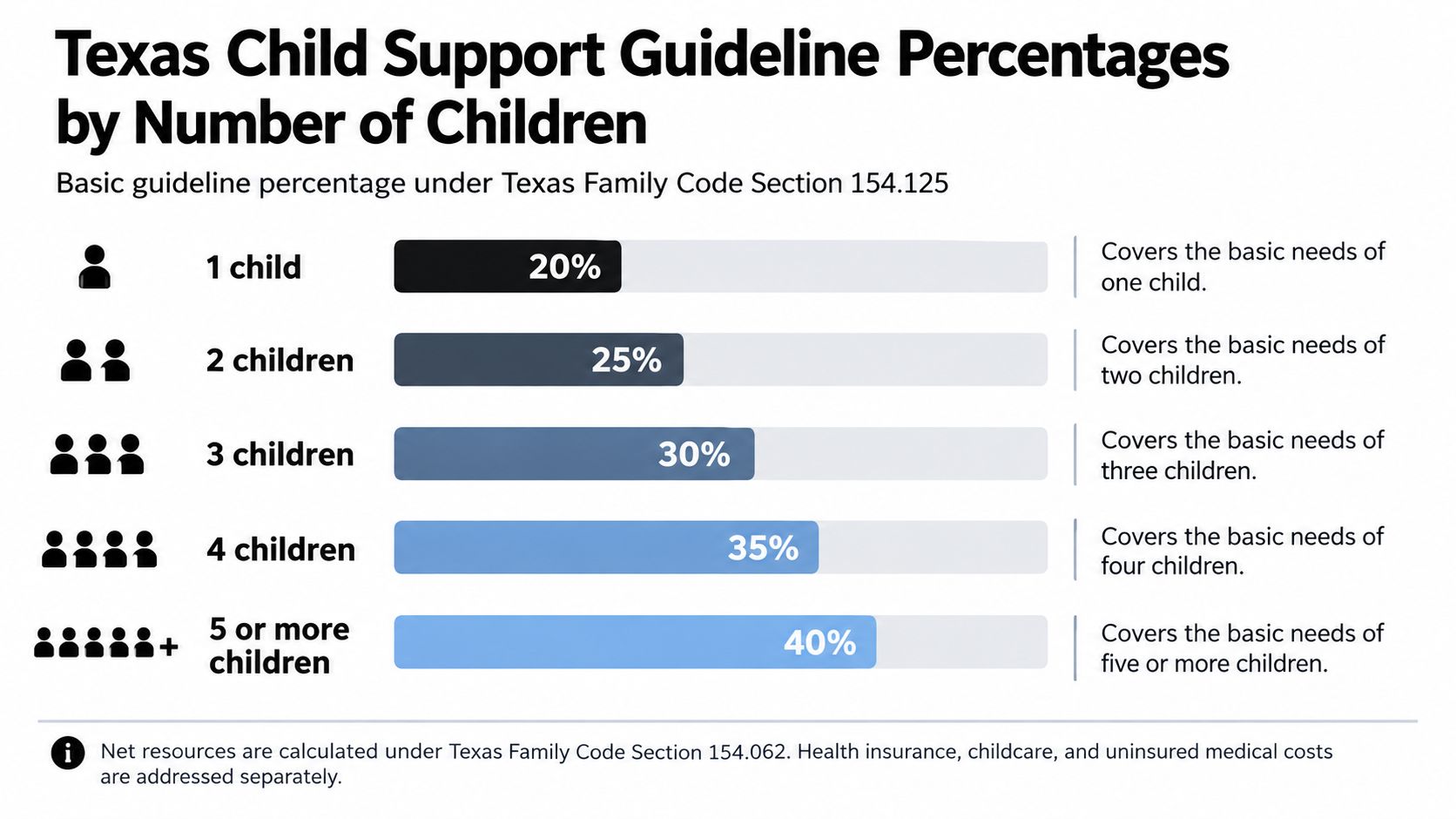
Prepare for child support with accurate income records and a clear list of child-related expenses. Texas Family Code Chapter 154 sets out child-support rules, including guideline calculations based on the paying parent's net resources. The figures used in any calculation should be checked against current income and the legal rules that apply to your case.
Gather pay statements, tax records, information about other income, and documents showing deductions that may matter under the statute. If you own a business or earn commissions or bonuses, bring records that help explain changes in income over time. Don't use one unusually high or low month as the whole picture.
Keep the child's budget concrete: List insurance premiums, childcare, uncovered medical expenses, and recurring activities separately from the basic support discussion.
Address costs beyond the monthly amount
A support proposal should explain how the parents will handle health insurance, medical expenses not covered by insurance, childcare, and other agreed costs. For each category, decide how you'll exchange receipts, request reimbursement, and resolve a disagreement about whether an expense was necessary. A clear process can prevent routine costs from becoming repeated conflict.
For example, if one parent carries the child's health insurance through work, identify the policy and premium information, then discuss how the parents will share uncovered expenses. If a parent's business income varies, use appropriate records to discuss a support structure with your attorney rather than relying on an unsupported estimate.
Texas courts can consider whether a guideline amount is appropriate in the circumstances, and parents may discuss a different arrangement in mediation. Any agreement still needs to protect the child's interests and be presented properly to the court. Support orders can also be subject to later modification when legal requirements are met, so don't use mediation to make informal promises that contradict the written order.
6. Evaluate Spousal Maintenance Eligibility Before Mediation
Spousal maintenance is not automatic in Texas. If you expect to request it or your spouse may request it, evaluate the issue before the mediation session rather than relying on assumptions. Texas Family Code § 8.051 sets eligibility requirements, including whether a spouse can meet minimum reasonable needs with the property available and whether an additional statutory condition applies.
Those conditions can involve a spouse's disability, responsibility for a child with a disability who needs substantial care, or the length of the marriage and the spouse's ability to earn enough income. The law also limits the amount and duration of court-ordered maintenance. The details depend on the circumstances, so bring your attorney a realistic household budget and records supporting any claimed health or caregiving limitations.
Compare maintenance with the full settlement
Maintenance is only one part of the financial picture. Compare a possible payment arrangement with the property division, debts, retirement assets, housing costs, and each spouse's ability to earn income. A property trade-off may provide more certainty in some cases, while another family may need to discuss ongoing payments. Don't agree to either option without understanding its legal and financial consequences.
Use Texas spousal maintenance eligibility to prepare questions about the statutory requirements. Ask a qualified tax professional about tax treatment where needed, and make sure the written agreement states the amount, timing, duration, and conditions for ending or changing payments.
A budget should include necessary costs such as housing, utilities, food, transportation, insurance, and health care. If you support a child or have limits on your ability to work, document those facts clearly. If maintenance is part of your proposal, identify what records support the request and which terms you're willing to negotiate. Don't treat a broad statement such as “help with bills” as a complete agreement.
7. Choose the Right Mediator and Understand What Makes an Agreement Binding
A mediator helps you and your spouse negotiate; the mediator doesn't decide the outcome for you. Ask about the mediator's Texas family-law experience, approach to high-conflict cases, fees, session format, and process for drafting or recording an agreement. A mediator may be an attorney or a trained professional in another field, but the mediator doesn't replace your own lawyer.
Texas Family Code §§ 6.602 and 153.0071 address mediated settlement agreements in divorce and suits affecting the parent-child relationship. These statutes set requirements for agreements that qualify for binding treatment. Before signing, ask your attorney to confirm that the document reflects what you agreed to, includes the required language and signatures, and covers each issue you meant to resolve.

Check readiness and safety
Attendance doesn't mean you're ready to settle. Before mediation, confirm that you have enough financial information, authority to negotiate, and a safe way to participate. Separate sessions, remote participation, attorney involvement, or another protective arrangement may help in some situations. If fear or coercion means you can't freely disagree, tell your attorney. Mediation may be inappropriate when safe, informed consent isn't possible.
Prepare a one-page list of priorities, acceptable compromises, and questions that need an answer before you sign. Ask who will attend, whether you can take breaks, how the mediator handles separate rooms, and what happens if you don't reach agreement. Also confirm payment terms and whether the mediator expects both parties to review a written draft before signing.
Don't sign because you feel rushed or because the session is ending. A mediated agreement can have significant legal consequences. Get independent legal advice before committing, especially if the agreement covers property, parenting, support, or enforcement details that will need to work in daily life.
8. Know the Texas Divorce Timeline and Automatic Temporary Orders
A Texas divorce usually cannot be granted before the 60th day after the divorce suit is filed, subject to limited statutory exceptions. Texas Family Code § 6.702 sets that waiting period. Filing starts the clock, but it doesn't automatically finish the case. You still need to complete service or a waiver, address financial and parenting issues, satisfy court requirements, and obtain a final decree.
Mediation can take place during the waiting period, and a court may refer a divorce case to mediation under Texas Family Code Chapter 6. The court may also require mediation before certain contested settings or trial, subject to applicable rules and exceptions. Check your referral order and local court rules for deadlines, required documents, fees, and reporting obligations.
Track every step through the final decree
Use a calendar to record the filing date, service status, mediation date, court settings, and any deadline in an order. Read your temporary orders carefully. Texas Family Code § 6.501 allows courts to issue temporary restraining orders in divorce cases; the actual terms in your case determine what you may and may not do. Ask your attorney before changing insurance, transferring property, or taking action that could affect your spouse or children.
A practical sequence looks like this:
- File and serve: Start the case and complete the required notice process.
- Follow temporary orders: Understand the restrictions that apply while the divorce is pending.
- Exchange and review information: Identify property, debts, income, parenting concerns, and missing records.
- Attend mediation or a required setting: Read the referral order and prepare the materials requested.
- Finalize the case: Make sure the written settlement is converted into the required court documents and final decree.
The statutory waiting period is a minimum, not a promise that your divorce will be granted as soon as it ends. Keep following court instructions until the judge signs the final decree.
8-Point Texas Divorce Mediation Checklist Comparison
| Preparation Item | 🔄 Implementation Complexity | Resources Required | 📊 Expected Outcomes | 💡 Ideal Use Cases | ⭐ Key Advantages |
|---|---|---|---|---|---|
| Gather and Organize Financial Documents | Moderate; requires collecting and sorting records | Tax returns, pay stubs, account statements, loan records, spreadsheet | More complete disclosures and fewer information gaps | Any divorce involving financial disclosure or property division | ⚡ Reduces follow-up requests and can reveal discrepancies early |
| Understand Community vs. Separate Property | Moderate to high; classification may require tracing | Acquisition records, account histories, inheritance or gift documents, legal advice | Clearer property claims and more informed settlement proposals | Cases involving premarital assets, inheritances, gifts, or commingled funds | Helps set realistic goals and support separate-property claims |
| Prepare a Business and High-Value Asset Valuation | High; valuation methods and goodwill may be disputed | Business financial statements, tax returns, agreements, valuation expert | Estimated asset value and potential buyout or payment options | Divorce involving a business, professional practice, or substantial assets | Supports informed negotiations while helping plan for business continuity |
| Build a Child-Focused Parenting Plan | Moderate; requires detailed scheduling and coordination | Child's school, medical, activity, and routine information; parent education course | Specific arrangements for decision-making, schedules, holidays, and communication | Parents who need to agree on conservatorship and possession arrangements | ⭐ Encourages a practical plan tailored to the child's needs |
| Calculate Child Support Using Texas Guidelines | Moderate; may be more complex with variable income | Income records, allowed deduction details, insurance and childcare costs | Guideline-based estimate and clearer discussion of additional expenses | Parents negotiating support, especially where income varies | ⚡ Provides a predictable starting point for negotiations |
| Evaluate Spousal Maintenance Eligibility | Moderate; requires reviewing statutory criteria and finances | Monthly budget, income and property records, relevant health or caregiving documentation | Assessment of potential eligibility, amount limits, and duration | Spouses considering whether maintenance may apply | Clarifies statutory limits and supports realistic financial planning |
| Choose a Mediator and Understand Binding Agreements | Moderate; requires mediator selection and careful agreement review | Mediator fee and experience details, priorities list, attorney review | More structured mediation and a clearer understanding of agreement terms | Contested cases seeking settlement without a full trial | ⚡ Can reduce time and cost while allowing more control over outcomes |
| Know the Texas Divorce Timeline and Temporary Orders | Low to moderate; requires tracking dates and understanding restrictions | Petition and order documents, calendar, legal guidance | Better deadline planning and fewer accidental violations | Anyone beginning a Texas divorce, especially after filing | 💡 Clarifies the minimum timeline and restrictions in effect during the case |
Key Takeaway: Turn Preparation Into a Plan
Before mediation, put your financial records, property classifications, parenting proposal, support information, negotiation priorities, and attorney questions in one organized file. If you own a business or have high-value property, arrange for any needed valuation or tax advice before you negotiate. Decide which terms you can compromise on and write down the points you can't accept. Preparation won't guarantee agreement, but it helps you make decisions based on information rather than pressure.
Confirm the mediator's qualifications, format, fee arrangements, attendees, technology, and process for documenting any agreement. Ask how the session handles safety concerns and whether you can consult privately with your attorney. Review the final document before signing. A qualifying mediated settlement agreement may be binding, so the words on the page need to match the terms you intend to accept.
After filing, track the temporary orders, the waiting period under Texas Family Code § 6.702, mediation, any prove-up hearing, and the final decree. Keep copies of signed agreements and court orders, and make a plan for carrying out each term, including property transfers, support payments, insurance, and parenting exchanges.
If you're still gathering information, start with the records you can obtain safely and lawfully. Then speak with your attorney about disputed values, separate-property claims, your child's schedule, and any concerns that could make mediation unsafe. You don't have to enter the process with every answer. You do need a clear understanding of what you're agreeing to and what remains unresolved.
The Law Office of Bryan Fagan, PLLC offers family-law guidance for Texans navigating divorce, custody, property division, support, mediation, and enforcement. If you want help preparing for negotiations or reviewing proposed terms, schedule a free consultation and discuss a plan that fits your family's circumstances.
You can also explore the firm's resources on child custody, child support, mediation, and enforcement.
The Law Office of Bryan Fagan, PLLC can help you organize the issues in your mediation divorce checklist, understand Texas divorce procedures, and review proposed parenting and financial terms. Visit Law Office of Bryan Fagan, PLLC to schedule a free consultation and discuss your next steps.


