 Skip to content
You may have a Texas divorce order that clearly requires child support, yet still wonder why the money hasn't reached your child's household. That frustration is common in military families because establishing support and collecting support are separate legal and administrative tasks.
When Military Divorce and Child Support Intersect
A service member may be deployed, transferred, moved into the Reserve, or shifted back to civilian employment while the other parent is trying to keep rent, childcare, and school expenses covered. The divorce decree may say exactly what the obligor owes, but the decree alone usually doesn't tell the government payroll system where or how to withhold the money.
Texas law generally determines the support obligation, custody arrangement, and division of marital property. Federal systems, including the Defense Finance and Accounting Service, or DFAS, control how certain payments are taken from military pay. That means your case may involve a Texas court, a state child-support registry, DFAS, a pay center, and sometimes an out-of-state agency.

Practical rule: A support obligation written into a decree is not the same thing as a withholding order successfully processed by the correct payer.
Military divorce and child support therefore require more than a standard calculation. You need to examine jurisdiction, deployment schedules, pay status, allowances, arrears, federal withholding limits, and the exact wording of each order. Texas residency can remain available even when a service member is stationed elsewhere, while the Servicemembers Civil Relief Act may affect notice and hearing timing.
If your case also involves military justice, conduct allegations, or questions about how service obligations affect the family-law dispute, you may find it useful to browse UCMJ legal articles for additional background.
The central question is practical: What must happen for the ordered money to move from the service member's income to the child's household? The answer depends on matching the Texas order with the right federal paperwork, then monitoring changes instead of assuming the system will update itself.
How Federal Laws Shape Military Child Support
Two federal laws often appear in a military divorce file, but they solve different problems.
The Uniformed Services Former Spouses' Protection Act, or USFSPA, permits state courts to treat certain military retired pay as divisible marital property. It also provides a path for qualifying former-spouse awards and certain support obligations to be paid through DFAS. USFSPA does not automatically award child support, divide retirement, or create a payment right without an enforceable court order.
The Servicemembers Civil Relief Act, or SCRA, protects an active-duty service member's ability to participate in a case. It may affect default judgments, requests for stays, and the handling of hearings when military duties make participation difficult. It doesn't make a support case disappear, and it doesn't cancel an existing obligation. It helps ensure that the member receives a fair chance to respond.
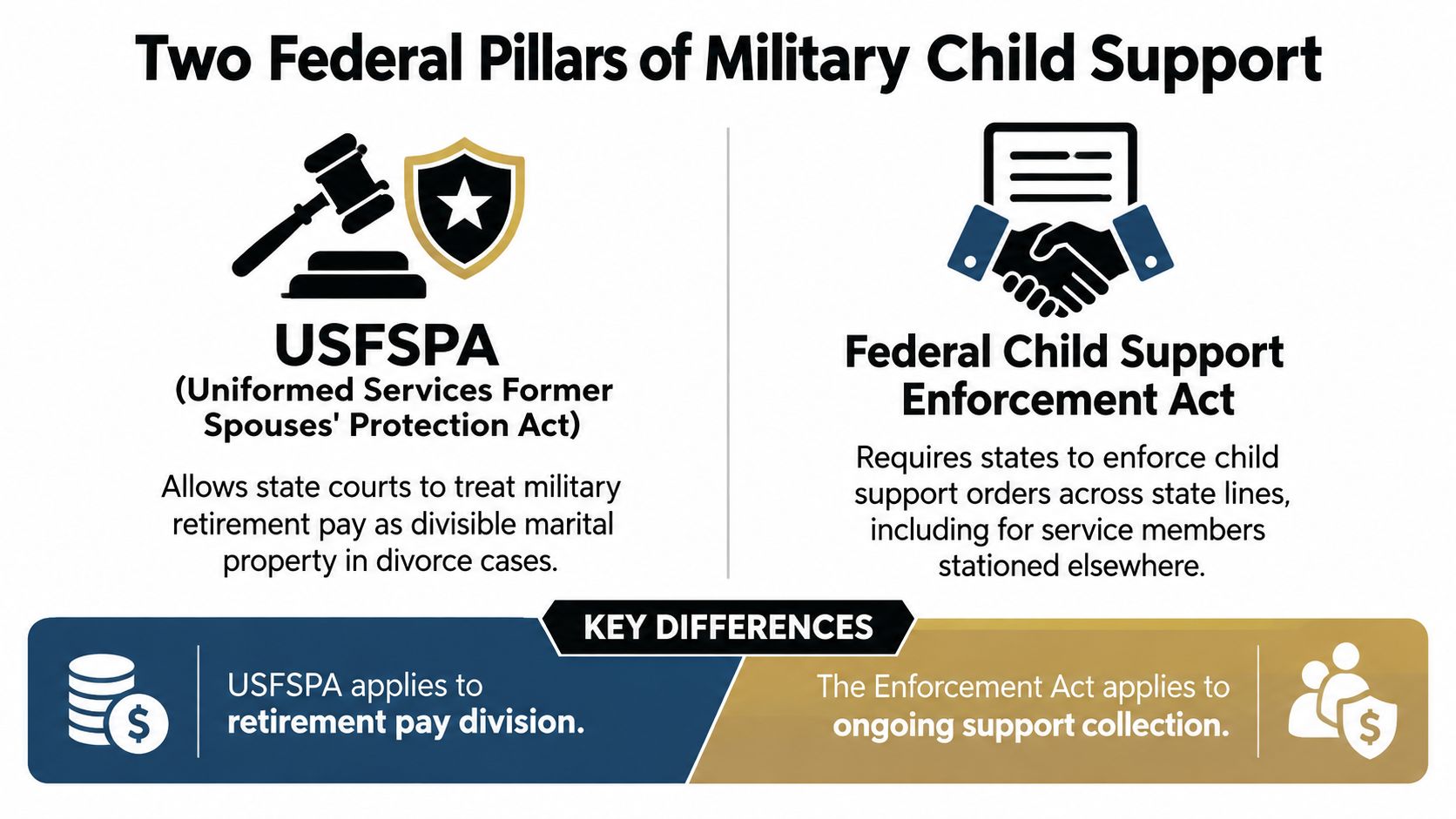
What each law does in your case
| Law | Primary purpose | Effect on child support |
|---|---|---|
| USFSPA | Addresses military retired pay and certain former-spouse enforcement rights | Can support collection through DFAS when the court order and application meet federal requirements |
| SCRA | Protects an active-duty member's ability to participate in litigation | Can affect notice, hearings, and default procedures, but doesn't erase support obligations |
| Federal interstate enforcement law | Helps agencies coordinate support across state lines | Supports locating parents, establishing orders, and enforcing support when a parent lives elsewhere |
You should also separate disposable pay from total compensation. Taxes, authorized deductions, allotments, competing support orders, housing allowances, special pay, and other income details may affect the amount available for withholding. The court may determine the legal obligation under Texas law, while DFAS applies federal processing rules to the amount it can take from military pay.
The Texas waiting period remains a separate state-law issue. The Texas 60-Day Divorce Waiting Period explains why a Texas divorce cannot finalize in under 60 days, subject to the statutory domestic-violence exception.
A properly handled case coordinates these laws rather than treating them as substitutes. USFSPA may matter to retirement or former-spouse payments. The SCRA may matter to participation and timing. Texas law still supplies the family-law framework for support, custody, and property division.
Filing for Divorce in Texas as a Military Family
An overseas assignment doesn't automatically end Texas residency. Texas generally permits a spouse to file when Texas has been the home state of either spouse for at least six months, and the filing county has been the home county of either spouse for at least 90 days. Those rules can apply even when the service member is stationed outside the state.
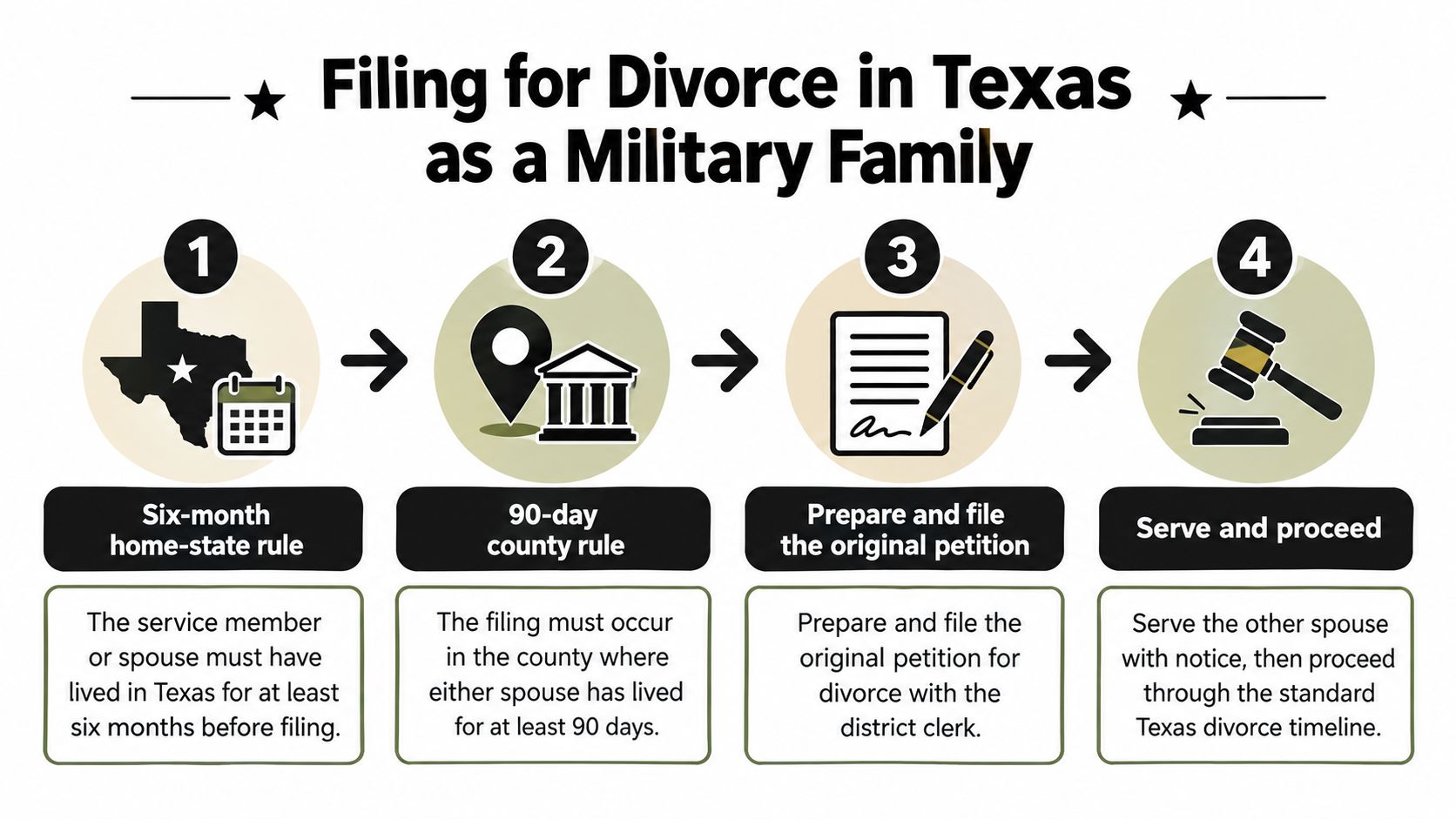
The Texas process in practical order
Confirm residency and venue. Review where each spouse has lived and which county meets the home-county requirement. Filing in the wrong county can create avoidable delay and expense.
Prepare the petition. The original petition identifies the marriage, children, property, requested relief, and any temporary orders you need. Military status and deployment concerns should be raised early when they affect notice or scheduling.
Provide legal notice. The other spouse may be formally served or may sign a waiver when appropriate. A service member who is deployed still needs proper notice and a meaningful opportunity to participate.
Request temporary orders when needed. Temporary orders can address possession, child support, temporary support, use of property, debt payments, and other immediate needs while the case continues.
Exchange information and negotiate. Discovery may be necessary for military pay records, retirement points, allowances, bank accounts, businesses, investments, and debts. Mediation can resolve issues privately, but you shouldn't sign an agreement without understanding how DFAS will process it.
Finish with a prove-up or hearing. The judge reviews the agreement or evidence and signs the final decree. The decree should address support, custody, property, retirement interests, arrears, and payment mechanisms with precision.
Texas generally requires a minimum 60-day waiting period before the court can grant the divorce, although a domestic-violence exception may apply. Deployment can make service, discovery, mediation, and hearings harder to schedule, so early planning matters more than counting calendar days.
For business owners and high-value estates, the filing stage is also when you should protect records and identify assets. Military retirement, disability-related income, businesses, real estate, investment accounts, and restricted compensation may require different treatment. A rushed agreement can create years of payment and enforcement problems.
Calculating Child Support and Running Into Federal Caps
Texas determines the child-support obligation under state law. The court examines the obligor's net monthly resources and applies the Texas Family Code framework, along with factors such as the children's needs, custody arrangement, healthcare, childcare, and available income.
Military compensation requires a careful income review. Base pay may be only one part of the financial picture. Housing allowances, special pay, bonuses, civilian earnings, retirement pay, and other recurring resources may affect the support analysis. The correct calculation is not necessarily the same as looking at a single leave-and-earnings statement.
The legal obligation and the collection ceiling
Federal limits can restrict how much DFAS collects from military pay at one time. DFAS identifies a 50% maximum for USFSPA payments. When a Title 42 income-withholding order is also involved, total payments may reach 65% of disposable income. These figures come from DFAS guidance on federal payment limits: military pay collection limits.
Those limits don't tell the Texas court what support should be ordered. They limit collection through a federal payment mechanism. If the order requires more than DFAS can withhold at that moment, the unpaid balance may become arrears rather than disappearing.
Taxes, authorized allotments, and competing support obligations can reduce disposable income. A deployment may also change housing or special pay. You need to distinguish current support from arrears and identify which obligation is being collected through which order.
The cap limits a payment channel. It doesn't rewrite the underlying Texas support order.
A decree should state the obligation clearly, identify effective dates, and address arrears with enough detail to avoid later disputes. If property division includes military retirement, review the drafting issues discussed in military pension division in a Texas divorce. Retirement property, child support, and spousal support are related in collection planning, but they aren't the same legal right.
How DFAS Withholding Actually Works
A divorce decree ordering a service member to pay child support is generally not enough for DFAS to begin withholding. DFAS requires an income-withholding or income-deduction order directed to the government as employer.
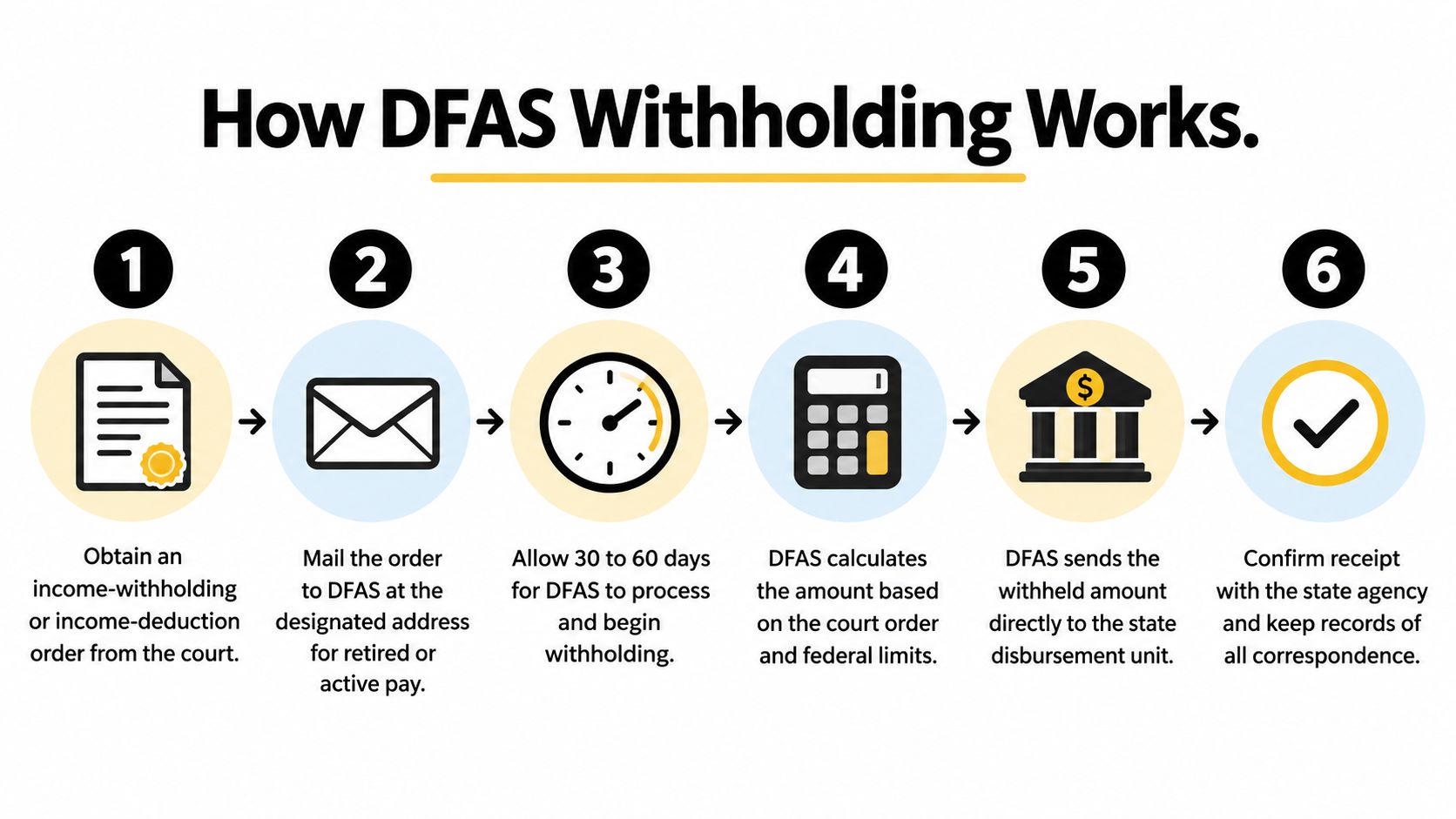
The paperwork sequence
Direct the order correctly. The order must identify the government as the employer and meet DFAS requirements. A decree that only tells the member to pay doesn't perform the same function.
Use certified or acceptable documents. Obtain the required certified court order or other acceptable withholding paperwork. Confirm the current DFAS submission instructions before mailing anything.
Identify the receiving agency. State the correct child-support disbursement unit so withheld funds go to the right account instead of becoming trapped in an administrative mismatch.
Confirm pay status. Determine whether the obligor is active duty, Reserve, Guard, retired, or receiving military pay alongside civilian earnings.
For active-duty pay, withholding is divided between the 15th and the first of the month, with remittance generally made on the first. Reserve or Guard withholding can be taken from the first pay received during the month and supplemented from later pay dates when necessary.
DFAS states that it doesn't charge a fee for honoring child-support withholding orders, including arrears. When the obligation changes, you must submit a formal modification or termination order. A civilian pay statement alone doesn't tell DFAS to stop reserve-pay withholding.
Keep copies of the decree, withholding order, proof of service, DFAS correspondence, state-account statements, and payment records. The parent receiving support should compare the state disbursement record with bank deposits. The parent paying support should review each deduction and raise discrepancies promptly.
Why Collection Often Breaks Down During Status Changes
The largest practical risk may not be a parent's refusal to pay. It may be administrative fragmentation between DFAS, a state registry, and a civilian employer.
A reservist can move from active duty to civilian employment, return to activation, or change pay status during a deployment cycle. DFAS explains that when support begins coming from a non-DoD civilian paycheck, the enforcement agency must send notice to terminate military-pay withholding. DFAS can't stop a reserve-pay deduction merely because someone provides a civilian pay statement.
Build a written transition plan
When military status changes, identify these items in writing:
Who redirects withholding. Name the Texas child-support agency, state disbursement unit, DFAS office, or other agency responsible for each notice.
Which obligation is current. Separate ongoing monthly support from arrears, reimbursement claims, medical expenses, and property payments.
When the change takes effect. Record the activation, demobilization, employment, and withholding dates rather than relying on verbal explanations.
How duplicate payments will be handled. If civilian and military deductions overlap temporarily, preserve every pay stub and request an account reconciliation.
What terminates the old order. Obtain formal written confirmation. Don't assume that a new employer or agency has notified DFAS.
A DFAS deduction also doesn't automatically modify the underlying Texas order. If income changes, you may need a Texas modification. If the amount collected exceeds or falls short of the ordered amount, the state account still needs to be reconciled.
For service members facing participation problems, the Servicemembers Civil Relief Act and Texas divorce provides related information. The practical lesson is simple: every status change needs a paper trail, a responsible agency, and a confirmed effective date.
Enforcement Across States and During Deployment
Military families often cross state lines. The Uniform Interstate Family Support Act, or UIFSA, allows state and tribal agencies to locate an absent parent, establish support, establish paternity, and enforce orders across state boundaries. That can help when a Texas parent lives elsewhere or a service member is stationed outside Texas.
You should identify the controlling order and notify the appropriate enforcement agency when the obligor changes residence or employment. Interstate enforcement works best when the agencies have current addresses, employer information, military status, Social Security information, and accurate account records.
Deployment changes parenting logistics, not automatically support
Deployment may change possession, travel, communication, childcare, and reimbursement expenses. It doesn't automatically reduce child support. Military pay, housing allowances, hazardous-duty compensation, and civilian income can change in different directions, so you need current financial records before requesting a modification.
Document:
- substitute childcare and transportation costs;
- travel required for possession exchanges;
- temporary caregivers and communication arrangements;
- changes in allowances, special pay, or civilian employment;
- missed possession caused by orders rather than choice;
- medical, school, and activity expenses paid by each parent.
A temporary deployment order may address immediate parenting arrangements without permanently changing the final support obligation. If the change is substantial and legally recognized, request a Texas modification rather than informally reducing payments.
Military-connected survivors may need remote testimony, trauma-informed procedures, and safety-related relocation. A parent who relocates for safety should promptly discuss protective orders, notice, possession, and support with counsel. Remote access can help a deployed parent participate, but the court still needs reliable notice and evidence.
The strongest approach protects both the child's stability and the service member's procedural rights. Don't treat deployment as either an automatic excuse or an automatic reason to deny reasonable temporary arrangements.
Your Next Steps and How We Support Texas Families
Your case should align three separate pieces:
- A Texas court order that addresses custody, support, property, arrears, and retirement interests clearly.
- A properly directed income-withholding order that tells the government as employer what to withhold.
- Current DFAS and state-agency records that reflect whether the obligor is active duty, Reserve, retired, or earning civilian income.
Federal caps may limit collection from military pay, but they don't erase a valid Texas obligation. Keep the order, pay records, account history, and status-change notices together, and request formal updates when income or employment changes.
The Law Office of Bryan Fagan, PLLC helps Texas parents and service members address divorce, custody, child support, military retirement, mediation, modification, and enforcement issues. Schedule a free consultation when you need a legal review of the order, DFAS paperwork, deployment concerns, or a high-value property division.
The Law Office of Bryan Fagan, PLLC can review your Texas military divorce, child-support order, pay status, arrears, and DFAS withholding documents so you understand what is owed and how collection should work. Visit Law Office of Bryan Fagan, PLLC to schedule a free consultation and discuss a practical path forward.


