 Skip to content

In most cases, you can't sue your spouse in Texas just for cheating. Adultery is a fault ground inside your divorce, where it can affect property division, rather than a separate lawsuit for money damages.
You may be reading a hotel charge or an unfamiliar message right now, wondering how much of your shared life paid for the affair. Your hurt matters, but protecting your finances starts with separating what you suspect from what you can prove.
The Short Answer on Suing Your Spouse in Texas
If you find evidence of an affair and want to know whether you can sue your spouse, separate two questions: whether the marriage can end based on adultery, and whether the affair creates a separate claim for money. Texas generally does not allow a standalone lawsuit for damages just because a spouse was unfaithful. The financial path is usually within the divorce, where you can raise community funds spent on the affair as part of property-related claims.
Under Texas Family Code section 6.003, a court may grant a divorce in your favor when your spouse committed adultery. That provision gives the court a recognized ground for divorce. It does not, by itself, require your spouse to pay you damages.
Cheating-Related Legal Options in Texas
| Legal Action | Available in Texas? | Where It Is Handled |
|---|---|---|
| Suing your spouse for money damages for adultery | No | Not a standalone claim; adultery is a divorce ground |
| Alienation of affection against the affair partner | No | Not available in Texas; see the historical overview of alienation of affection |
| Criminal conversation against the affair partner | No | Not available as a claim in Texas |
| Fault divorce based on adultery | Yes | Inside the divorce under the adultery provision |
| Reimbursement for community funds spent on an affair | Yes | Requested inside the divorce through financial-misconduct and property-division claims |
| No-fault divorce on insupportability | Yes | Inside the divorce, without proving adultery |
Judges divide property according to fairness and evidence, not according to who was wronged. An affair does not trigger a fixed financial penalty or guarantee a larger share of the estate. The court considers the property, financial records, and circumstances presented when deciding a fair division.
For example, evidence that shared money paid for affair-related expenses may matter to the financial claims raised in the divorce. Keep records of charges and other transactions, and discuss how they were paid with your lawyer. The key distinction is that the affair itself does not produce an automatic payment, while documented use of community funds may be relevant to the divorce outcome.
The rules for claims involving an affair partner are covered separately. For your own case, focus first on what the available records show about shared money and the relief you can request in the divorce.
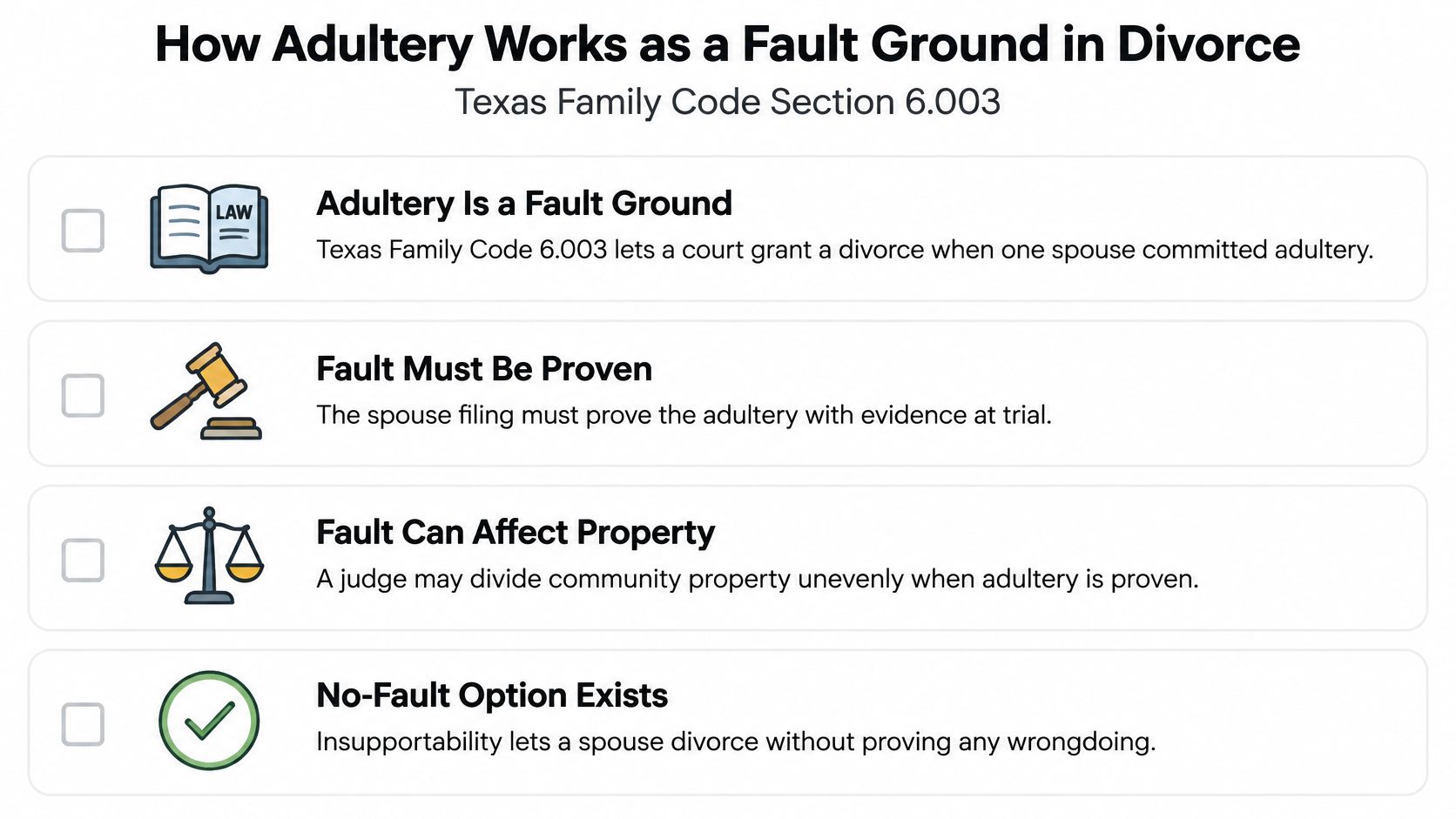
How Adultery Works as a Fault Ground in Divorce
A fault ground is the reason you ask the court to end your marriage based on your spouse's conduct. Proving that reason doesn't, by itself, prove that you're entitled to additional money.
The Texas Family Code's divorce provisions recognize adultery under section 6.003 and insupportability under section 6.001. With insupportability, you explain that conflict has destroyed the marital relationship and reconciliation isn't reasonably expected, rather than proving wrongdoing.
This checklist separates the ground for divorce from the evidence and financial questions.
What proof looks like
Adultery generally means a voluntary sexual relationship with someone outside your marriage. Suspicion, flirting, or an emotionally close friendship doesn't necessarily establish that relationship.
You may rely on direct evidence or circumstances that reasonably establish what happened. Your lawyer needs to assess whether records are authentic, lawfully obtained, and admissible.
Useful evidence may include:
- Messages and social media: Conversations showing the nature of the relationship, not merely contact.
- Hotel and travel records: Reservations and itineraries that connect people, places, and dates.
- Financial documents: Bank statements, card charges, receipts, and transfers.
- Photos and testimony: Images, witness accounts, and admissions obtained during discovery.
Discovery is the formal process for requesting information during your case. It can help obtain records you can't legally access yourself.
Choose a ground you can support
Save complete message threads and original documents. Keep a dated log explaining where each record came from, and give your attorney copies without editing them.
Don't hack accounts, guess passwords, install tracking software, or record private conversations illegally. Confronting the affair partner can also create safety problems and evidence you later regret.
Your choice among the grounds for divorce in Texas should reflect the strength of your evidence and your goals. An adultery claim may make sense when the proof is clear and fault matters to your case. Insupportability may avoid a costly dispute over intimate details when the evidence is thin.
Why Texas Does Not Allow Suits Against the Affair Partner
Texas generally does not let a spouse recover damages from an affair partner just because that person participated in the affair. The legal reason is that Texas does not recognize the civil claims known as alienation of affection and criminal conversation. Together, those theories address interference with a marriage and sexual intercourse with someone else's spouse.
Why another state's rules aren't your answer
Cornell's Legal Information Institute discusses jurisdictions that recognize one or both of these claims, including Hawaii, Illinois, Mississippi, New Mexico, North Carolina, South Dakota, and Utah. That list is a starting point for legal research, not proof that a claim is currently available or that a particular court can hear it.
A claim under another state's law may depend on where the conduct occurred, where the parties live, whether the court has authority over the defendant, and the law in effect when the claim is filed. A plaintiff may also have to show that the defendant caused the marriage to break down, rather than became involved after the relationship had already deteriorated. Proof, filing deadlines, privacy concerns, and constitutional questions can further affect whether a claim is viable.

Separate harmful conduct needs separate review
The affair itself usually does not create a damages claim against the other person in Texas. Separate conduct may still call for legal review, especially if it involves:
- Money transfers: Marital funds or assets moved to the affair partner.
- Threats or violence: Assault, stalking, harassment, or other safety concerns.
- Deception involving property: Conduct that may support a distinct financial claim.
For example, a transfer of marital money raises a different question from whether the affair partner caused the marriage to end. Your attorney can assess what records may support a separate claim and whether the conduct fits a recognized legal basis. Avoid demanding payment or filing in another court before getting advice, and raise any immediate safety concerns with your lawyer.
How Cheating Can Shift Property Division
Suppose Maria has been married to Sam for twelve years and discovers that he spent about $18,000 from their joint savings on hotels, dinners, and a trip with someone else. That hypothetical amount is not a typical recovery figure. It gives us a way to follow the money and see what a Texas court may consider.
Your strongest financial question is how the court should account for community money that no longer exists.
Separate the missing money from the emotional harm
Texas Family Code section 7.001 directs the court to divide the marital estate in a “just and right” manner. In plain English, the judge aims for a fair division, which does not necessarily mean equal shares.
Section 7.009 addresses fraud on the community. If one spouse improperly depleted community assets, the court can determine the loss, calculate the estate as though the money were still there, and fashion appropriate relief.
People sometimes call this reimbursement, but the terms are not interchangeable. Your lawyer can identify whether the facts support a fraud-on-the-community remedy or another reimbursement claim. Neither guarantees repayment of every charge you find.
How Texas Treats Affair-Related Spending
| Type of Spending or Transfer | How Texas Courts Usually Treat It | Evidence You Need |
|---|---|---|
| Joint money spent on hotels, gifts or dinners for the affair partner | Possible financial-misconduct finding and property adjustment | Card and bank statements, receipts, dated timeline |
| Joint money used to buy or improve property for the affair partner | Possible reimbursement or value adjustment | Deed records, payment trail, appraisal |
| Marital assets hidden or moved to the affair partner | Possible fraud on the community claim and property adjustment | Transfer records, timing, sworn disclosures |
| Adultery with no marital money involved | No automatic change to the split | Fault evidence may still be weighed in the overall division |
| Your separate property spent on the affair | Source, ownership, authorization, and available claims require tracing | Account records showing where the money came from |
For Maria, a restaurant charge by itself may show little. Pairing a statement with messages, travel dates, and a hotel receipt may help show who benefited and whether the expense served the marriage. A clear timeline also helps connect the transaction to the surrounding evidence.
Your Texas divorce property division strategy should account for debts, retirement assets, separate-property claims, and funds still available. The amount spent does not automatically determine the amount you receive.
Practical rule: Record the date, amount, account, recipient, and supporting document for each suspicious transaction. Flag any entry you cannot yet tie to a document.
If you own a business or have a high-value estate, valuation may become the larger dispute. Ask early whether a neutral business valuation or property appraisal would help, especially if personal spending passed through business accounts.
Ask your attorney to confirm applicable deadlines and pleading requirements. Waiting can make records harder to obtain and may jeopardize available claims.
Custody, Support and Spousal Maintenance After an Affair
Your spouse's behavior as a partner and behavior as a parent aren't automatically the same legal issue. You can be seriously hurt by the affair while still needing a parenting arrangement focused on your child's safety and stability.
Under Texas Family Code section 153.002, your child's best interest controls custody decisions. Adultery alone generally doesn't determine who receives decision-making authority or parenting time.
Show how conduct affects your child
Your judge needs parenting facts, not just evidence of betrayal. Relevant concerns may include neglected school pickups, exposure to unsafe people, missed medical care, or conflict that harms your child's well-being.
Compare a parent who maintains routines and communicates calmly with one who asks the child to spy, carry hostile messages, or reject the other parent. Your response to the separation can matter independently of who caused it.
- Document specific incidents: Record missed exchanges, safety concerns, and effects on your child.
- Protect adult boundaries: Don't share intimate evidence or ask your child to choose sides.
- Preserve stability: Keep school, medical care, and everyday routines as consistent as possible.
Keep support questions separate
Child support follows Texas guidelines and financial circumstances, not a punishment scale for cheating. Your attorney should review income, resources, insurance, and any grounds for departing from the guidelines.
Texas Family Code section 8.051 governs eligibility for court-ordered spousal maintenance. You must satisfy the applicable property, income, and qualifying-circumstance requirements, which can involve disability, caregiving responsibilities, marriage duration, or family violence.
An affair alone doesn't establish eligibility. However, don't confuse eligibility with the later decision about an award: marital misconduct, including adultery, can matter when the court evaluates maintenance after eligibility is established.
You can address custody, support, and enforcement disputes through mediation where appropriate. Later changes may support modification, but an existing order remains binding until it's changed; enforcement addresses noncompliance rather than rewriting the order.
Before You File in Texas
Your first questions are whether you can file in the chosen court and how you'll protect reliable evidence. Preparation gives you options without forcing you to decide every disputed issue immediately.
Prepare your filing decisions
- Confirm residency. Generally, either you or your spouse must have lived in Texas for at least six months and in the filing county for at least ninety days. Ask counsel to check exceptions and filing location before submitting paperwork.
- Build a lawful timeline. Gather records from your own accounts and documents you may legally access. If you're considering professional evidence gathering, Private investigator services from Sentry Private Investigators Ltd illustrate that type of service; ask your Texas attorney about local licensing, lawful methods, and relevance before hiring anyone.
- Inventory your finances. List assets, debts, accounts, and suspected transfers. How Property Is Divided in a Texas Divorce explains just-and-right community-property division in greater depth.
- Choose supportable grounds. Discuss whether a fault allegation advances your goals or whether no-fault grounds offer a more practical route.
Prepare for resolution
- Plan for mediation. Local requirements matter: Bexar County court materials require jury-docket cases to be mediated no later than 45 days before trial and describe orders identifying the mediator, fee allocation, deadline, and sanctions. Mediation provides a generally confidential setting for negotiation, not a requirement to forgive or surrender valid claims.
- Get individual advice. Alongside counseling and financial planning, you can book a free consultation with the Law Office of Bryan Fagan, PLLC. You can discuss in-person or virtual options serving Houston, Dallas-Fort Worth, Austin, San Antonio, and surrounding counties.
Bring your essential settlement terms, especially those protecting your children, business, retirement, and future financial stability.
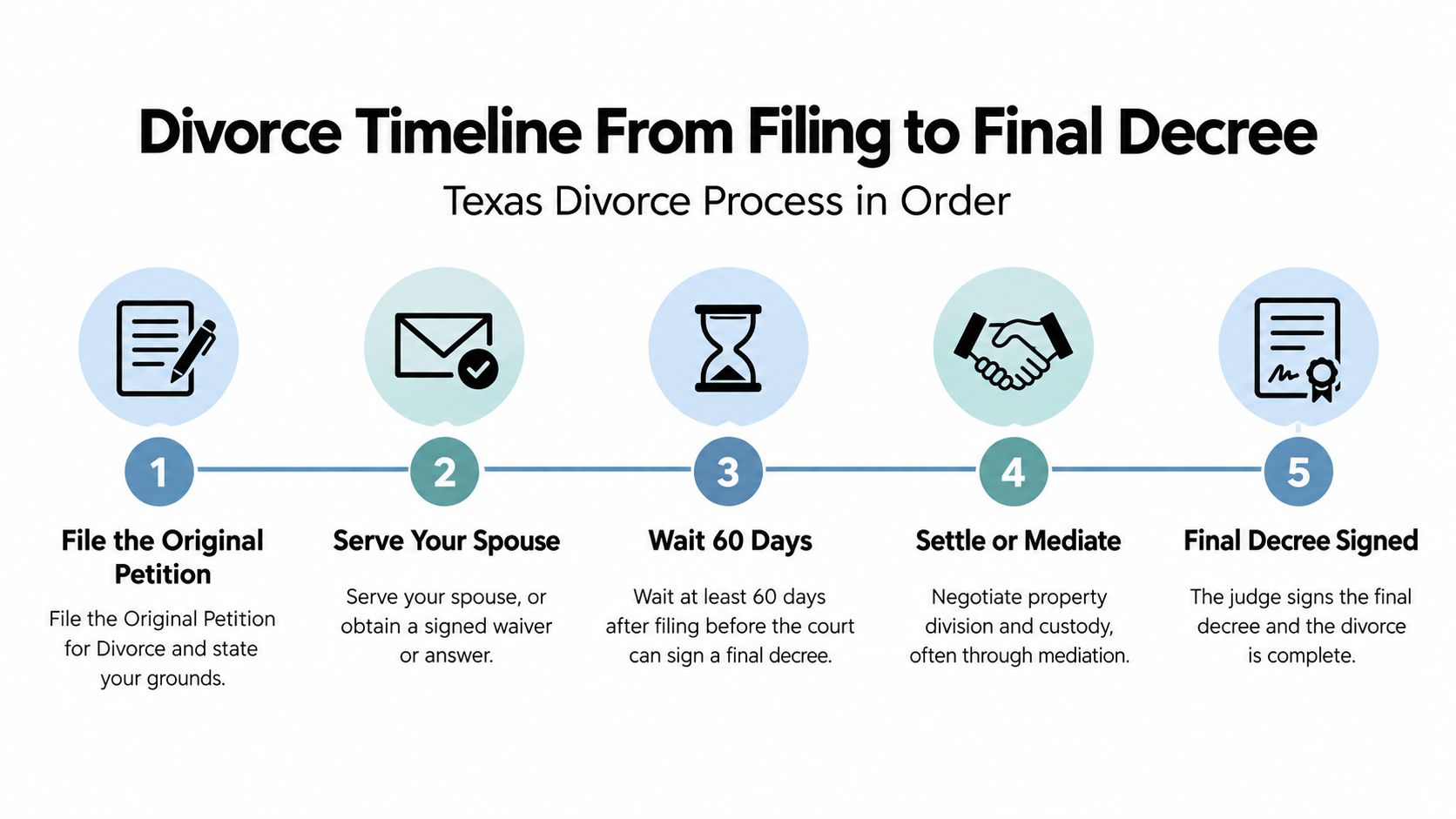
Divorce Timeline From Filing to Final Decree
Your divorce follows a court process, even when the affair feels urgent. This visual outlines the major stages; the detailed steps also include temporary protection, financial disclosure, and filing the signed decree.
From petition to court approval
- File your Original Petition for Divorce. State your grounds and request appropriate relief.
- Arrange service. Your spouse must receive proper legal notice, or the case must proceed through an appropriate waiver or answer. Service problems can delay progress.
- Account for the waiting period. Texas court divorce instructions describe a minimum 60-day waiting period, with finalization generally available after the 61st day, subject to limited exceptions.
- Request temporary orders if needed. You may need interim arrangements for parenting, support, bills, or use of property while the case remains pending.
- Exchange financial information. Disclose assets, debts, retirement accounts, and relevant records. Missing documents and disputed valuations often slow this stage.
- Negotiate or mediate. Bring your inventory and supporting evidence so you can evaluate proposals against actual financial information.
- Prepare the Final Decree of Divorce. Your decree should clearly address property, debts, parenting, and support, along with any additional documents needed to carry out the agreement.
- Present your case to the judge. An agreed case may use a brief prove-up process; unresolved disputes may require a final hearing or trial.
- Confirm filing of the signed decree. Make sure the signed order is filed with the district clerk, and obtain a copy for your records.
Plan for delays and your own well-being
The minimum waiting period isn't a completion promise. Custody disputes, protective-order issues, retirement paperwork, and business appraisals can extend your Texas divorce timeline.
For emotional support between legal appointments, you may find the divorce coping strategies from DeTalks useful alongside counseling and support from people you trust.
You can also use this video as an additional educational resource.
Key Takeaway
You generally can't sue your spouse in Texas merely for cheating, but you can pursue appropriate relief within your divorce. Preserve lawful evidence, trace missing community funds, and make decisions that protect your children and financial future.
You don't have to handle an affair and divorce alone. Visit Law Office of Bryan Fagan, PLLC to schedule a free consultation about your evidence, property concerns, and parenting needs, and get guidance on the next steps in your Texas divorce.


