 Skip to content

You're staring at a report about your business, your finances, or your child, wondering how a judge will know whether to trust it.
What Expert Witness Testimony Means for Your Case
Your spouse says the family business earned far less than its bank deposits suggest. You have statements and tax returns, but explaining the difference requires more than handing the judge a stack of paper.
Expert witness testimony is an opinion from someone with specialized knowledge, training, or experience who helps the court understand a disputed fact. You might need that help when financial records, medical findings, or a child's developmental needs aren't easy to interpret.
An ordinary witness describes what they saw or heard. An expert acts more like a translator, explaining what those observations or records mean.
Turning records into an explanation
For example, you might testify that your spouse moved money between business and personal accounts. A forensic accountant could trace those transfers, distinguish sales revenue from loans, and explain whether the records support the income your spouse reported.
That distinction matters. A deposit isn't automatically profit, and a transfer isn't automatically hidden income. You need an explanation that accounts for the records rather than assuming every unfamiliar transaction proves wrongdoing.
Practical rule: Ask what the expert can explain that the records alone cannot.
The judge still decides the disputed facts. Your expert doesn't take over the judge's role or guarantee that the court will accept your position.
Deciding whether specialized help matters
Texas courts require expert testimony to be helpful, not merely impressive. The court screens the proposed testimony before allowing the expert's specialized opinions to inform its decision.
You can begin with these questions:
- A disputed number: Do you need help explaining business income, asset value, or financial transfers?
- A complicated record: Would someone need specialized training to interpret the evidence?
- A clinical question: Does a diagnosis or developmental issue require more than everyday observation?
You don't need to understand every accounting entry or clinical term yourself. Your next step is to identify the question you need answered, then ask your lawyer whether expert witness testimony would help answer it.
Types of Experts Used in Texas Family Cases
A company's value is disputed, and your child's schedule is contested. Those questions may call for different experts, because a professional's credentials alone do not show whether an opinion is reliable. The fit depends on the connection between the source material, the method used, and the conclusion offered.
| Expert type | What they examine | Typical family-law question |
|---|---|---|
| Forensic accountant | Bank records, tax returns, commingled accounts | Tracing separate property or examining reported income |
| Business valuator | Financial statements, owner compensation, goodwill | Value of a closely held company for property division |
| Economist | Income history, financial projections | Long-term income and financial impact |
| Vocational expert | Job skills, labor market, earning capacity | Whether a spouse could earn more than reported |
| Child psychologist | Child development, attachment, emotional needs | What schedule suits a child's age and needs |
| Custody evaluator | Parent-child relationships, home visits, testing | Conservatorship and possession recommendations |
| Forensic psychologist or psychiatrist | Diagnoses such as PTSD, treatment history | How a condition affects parenting or decision-making |
| Treating physician | Medical history, injuries, prognosis | Medical needs or health-related support claims |
Similar titles don't mean identical roles
A forensic accountant may trace business funds without valuing the company. A business valuator may estimate its value but need reliable records or separate accounting analysis to support the estimate. If a company is part of your property dispute, understanding business valuation in a Texas divorce can help you identify the assignment your case may require.
The distinction matters for child-related experts, too. Your child's psychologist can explain treatment observations and emotional needs. A custody evaluator has a broader role, examining family relationships and potentially making recommendations rather than treating your child.
Match the assignment to the dispute
Suppose your spouse reports little income while running a busy professional practice. A forensic accountant could examine the financial records, while a vocational expert could assess earning capacity. Which one comes first depends on the question: if the records do not explain income, begin by clarifying the financial picture; consider vocational analysis if the dispute is about what your spouse could earn.
If both the business's value and your child's needs are disputed, sequence the work around what each opinion must establish. Start with the financial expert if a reliable business value depends on reviewing company records. Then decide whether a child-focused professional is needed to address a separate question about development or family relationships. This keeps each assignment tied to its evidence and conclusion, instead of treating credentials as proof that an opinion fits your case.
You can check that bridge with your lawyer: what information will the expert use, what method will be applied, and how does that method support the proposed conclusion under Texas standards?
When Your Case Needs an Expert Witness
A closely held business, unexplained transfers, disputed earning capacity, or concerns about your child's needs can justify discussing expert help early. The important question isn't how upset you and your spouse are. It's whether specialized analysis would help resolve something material.
For a business owner, that might mean separating business expenses from personal spending. For a parent, it might mean understanding whether a proposed possession schedule fits a child's treatment needs.
Financial documents can provide a starting point for that discussion.

Financial disputes that deserve a closer look
You may benefit from expert help when you're dealing with:
- A business or professional practice: You need a supportable value rather than competing guesses.
- Mixed funds: Separate and community funds have moved through the same accounts.
- Disputed income: Reported earnings don't appear to match available financial records.
- A complex estate: Business interests, investments, and transfers require coordinated analysis.
For example, an inherited account may later receive wages and fund household purchases. Rather than assuming everything in the account has the same character, you can ask counsel whether tracing work would clarify the evidence.
An expert can analyze the transactions. Your attorney must connect that analysis to the property questions the court needs to decide.
Parenting concerns require careful connections
Under Texas Family Code § 153.002, your child's best interest is the court's primary consideration in conservatorship and possession decisions. In plain English, your evidence should explain how a proposed decision serves your child, not merely why you distrust the other parent.
A mental-health diagnosis alone doesn't answer that question. If PTSD is raised, for example, the useful inquiry concerns symptoms, treatment, daily functioning, and any supported effect on parenting.
Your lawyer can help you understand how parent psychological evaluations affect Texas custody decisions without treating a diagnosis as an automatic finding of parental unfitness.
A useful parenting opinion explains a child's needs and the evidence behind the recommendation. It doesn't rely on a label alone.
You may not need an expert if your divorce is uncontested, your assets are straightforward, and you agree on parenting arrangements. Ask whether the judge needs specialized help understanding a number, record, or condition to decide fairly. If so, bring that issue to your lawyer before deadlines become urgent.
How Texas Courts Decide Whether an Expert Can Testify
Suppose a business appraiser has years of experience and uses a sound valuation method. If the appraiser's records omit a major liability, the calculation may still rest on faulty inputs. That is the gap Texas courts examine: credentials matter, but the opinion must also be useful and reliably connected to the evidence.
Texas Rule of Evidence 702 asks whether a witness is qualified by knowledge, skill, experience, training, or education, and whether specialized testimony will help the judge or jury understand evidence or decide a disputed fact. The Texas Supreme Court's discussion of expert usefulness explains that expert testimony may add little when jurors can assess an issue through ordinary experience. An expert also cannot replace the court by telling it what the law means.
Qualifications are the starting point
A résumé can show that an expert has relevant experience. It does not establish that the expert's specific opinion is dependable. For example, a valuation expert may be qualified and use an accepted method, yet rely on an outdated income statement that leaves out a recent business debt. You and your lawyer can check the bridge from source records, to method, to conclusion.
| Standard | Where it applies | Core question |
|---|---|---|
| Texas Rule of Evidence 702 | Texas civil cases, including divorce and custody | Is the witness qualified, and will the testimony help the judge or jury? |
| Robinson reliability test | Scientific testimony in Texas state courts | Is the underlying science reliable and appropriately applied? |
| Daubert standard | Federal courts; persuasive rather than controlling in Texas state court | Does the proposed testimony rest on reliable principles and methods? |
The Robinson test helps Texas civil courts assess whether scientific testimony is reliable. Courts may examine the principles behind the opinion and how the expert applied them. The practical question for your case is whether the expert's sources and reasoning support the conclusion, not merely whether the expert has impressive credentials.

A Kelly row sometimes appears in Texas-law discussions because it addresses reliability in Texas criminal cases. It is not the usual screening framework for a Texas family case, so focus your questions on Rule 702 and the civil standards that apply to the opinion at issue.
Federal decisions, including Daubert v. Merrell Dow Pharmaceuticals, Inc. and Kumho Tire Co. v. Carmichael, offer context for expert screening. The official Rule 702 text and historical notes set out the federal rule. In a Texas state divorce or custody case, the court applies Texas law; the federal framework does not automatically control.
Ask your lawyer to identify which Texas standard fits the type of opinion, such as scientific testing, financial modeling, or clinical judgment. Then review whether the expert's records are complete, the method suits the question, and the conclusion follows from the work. These checks help you understand what the opinion can support and where its limits lie.
Keep legal conclusions out of the expert's assignment
An accountant can explain how funds moved and show the calculations supporting that analysis. Your attorney addresses how the law applies, and the judge decides the legal issues. A report declaring that your spouse must lose a property claim crosses that boundary. A useful report identifies its records, explains its reasoning, and stays within the expert's field.
How Expert Testimony Moves From Hiring to Trial
You can make expert work more manageable by treating it as a scheduled part of your divorce, not an emergency task before trial. Your lawyer should coordinate the assignment with discovery, settlement discussions, and the court's deadlines.
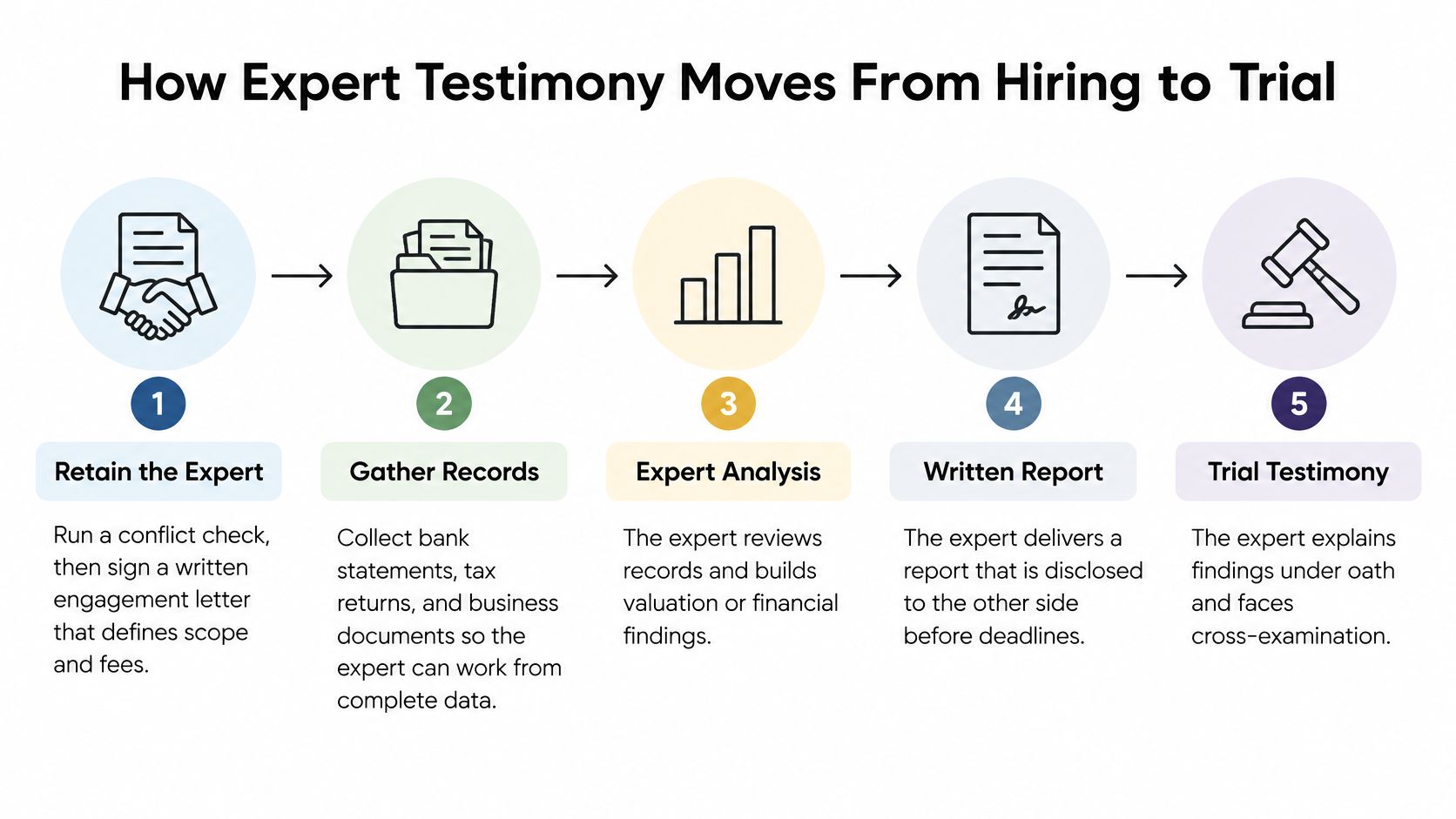
This visual summarizes the main stages of expert work.
Build the expert's assignment deliberately
Retain the expert after a conflict check. Ask for a written engagement letter describing the assignment, fees, and expected deliverables. For example, specify whether your accountant will trace an account, investigate income, or also address business value.
Gather the necessary records with your attorney's guidance. Bank statements, tax returns, business financials, school records, medical records, and parenting history may matter, but sensitive information should be collected and shared through an appropriate process.
Review the analysis and written report. Ask the expert to identify missing records, important assumptions, and limitations. You need an honest explanation of uncertainty, not language that sounds more confident than the evidence allows.
Make the required expert disclosures on time. Under Texas Rule of Civil Procedure 194.5, expert discovery addresses identifying information, subject matter, opinions, and their basis through the permitted procedures.
Prepare for the expert's deposition. The other side's lawyer can question the expert about the analysis and supporting facts. If you seek affirmative relief, a retained, employed, or controlled expert must be made available for deposition as the rule requires.
Address any admissibility challenge before trial according to the court's schedule. Your lawyer may need to defend your expert's qualifications and reliability or challenge an opposing opinion through a motion to exclude.
Use reliable analysis in mediation. A supported valuation can help you compare settlement proposals rather than bargain from guesses. Before signing, confirm that the agreement addresses how any valuation will translate into the actual property division.
Present the testimony at trial if settlement doesn't resolve the dispute. Your expert explains the work under oath and faces cross-examination, while your lawyer connects that testimony to the issues the court must decide.
Fit expert work into the divorce timeline
Your overall case still moves from filing, through service or waiver, necessary disclosures and discovery, negotiation or mediation, and preparation of the final decree. An expert's report doesn't replace those procedural steps.
For example, agreeing on a company's value doesn't itself transfer ownership or resolve how a payment will be made. You still need settlement terms or a court ruling reflected in an appropriate decree.
For another way to review the court process, you can use this video alongside your questions for counsel.
Texas generally requires a 60-day waiting period from filing before a divorce may be granted, subject to limited exceptions involving matters such as family violence or protective orders. Under Texas Family Code Chapter 6, that minimum doesn't eliminate the remaining work needed to finish your case.
The same chapter's § 6.602 makes a divorce mediated settlement agreement binding when it contains the required prominent non-revocation language and proper signatures, including attorneys who are present. Signing alone isn't the whole test.
Expert work can take substantial time when records are missing or analysis is contested. Plan around your actual discovery and court schedule, not just the waiting-period minimum.
What Expert Witnesses Cost and How to Budget
In 2024, the median hourly fee for both deposition and trial testimony was $500, according to Trial Witness's report of SEAK's survey covering 1,633 experts. That's a benchmark, not a quote for your case.
Your engagement should explain the expert's actual rates and billing policies. Specialty, location, record quality, and the scope of the assignment can affect the work required.
| Cost item | How it is billed | What drives the total |
|---|---|---|
| Initial file review | Hourly under the engagement terms | Volume and condition of records |
| Report writing | Hourly under the engagement terms | Number of issues and depth of analysis |
| Deposition testimony | Hourly under the agreed testimony rate | Session length, preparation, travel |
| Trial testimony | Hourly under the agreed testimony rate | Testimony, preparation, waiting time |
| Additional testing or site visits | Hourly or flat fee, as agreed | Sessions, travel, and assignment scope |
| Retainer or deposit | Paid upfront under the agreement | Expected scope and billing policy |
Budget for the assignment, not just testimony
A testimony rate doesn't tell you the total cost. Reviewing disorganized statements, reconciling inconsistent records, preparing exhibits, and responding to new information can all require additional work.
Judges have expressed concerns about both expert expense and lack of objectivity, as described in the PwC review of expert-testimony research and Daubert challenges. You can address the expense concern by giving the expert a focused assignment.
For example, a disputed company value may justify detailed analysis because it affects a substantial part of your estate. The same scope may be disproportionate for a minor item that could be resolved through negotiation.
Use practical spending controls
- Define the scope in writing: Identify the questions the expert must answer and what falls outside the assignment.
- Request phase estimates: Separate record review, analysis, reporting, deposition, and trial preparation.
- Ask for itemized invoices: Review what work was performed and why.
- Set a check-in threshold: Require a discussion before the expert exceeds an agreed budget level.
- Avoid duplicate work: Have counsel coordinate professionals when their assignments overlap.
Budget checkpoint: Before authorizing more work, ask what decision the additional analysis could change.
You don't have to choose between unlimited spending and no expert help. Ask whether a narrower initial review could identify the core dispute before you commit to a broader assignment.
Working Well With Your Expert and Surviving Cross-Examination
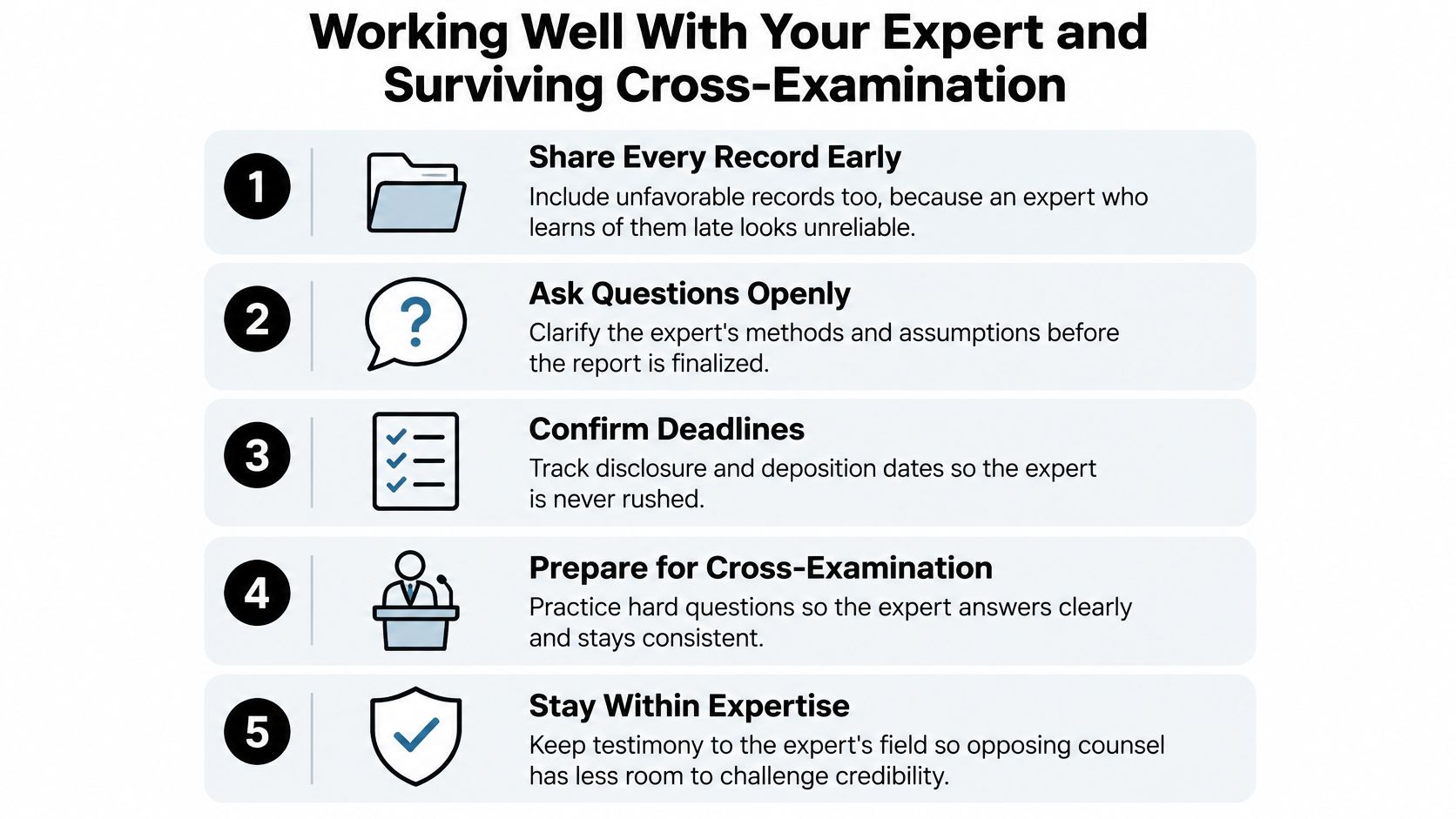
Share unfavorable records early. If a business account includes a loan deposit that might look like income, provide the loan documents before the expert finishes the analysis. A missing record can leave a gap in the explanation and give the other side a reason to question the result.
Audit the source, method, and conclusion
Ask the expert to identify the records used, the method applied, and how that method supports the conclusion. These steps form a bridge: if one part is missing, the final opinion may not follow from the evidence.
For example, suppose a valuation report treats every deposit into a business account as revenue. You provide a bank statement showing a large deposit, and the expert counts it as income. Later, the loan agreement shows that the deposit was borrowed money. The expert must then trace the deposit, distinguish it from sales, and adjust the calculation. If the report never reconciles the deposit against the loan documents, the conclusion rests on an incomplete comparison. Ask what records were checked and how any adjustment changed the result.
Request a written list of material assumptions, too. In a business valuation, these might include owner compensation, personal expenses paid by the company, and facts relevant to separate and community interests. You can then check whether an assumption matches the records you know.
For software-assisted analysis, ask who entered the information, what the tool calculated, and whether a qualified person checked the output. A polished chart is not proof that the inputs were accurate. The expert should be able to explain the process and identify documentation the opposing party can review. The proposed federal evidence-rule changes concerning machine-generated evidence illustrate why questions about software output matter, though a proposal is not an operative Texas rule.
Texas authorities govern your state-court case. The standards discussed in How Texas Courts Decide Whether an Expert Can Testify provide context for evaluating the opinion, without repeating the federal amendment here.
Prepare for questions without scripting answers
Your lawyer can help you understand whether a challenge concerns the expert's method or credibility. An unsupported calculation differs from questions about fees or prior testimony, and the distinction can help you follow the examination.
Review what to expect during cross-examination in divorce court. If you testify about records you gave the expert, answer the question asked, say when you do not know, and avoid guessing. You can identify the bank statement you provided without claiming you personally verified every accounting adjustment. Clear limits make your answers more accurate.
Common Questions About Expert Witnesses in Texas Divorce
Can you use your own doctor or counselor?
Ask your lawyer to check three things: Did the professional observe your child directly? Do their training and experience fit the opinion you want them to give? Would that opinion address treatment or observations, rather than make a broad custody recommendation? A counselor's notes about a child's anxiety, for example, do not by themselves establish which parent should have custody. The source, method, and conclusion must fit together, and confidentiality rules may affect what can be shared.
Who pays the expert?
If you hire the expert, your engagement agreement should spell out your payment obligations. Ask your lawyer whether the court may allocate or order reimbursement in your circumstances. Do not budget on the assumption that the other side will pay.
Does an expert guarantee your result?
No. Ask whether the expert's conclusion follows from the records and method, and what evidence could point the other way. A business valuation, for example, may be challenged if its assumptions do not match the financial records. Credentials matter, but they do not make an opinion conclusive.
Can the judge appoint a neutral expert?
Ask what question the evaluator is assigned to answer, what information they can review, and whether each parent can provide information or respond to it. Find out whether the evaluator will issue a written report, who receives it, and how you can raise factual errors. For example, if the assignment concerns parenting arrangements, clarify whether it covers a specific custody question or a broader evaluation. “Neutral” describes the role, not a guarantee that the conclusion is correct.
Do you need an expert if you expect to settle?
A trial may not be necessary for expert work to help you assess an offer. For example, a business valuation can give you a basis for comparing proposed property divisions. You can explore Divorce Mediation in Texas: How It Works to understand how financial information may be used in negotiations.
How long will the work take?
The schedule depends on the assignment, records, expert availability, and disputed issues. Ask for a case-specific timeline, including when the expert needs documents and when you can expect findings. A divorce waiting period alone does not show whether the work can be completed in time.
Can your expert tell the judge what the law requires?
No. The expert explains specialized findings within the permitted scope. Your lawyer makes legal arguments, and the judge decides what the law requires.
Ask what source supports the opinion, what method connects it to the conclusion, and whether that reasoning fits Texas standards.
Decide If an Expert Fits Your Case and Take Your Next Step
What disputed issue would an expert help the court understand? Start there. If business value, unexplained money, disputed income, your child's specific needs, or a mental-health concern could affect the outcome, discuss it with a family lawyer early. For example, if your spouse's reported earnings conflict with business records, bring the records so your lawyer can help identify what the gap may require an expert to examine.
What to do next
Before your consultation, gather records you can safely access:
- Financial records: Bank and credit statements, tax returns, and business financials.
- Parenting information: Existing orders, custody history, and relevant school communications.
- Sensitive records: Note medical or counseling materials, but share them only as your attorney advises.
- Your main questions: State what you believe is disputed and what decision you need help evaluating.
An expert's credentials alone do not establish that an opinion is reliable. Ask how the proposed assignment connects its sources, method, and conclusion, and how the opinion fits Texas standards. For instance, if an expert values a business, you should understand which records support the valuation and how the expert used them.
You can review How Property Is Divided in a Texas Divorce to understand just-and-right division of community property. Ask how the expert's assignment relates to custody, child support, mediation, or enforcement of existing orders, rather than treating a report as a stand-alone project.
Bring three questions to your consultation: What evidence already answers the disputed issue? What information is missing? How could specialized analysis change the decision?
You can schedule a free consultation with the Law Office of Bryan Fagan, PLLC to discuss whether expert testimony fits your divorce or custody dispute and which records to prepare. In-person and virtual consultations are available for people in Houston, Dallas–Fort Worth, Austin, San Antonio, and surrounding counties. You can handle the next step with a clearer question and the records you have.


