 Skip to content

You've already had the hardest conversation, and now you're staring at forms wondering if agreeing with your spouse is enough to finish this.
You're not alone in that moment, and you don't need to turn a peaceful decision into a courtroom fight. You do need a clear plan, because in Texas an agreed case still follows strict deadlines, notice rules, and judicial review before you're legally divorced.
What an Uncontested Divorce in Texas Really Means
You and your spouse have probably talked through the house, the accounts, and maybe even holidays with the kids. That cooperation matters, but uncontested means more than getting along. It means you agree on every material issue the court must decide and you can put that agreement into a decree a judge can sign and enforce.
If you agree your spouse keeps the house but you haven't decided who pays the mortgage, whether there's a refinance deadline, or what happens if refinancing fails, you don't have a complete agreement yet. The same is true if you say you'll share time with your children but you can't describe the regular schedule, holidays, and exchanges. Small gaps like that are where friendly cases stall.
Who Can File and Where
Before you file anything, check residency first. Either spouse must have been domiciled in Texas for at least six months and lived in the filing county for at least 90 days, as part of the filing sequence described in Texas Family Code Chapter 6 on suit for dissolution of marriage. If you file too early or in the wrong county, the court can't grant the divorce even if everything else is perfect.
Think of residency as the court's permission slip to hear your case. You confirm it before you spend time drafting, not after. That one check prevents a dismissal that has nothing to do with whether you and your spouse agree.
The visual below shows the sequence your case will follow from agreement to signed decree.

The Deadline Controlled Sequence
Treat an uncontested divorce in Texas as a sequence you must complete in order, not a pile of forms you can submit in any order. Each step gives the court something it needs for the next one. Skip or rush a step and the later steps won't work.
- File the Original Petition: You open the case with the district clerk and start the statutory clock. Filing alone doesn't end your marriage.
- Complete service or file a waiver or answer: Your spouse must receive legally valid notice. In a cooperative case, a waiver can replace formal service, but it must be signed correctly.
- Prepare the Final Decree: You convert your agreement into specific, enforceable language covering property, debts, and if applicable, children.
- Wait out the statutory period: You can't finalize until the waiting period runs, no matter how ready your paperwork is.
- Get the judge's signature: You present the case at a prove up or through an authorized local procedure, and the divorce becomes final when the signed decree is filed with the clerk.
Under Texas Family Code §6.702 on the waiting period, a court generally may not grant a divorce before the 60th day after the suit is filed. Texas court self help materials explain that after 61 days have passed from filing, you may seek to finalize, and you're not divorced until the signed decree is filed. Your agreement doesn't waive that timeline.
Practical rule: Signing an agreement with your spouse is the start of finalizing your divorce, not the finish line.
The Waiver Detail People Miss
If your spouse uses a waiver, timing and execution matter. Texas court self help materials for cases with no minor children and no real property state the waiver must be signed before a notary and signed at least one day after the Original Petition is filed. A waiver signed too early, not notarized, or never filed can force you to start notice over again.
That's why I tell clients to measure progress by operational benchmarks, not by how friendly things feel. Has the filing been accepted, is notice valid, has the waiting period expired, and do you have a complete decree ready for signature? If you can answer yes to each one, you're close.
You're also not an outlier for being here. The CDC historical divorce rate series for Texas reported 1.9 divorces per 1,000 residents in 1990 and 5.5 per 1,000 in 2022, although that series doesn't separate contested from uncontested cases. It can't predict your outcome, but it does show you're navigating a common legal process, not an unusual one.
Texas Family Code Sections That Shape Your Case
You don't need to memorize the Family Code, but you should recognize the sections that control your decree. When you understand what a judge is checking, you can draft terms that pass review the first time. That saves you a reset hearing and weeks of waiting.
Section 6.702 controls timing. It sets the general prohibition on granting a divorce before the 60th day and provides limited exceptions tied to family violence. If an exception might apply in your case, you need advice before you file, because safety and timing decisions interact.
Property Division Under Section 7.001
Texas doesn't require a perfectly equal split. Under Texas Family Code §7.001 in Chapter 7 on property division, the court divides the community estate in a manner it considers just and right, considering your rights and your children's needs. In your agreed case, you can propose your own division, but you must describe it clearly enough to enforce.
That distinction helps you. You aren't forced into a rigid formula, but you are responsible for precision. If you want an unequal division because one of you is keeping the house and the other is keeping more cash, spell out the assets, the debts, and the transfer steps so the judge sees a complete plan.
Children and Support Chapters
When minor children are involved, your decree must do more than end the marriage. It should establish conservatorship, possession and access, child support, and medical support in one coherent set of orders. If you can't agree on those issues, the court decides them based on your child's best interests rather than picking one parent's preference.
Spousal maintenance needs the same careful approach. Don't assume long term support is automatic or assume it's never available. Ask whether you or your spouse fits a specific eligibility category, then decide together whether any payment belongs in your agreement or court ordered terms need to be addressed. Guessing here creates regret later.
Choosing the Right Path for Your Case
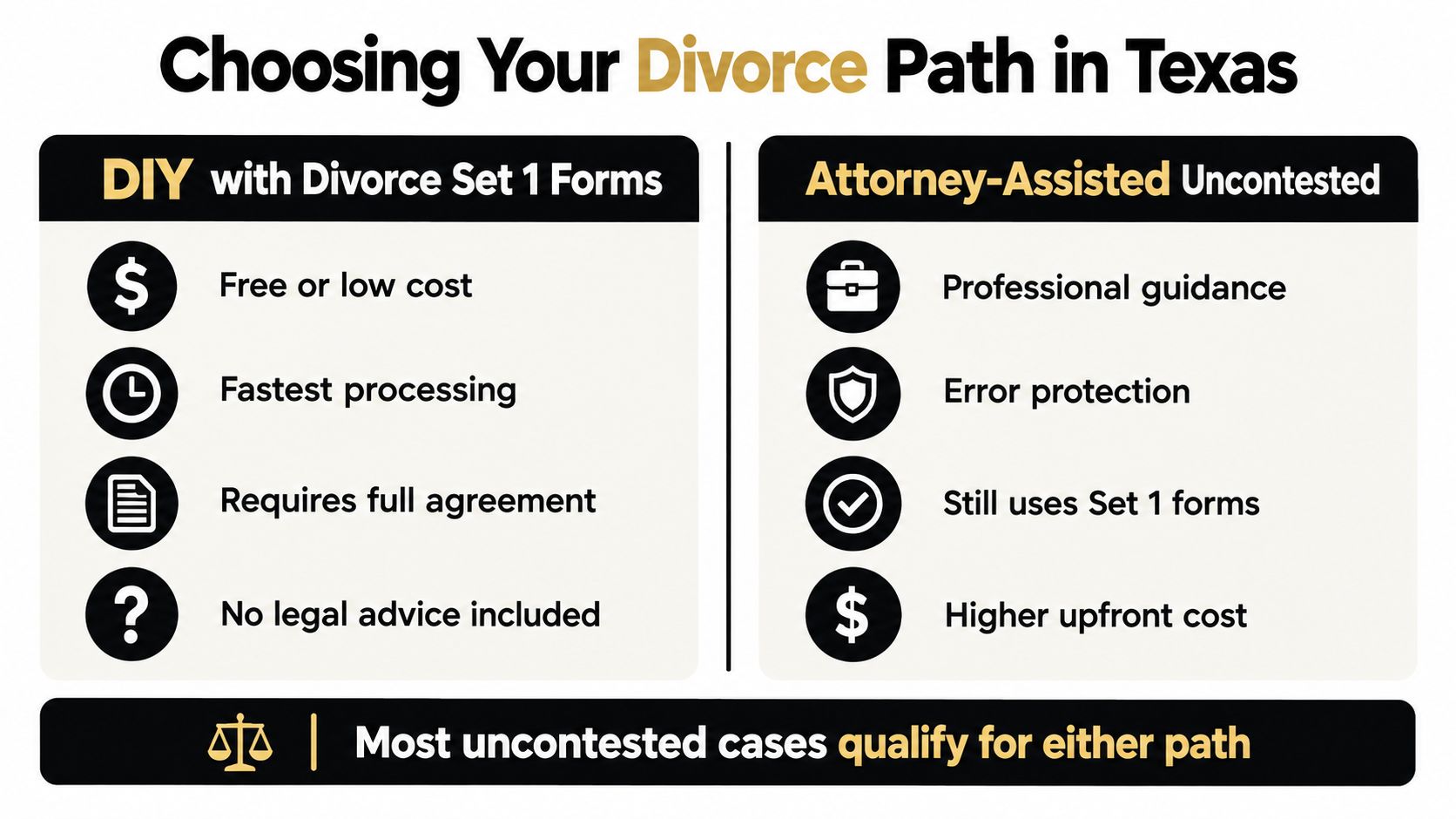
The right path depends on what you own and whether you have children, not on how well you get along. The Texas Supreme Court approved Divorce Set 1 forms are built for a narrow situation only. The State Law Library guide to Texas divorce forms distinguishes those approved forms for cases with no minor children and no real property from other divorce situations.
This comparison helps you see where the do it yourself route ends and professional help should begin.
| Case profile | Recommended path | Watch for |
|---|---|---|
| No minor children, no real property, few accounts, full agreement | DIY with Divorce Set 1 | Waiver timing, blank fields, inconsistent names and dates |
| House, retirement accounts, shared debt, or vehicles to retitle | Limited scope legal review | Title transfers, refinance deadlines, retirement orders, tax duties |
| Children, a business, military benefits, high value assets, or safety concerns | Full representation | Parenting terms, valuation, separate property claims, enforcement risk |
My recommendation is direct. If your case fits the first row exactly, the forms may be enough if you're meticulous. If you're in the second row, pay for a review of your draft decree before you file it, because fixing a signed decree is far harder than fixing a draft. If you're in the third row, don't label your case simple just because you aren't fighting.
If you hit one or two sticking points, mediation can help you reach terms without turning the whole case contested, as explained in Divorce Mediation in Texas: How It Works, which covers why most contested Texas divorces settle in mediation. You can also use that process proactively to close gaps in an otherwise agreed case.
The short video below walks through the decision in plain language if you want to hear it before you choose.
Settlement Terms That Protect You Long Term
Your decree will govern your finances long after the stress of filing fades. Vague language feels kind in the moment and causes fights later. Your job is to turn a handshake into instructions a bank, a title company, a retirement plan administrator, and a future judge can follow without guessing.
Start with a complete inventory. List real property, retirement accounts, business interests, debts with creditors, insurance, tax liabilities, and approximate values, and separate what you claim is separate property from community property. If an asset or debt isn't listed, assume it will create a problem later.
Terms You Should Never Leave Vague
- Real estate: Identify the property, who receives it, who pays the mortgage, the refinance or sale deadline, and what happens if that deadline is missed.
- Retirement accounts: State how each account is divided and whether a qualified domestic relations order or similar order must be prepared after the decree.
- Business interests: Address ownership, control, buyout or sale terms, and how future income or sale proceeds are handled.
- Debts and taxes: Name the creditor and the responsible spouse for each debt, and assign tax filing duties and liabilities by year.
- Insurance: Say who maintains health, life, and auto coverage, who pays, and when coverage can change.
A sentence saying each of you keeps your own property doesn't do that work. It leaves valuation, hidden asset, and implementation disputes wide open, especially when you have a paid off house and one retirement account, a private practice or LLC, or a vested stock grant that needs specific treatment.
When you review your draft, compare it against basic legally binding document requirements so signatures, intent, and essential terms are clear before you present anything to the court. Then make sure your settlement and decree match each other word for word on material terms, a point that matters when you use an agreement incident to divorce under Family Code Section 7.006.
If a stranger couldn't carry out your decree from the document alone, it isn't finished yet.
Read every page as if you and your spouse will disagree in two years. You probably won't, but that test forces deadlines, dollar responsibilities without guessing at future disputes, and transfer steps into the open. That's what protects you.
Handling Children, Custody, and Support
If you have minor children, your parenting terms are the most important part of your decree. Texas calls custody conservatorship, and your orders should cover both decision making and the actual schedule. A plan that sounds fair in conversation must still work on school nights, holidays, and sick days.
Your decree should combine the divorce and the child related case correctly, which is why mandatory joinder of a suit affecting the parent child relationship with divorce matters when children are involved. When those pieces are not coordinated, you can end up with conflicting orders. Coordination now prevents enforcement problems later.
What Your Parenting Plan Must Cover
Spell out the regular possession schedule, holidays, school breaks, transportation, exchange locations and times, electronic communication, and travel notice. Add how you'll handle disagreements, schedule changes, and right of first refusal if you want that option. Judges approve customized schedules more readily when parents show they've thought through real life logistics.
Decision making needs equal clarity. State who can consent to medical care, choose schools, and make other major decisions, and whether those rights are shared or allocated. Don't rely on a promise to work it out, because that phrase gives neither parent a clear answer when a deadline arrives.
Support and Medical Support
Your support terms should identify the paying parent, the amount basis, the payment method, and the start date. Address health and dental insurance, who provides it, who pays premiums within the support structure, and how you split unreimbursed health care expenses. Clear payment mechanics matter as much as the amount, because support that depends on informal transfers is harder to track and enforce.
TexasLawHelp guidance on divorce in Texas explains that temporary orders may address child support, custody, use of property, and attorney's fees while a divorce is pending. Even in an agreed case, consider whether you need temporary structure during the waiting period. A short written plan for the interim can keep a cooperative case cooperative.
What Actually Happens at the Final Hearing
You walk into court, or log in if your county permits a remote appearance, with a stack of signed papers and a knot in your stomach. For a true uncontested case, the prove up is usually brief and focused. The judge isn't looking to create conflict, but the judge must confirm the court has authority and your decree is complete and lawful.
This courtroom image reflects what that final review looks like in practice, with counsel and the court checking documents before anything is signed.

Expect questions under oath about residency, whether the marriage has become insupportable with no reasonable expectation of reconciliation, and whether you entered the agreement voluntarily. If you have children, expect questions about whether the proposed orders serve their best interests. Answer directly and don't add new terms from the witness stand that aren't in your decree.
Why Cases Get Continued Instead of Signed
Most failed prove ups don't fail because spouses suddenly disagree. They fail on paper. Inconsistent terms across the petition, waiver, and decree, unresolved blanks, missing signatures, and support language that doesn't match the rest of the orders can all stop the hearing.
The Texas Courts self represented litigant resources point you toward court approved help, but they don't replace a final document check. Use zero unresolved blanks as your quality standard. Read names, dates, property descriptions, and child related provisions side by side across every document before you request a setting.
- Notice problems: Confirm service proof or the waiver and answer are on file and were executed correctly.
- Incomplete financial terms: Confirm every asset and debt you intended to divide appears in the decree with transfer language.
- Post decree instruments: Confirm who will draft retirement orders, deeds, and vehicle title paperwork and by when.
- Timing errors: Confirm the waiting period has run before you ask the court to sign.
Learning what judges check during a prove up hearing in a Texas divorce helps you arrive prepared instead of hoping the court will overlook a gap. Preparation is especially important if only one spouse appears. That spouse must be able to testify cleanly to the required facts.
Virtual Prove Ups and County Differences
Don't assume your county handles final hearings the same way as the county next door. Filing acceptance, efiling, prove up scheduling, judge availability, and remote appearance rules vary locally. Call the clerk or check the court's self help instructions before the waiting period ends so you know whether you need to appear in person, submit documents in advance, or test a video platform.
The Divorce Set 1 forms packet also illustrates why paperwork planning matters, because it bundles petition, waiver, decree, and related forms for only the narrow no children and no real property track. If your case is outside that track, your county may expect different pleadings and supporting orders. Confirm that before your hearing date, not in the courtroom.
Safety Exceptions That Can Change Timing
Two waiting period exceptions matter in real life. They involve a qualifying family violence conviction or deferred adjudication, or an active protective or emergency protection order arising from family violence. If safety is part of your story, don't try to fit your case into a standard agreed timeline without advice, because the structure, notice method, and hearing plan may need to change.
Remember one more timing rule after signature. Neither former spouse may marry a third party until the 31st day after the decree unless an exception applies. Plan weddings, benefits changes, and name change steps around the filed decree, not around the day you shook hands on terms.
Your Next Move Toward a Final Decree
You can make real progress tonight without filing anything. Gather identification, your residence history for the relevant period, recent tax returns, pay information, account statements, debt statements, and any existing custody or support orders. Put everything in one folder so you aren't hunting for documents when a clerk or attorney asks a basic question.
Next, write your own one page inventory. List every asset and debt, who you believe should receive or pay it, and any transfer step required, such as a deed, refinance, account division, or title change. If you have children, draft the weekly schedule and holiday plan on an actual calendar so gaps become visible.
What to Do Next This Week
- Confirm your county and track: Verify residency, identify where you will file, and carefully decide whether you fit the no children and no real property forms track.
- Check local procedure: Ask the clerk about filing, waiver, prove up scheduling, and whether remote appearance is allowed in your court.
- Pressure test the decree: Compare petition, waiver or answer, settlement, and decree for blank fields and inconsistent terms.
- Get a case specific review: Schedule a free consultation if you have a house, retirement accounts, a business, children, military benefits, or any safety concern.
Key takeaway: You're finished only when the judge signs your Final Decree and the clerk files it, after valid notice and after the waiting period has run.
An agreed divorce can let you close this chapter with dignity and keep control over decisions that affect your money and your children. Don't undermine that advantage with vague paperwork or a missed deadline. Do the inventory, choose the right path for your asset and parenting profile, and get help reviewing the decree before you ask a judge to sign it.
If you're considering an uncontested divorce in Texas and you want your agreement reviewed for enforceability, deadlines, and county specific prove up requirements before you file, schedule a free consultation for direct, case specific guidance. Visit Law Office of Bryan Fagan, PLLC to discuss your settlement terms, your children, and the clearest route to a signed Final Decree.


