 Skip to content

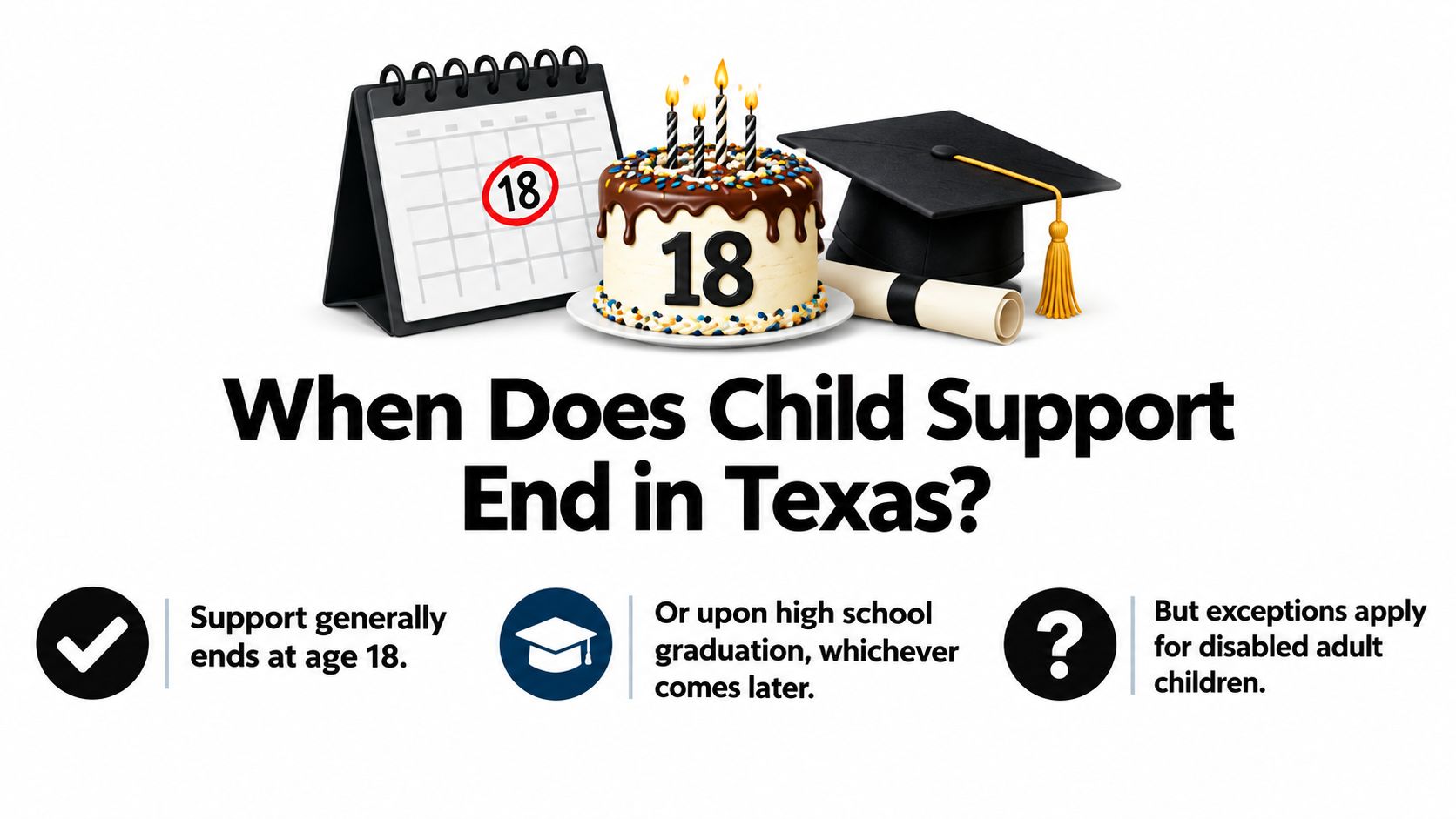
In Texas, ordinary child support ends at the later of your child's 18th birthday or high school graduation, subject to specific statutory exceptions. If you're looking at a birthday invitation, a graduation calendar, and a payroll deduction that's still coming out, it's understandable to feel unsure about what happens next.
You deserve a clear answer before you change your budget or your payments. The key is to separate your duty to pay current support from the steps needed to update your order, address unpaid balances, and stop withholding correctly.
Understanding the Basics of When Child Support Ends in Texas
Your child has reached adulthood, but there are still classes to attend and a diploma to earn. You may wonder whether the birthday changes everything or whether you're expected to keep paying until school ends.
Under Texas Family Code §154.001 and §154.002, the ordinary endpoint depends on both age and completion of an eligible high school program. In plain English, reaching adulthood doesn't necessarily end support while your child is still completing qualifying secondary education. The Texas statutory rule for ordering child support provides the legal starting point, but your order supplies the details you need for your case.
Separate the legal question from the payment question
When you ask “when does child support end,” you're often asking several different things:
- Current support: When does your duty to make new monthly support payments end?
- Your court order: Does it already describe the termination event and any reduction?
- Payment administration: What must happen before payroll or the enforcement agency changes its records?
- Other obligations: Are there remaining children, medical-support provisions, or unpaid balances to address?
These questions belong together, but they don't always have the same answer. You shouldn't treat a birthday as permission to stop every deduction.
Use this visual as a starting point, then compare it with your actual order.
Read the whole support provision
Look beyond the sentence stating the monthly amount. Find the termination language, any provisions for remaining children, and any disability-related terms.
If you're reviewing an older decree, understanding when child support starts in Texas can also help you trace the payment period from its beginning. Keep the signed order nearby as you review the events that may change its endpoint.
The 18th Birthday and High School Graduation Rule
The high school exception is more precise than “your child is still in school.” Enrollment, the type of program, attendance, and graduation timing all matter.
Texas Family Code §154.002 addresses accredited public secondary schools, eligible private secondary schools, and qualifying joint high-school and junior-college courses. Your child must also comply with applicable minimum attendance requirements. The TexasLawHelp child-support order form shows how these conditions can appear in an actual order.
How the graduation month works
Consider a hypothetical situation: your child reaches the ordinary termination birthday during the spring but graduates in the summer. If the qualifying school conditions apply, the birthday alone doesn't end the obligation.
The order may require periodic support through the end of the graduation month, rather than stopping on the day your child walks across the stage. That distinction matters when graduation occurs before the final scheduled payment for that month.
Compare these situations:
| Your child's situation | What you should examine |
|---|---|
| The birthday occurs before graduation | Enrollment, attendance, and the graduation-month language |
| Graduation occurs before the ordinary termination birthday | The age-related endpoint in your order |
| Your child remains in high school beyond the usual graduation schedule | Whether the program and attendance still qualify |
| Your child takes joint secondary-school and junior-college courses | Whether those courses fall within the statutory exception |
A graduation ceremony, a planned graduation date, and actual completion of diploma requirements may not tell you the same thing. Ask the school for documentation rather than relying only on an invitation or calendar.
What if school takes longer?
You shouldn't substitute another state's age limit for the Texas school-enrollment rule. For a child who remains in high school beyond the expected graduation schedule, review the statutory conditions and your order instead of assuming that another birthday supplies a new cutoff.
A request for support through graduation may be filed before or after the ordinary termination birthday. Addressing the issue early gives you time to resolve disputes about school eligibility or attendance.
For a nonlegal perspective on finishing school, Gradshop's discussion of the final hurdles to high school diploma can prompt useful questions for your child's school. It doesn't determine Texas support eligibility.
Practical rule: Use school records and the signed order to establish the final payment period, not the graduation party date.
Other Events That Can End Child Support Early
A child's age and schooling aren't the only possible termination events. Texas Family Code Chapter 154 also recognizes marriage, court-ordered emancipation, entry into active-duty military service, and the child's death as events that may end support earlier. You can review those provisions in the official Texas Family Code Chapter 154.
The important distinction is between an event that legally changes the obligation and an informal change in your child's life.
Marriage and military service
Suppose your child marries while support is still being paid. Your next step is to obtain the marriage documentation and compare the event with your order's termination terms, rather than rely on a family announcement.
Military service requires similar care. If your child signs recruiting paperwork but hasn't entered active-duty service, don't assume the paperwork establishes the statutory trigger. Ask for records showing the actual service status and effective date.
For military families, keep copies in a place you can access during relocation or deployment. Clear documentation helps you address any difference between the legal event and the date payroll processes an update.
Court-ordered emancipation and adoption
If your child moves out or begins working, those facts aren't the same as a signed emancipation decree. The event identified in the Texas support rule is emancipation by court order.
For example, if your teenager tells you they're financially independent, you still need to determine whether a court has made the required legal decision. A disagreement about household rules doesn't establish that decision.
Adoption also requires close review. Texas Family Code §154.006 on termination of support recognizes adoption as a terminating event, but you should have an attorney examine the adoption order and the existing support terms before changing payments.
- For marriage: Preserve the certificate and effective date.
- For military service: Obtain documentation of entry into active duty.
- For emancipation: Locate the signed court order.
- For adoption: Review the final adoption documents alongside the support order.
When a death changes the situation
If your child dies, handling support paperwork may feel overwhelming. You can ask counsel or the child-support agency to help identify the documents needed to update the case.
If a paying parent dies, don't assume the same termination analysis applies. Ask an attorney to review the decree and any estate-related obligations before treating the support case as closed, especially if your family has business interests or substantial assets.
When Support Continues for an Adult Child With a Disability
If your child needs ongoing care, the transition to adulthood can raise questions about housing, medical decisions, benefits, and financial support all at once. You don't have to treat those questions as separate emergencies.
Under Texas Family Code §154.302 on support for an adult child with a disability, a court may order support for an indefinite period when the statutory conditions are met, including that the disability or its cause existed on or before your child's 18th birthday.
Understand what must be established
The statute focuses on more than a diagnosis. It addresses a mental or physical disability, the need for substantial care and personal supervision, and an inability to support oneself.
That means your preparation should connect medical information with daily functioning:
- Disability or its cause: Preserve records explaining the condition and when it began.
- Personal care: Document help needed with daily activities, treatment, or essential routines.
- Supervision: Describe why your child needs substantial oversight.
- Self-support: Gather information about your child's ability to meet living expenses independently.
A diagnosis can be important evidence, but it doesn't tell the whole story. Your records should explain what your child can do, what assistance remains necessary, and how those needs affect financial independence.
Planning works best when you consider your child's daily life alongside the legal paperwork.

Prepare for the adult-care transition
Start with your existing order and organize school, medical, therapy, and caregiving records. Ask your attorney whether the current language addresses adult disability support or whether you need a separate court determination.
You should also discuss Supplemental Security Income, guardianship, housing, and medical-care arrangements with professionals who handle those matters. Don't assume a child-support decision answers questions about benefits eligibility or who can make decisions for your adult child.
For example, you may need support for ongoing supervision even while your child participates in education or supported work. The relevant question is functional dependence under the statute, not whether your child has any activity outside the home.
You can support your child's independence while also documenting the care they still need.
Ask who has standing to seek relief after adulthood and what evidence your particular case requires. Neither automatic continuation nor automatic termination is a safe assumption when substantial long-term care needs are involved.
How Multi-Child Orders Change When One Child Ages Out
If your order covers more than one child, the oldest child's termination event may change the payment without ending it. Your younger children may still be entitled to current support.
The TexasLawHelp final divorce decree with children illustrates how an order can specify reduced payments as support terminates for individual children. Read the reduction schedule before calculating anything yourself.
Don't divide the payment by the number of children
Consider a hypothetical order covering an older child who has completed the required age-and-school conditions and a younger child still attending school. You shouldn't stop the entire payment, and you shouldn't assume each child represents an equal share.
The starting point is the amount your decree requires after the older child's support terminates. If that amount isn't clear, seek a court determination rather than sending a reduced payment based on your own estimate.
A guideline calculation also requires care. Don't apply a percentage to gross pay or business revenue and assume that gives you the court-ordered amount.
Texas Guideline Support Percentage by Number of Children
Use this table as a review checklist, not as a substitute for a verified guideline calculation.
| Number of Children | Percentage of Net Resources | Example Monthly Support on $5,000 Net Resources |
|---|---|---|
| All children currently covered by your order | Verify the applicable guideline and order | Use a verified calculation |
| Fewer children remain eligible | Confirm the revised guideline and any ordered reduction | Use the authorized reduced amount |
| No children remain eligible for ordinary support | Review any continuing exceptions | Separate current support from other obligations |
Before changing your payment, take these practical steps:
- Find the schedule: Look for language showing what happens when each child's support ends.
- Check the remaining obligations: Identify medical support and any disability-related provisions.
- Confirm the calculation: Ask counsel to review the applicable resources and proposed amount.
- Resolve unclear wording: Seek modification or clarification before relying on an estimate.
If you own a business, organize your financial records so counsel can distinguish personal resources from business cash flow. If you have a high-value estate, keep property-division records separate from the support calculation rather than treating an asset transfer as an informal payment adjustment.
Your goal is a payment change that protects your budget without leaving the remaining children's support underpaid.
How to Modify or Terminate a Texas Child Support Order
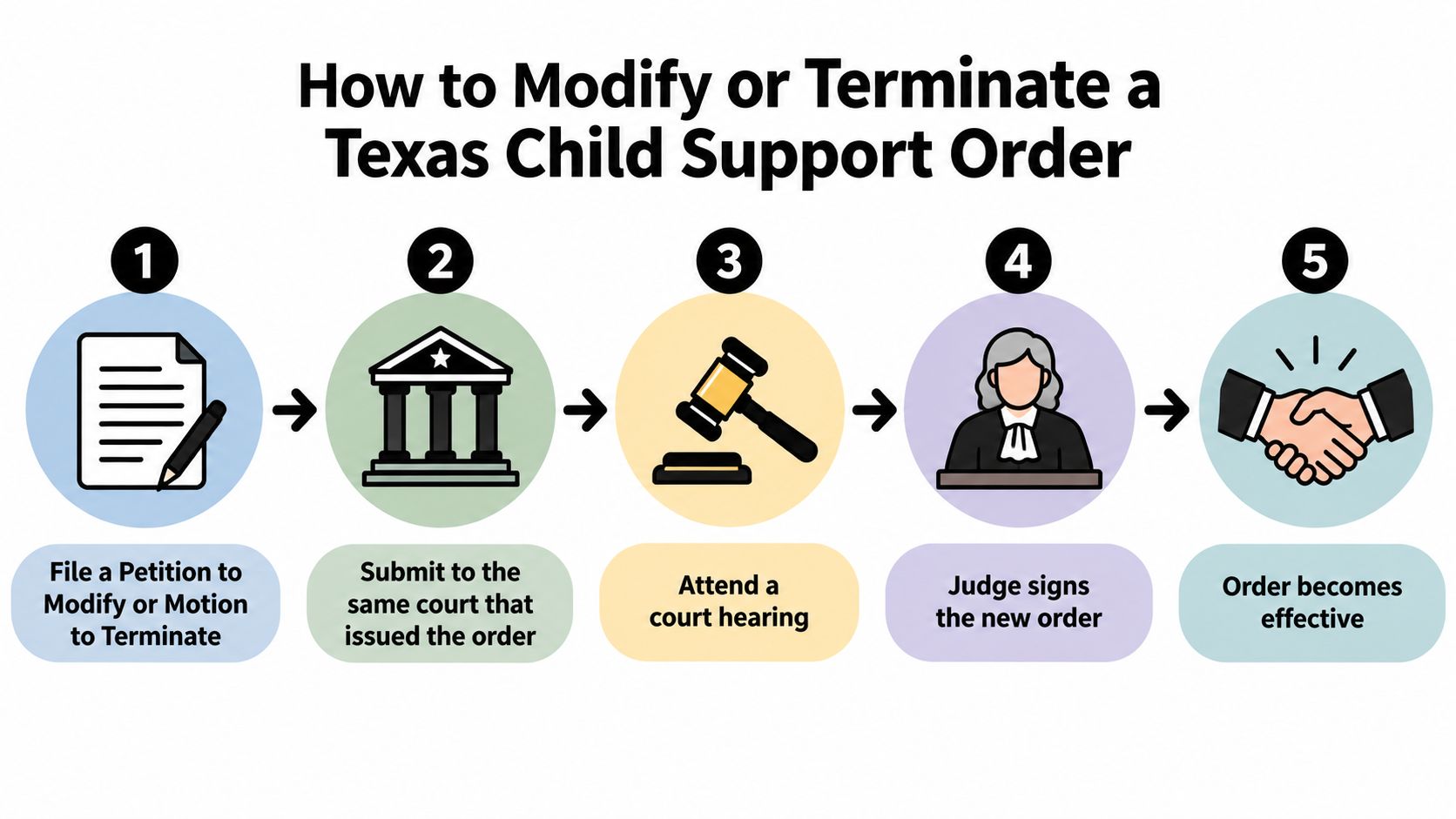
A termination event and a new court order aren't the same thing. Your existing decree may already establish an endpoint, while your circumstances may require modification, clarification, or an update to withholding.
Start by reviewing how to modify child support in Texas and asking counsel which procedure fits your order. Don't assume every case requires the same filing.
The process below gives you a practical way to organize the work.
Build your court-file checklist
Your attorney can help you work through these tasks:
- Identify the proper filing: Ask whether you need a Petition to Modify, a Motion to Terminate withholding, or another form of relief.
- Confirm the court: Begin with the issuing court, especially if your family has relocated.
- Gather evidence: Bring school records, marriage documents, military orders, an emancipation decree, or disability records, depending on the issue.
- Address notice and service: Confirm what must be formally delivered to the other party.
- Obtain a clear result: Make sure the signed order or written confirmation states the effective date and payment consequences.
If you're requesting a modification based on changed circumstances, ask counsel how the material-and-substantial-change standard applies to your request. A statutory termination event and a request to change the amount can involve different legal questions.
Choose the appropriate resolution path
If you and the other parent agree on the facts, ask about an agreed order. Mediation may help resolve disagreements about records, timing, or remaining obligations; a contested hearing may be necessary when you can't reach agreement.
Don't assume a private agreement updates payroll or replaces the signed decree. Have counsel identify what must be submitted to the court and enforcement agency.
You can use the following video as an additional educational resource while preparing your questions.
Keep divorce timing separate
If your support issue arises during a divorce, the broader sequence is filing the petition, addressing service, exchanging needed information, resolving or trying disputed issues, and obtaining the final decree.
Texas generally requires at least 60 days after filing the Original Petition for Divorce, with limited family-violence exceptions, before the judge can finalize the divorce. The TexasLawHelp divorce procedure guidance explains the counting rules and confirms that finality requires the judge's signature and filing by the clerk.
Don't treat that divorce waiting period as a guaranteed support-modification timeline. Ask separately about your court's schedule, service, mediation, and any hearing requirements.
Arrears, Wage Withholding, and Closing Out the Order
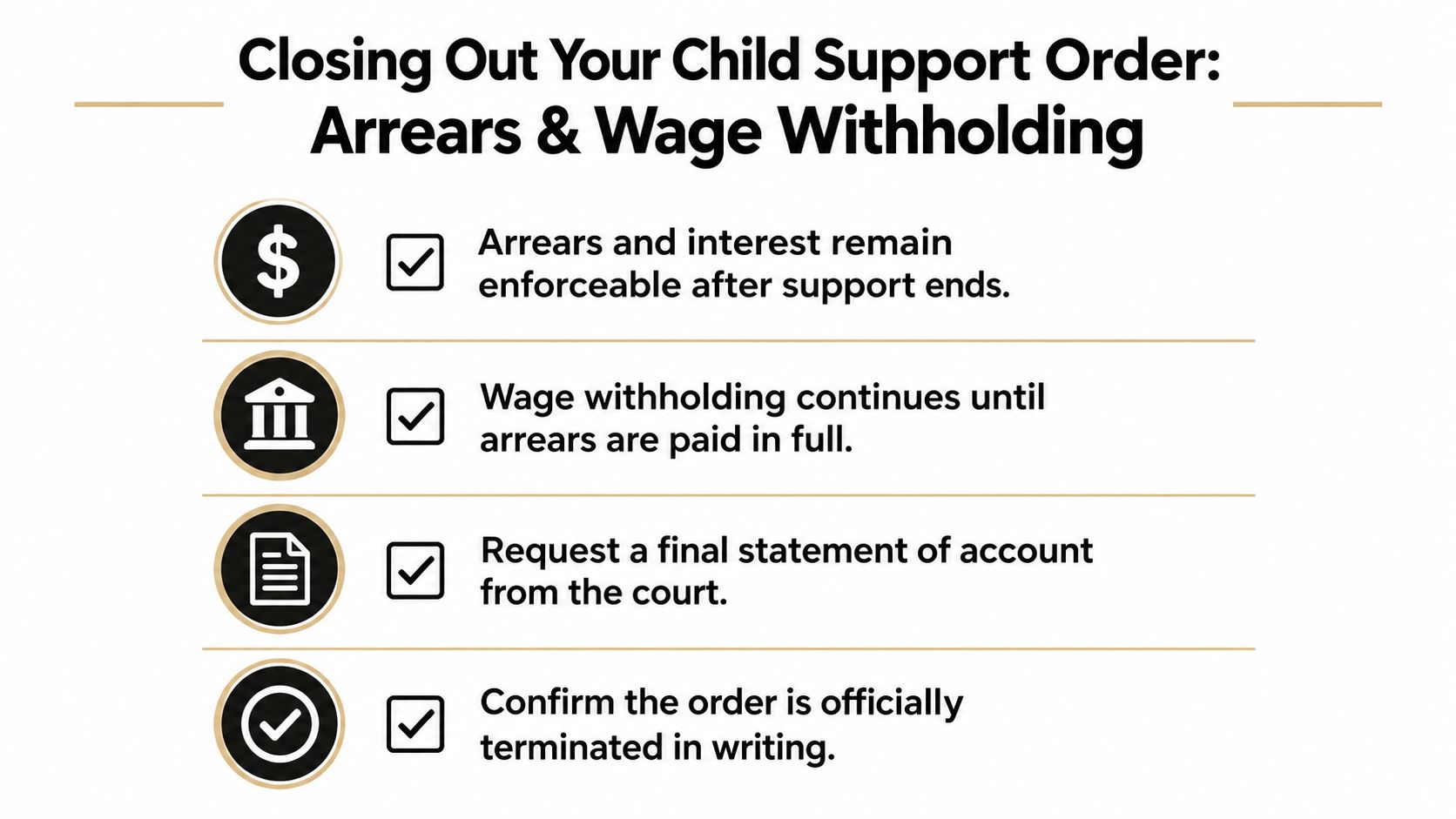
Ending current support does not erase unpaid support. This is the distinction that often causes the most expensive confusion.
TexasLawHelp's child-support guidance explains that arrears and applicable interest remain collectible after adulthood until paid in full. It also confirms that termination of parental rights doesn't erase that debt.
Know what the deduction is paying
An ongoing payroll deduction may include current support, past-due support, or other amounts addressed in the order. Before asking your employer to stop deductions, obtain a payment history and identify what the remaining balance represents.
Your employer shouldn't have to decide whether your child's school records satisfy Texas law. Use the appropriate court or enforcement process to provide written instructions about withholding.
Before changing payroll: Confirm both the legal endpoint and the amount still owed.
If deductions continue after you believe current support has ended, contact the child-support agency or counsel promptly. Request a review rather than waiting for payroll to correct itself or trying to offset the deductions through informal payments.
Use this checklist to organize the closeout.
Close the account with a paper trail
- Confirm the effective date: Match the termination event to the language in your order.
- Request an accounting: Review payments, arrears, interest, and any disputed entries.
- Check other obligations: Identify medical support and support for remaining children.
- Update withholding properly: Obtain written closure or modification through the appropriate process.
- Preserve the records: Keep the signed order, account statements, and correspondence.
If your decree directs payments through the Texas Child Support State Disbursement Unit, continue using that designated system for payments that remain due. Don't switch to paying the other parent directly because you're trying to close the case.
If you're facing a disputed balance, reviewing back child support in Texas can help you prepare focused questions about enforcement and accounting. Whether you pay or receive support, written confirmation protects you better than an informal understanding.
Common Misconceptions and Your Next Steps in Texas
A friend's experience in another state may not answer your Texas question. LawInfo's overview of child-support duration explains that state law governs the endpoint, so there isn't one universal national rule.
Replace assumptions with questions you can verify:
- College automatically extends support: College attendance alone isn't the ordinary automatic extension trigger in the Texas guidance discussed above.
- Adulthood ends everything: The school exception and adult disability provisions require separate review.
- Emancipation needs no paperwork: Don't confuse ordinary adulthood with the court-ordered early-emancipation event.
- Old debt disappears: Review the accounting even when current support has ended.
What to Do Next
Gather your decree, school or other termination records, and payment history. Ask what relief or written confirmation you need before changing payments.
If you're also divorcing, Divorce With Children in Texas addresses how custody, support, and parenting time are decided. Keep property division and any spousal-maintenance obligations on a separate review list so closing child support doesn't leave another financial issue unresolved.
You can get help reviewing your termination date, remaining balances, and the steps needed to change support or withholding. Visit Law Office of Bryan Fagan, PLLC to schedule a free consultation, and bring your support order and recent payment history so you can discuss a clear path forward.


