 Skip to content

In Texas, child custody lawyer fees are driven primarily by hourly billing, with published family-law rates around $230 to $320 per hour in cities like Houston, Dallas, and Austin. An uncontested case typically runs $2,500 to $5,000 in attorney fees, while a contested case commonly runs $5,000 to $20,000 or more.
You're probably reading this at your kitchen table after being served, after a hard conversation with your co-parent, or after deciding you can't keep living with an order that doesn't work for your child. You need a lawyer, but you also need to know what this will do to your savings, your monthly budget, and your ability to stay in the fight if it gets difficult. I'll be direct with you. The hourly rate matters, but it's rarely what decides your final bill. What decides it is how many hours your case requires, which professionals the court brings in, and whether you and the other parent can reach agreement before litigation takes over.
Why Child Custody Lawyer Fees in Texas Feel So Unpredictable
You call three lawyers and get three different answers. One quotes an hourly rate. One asks for a retainer. One won't give you a total at all. That doesn't necessarily mean anyone's hiding the ball. A custody case isn't a fixed-price purchase because neither you nor your lawyer controls the other parent, the court's schedule, or what evidence shows up once the case starts.

Four things drive your bill.
The Four Drivers You Need to Watch
- Billing structure: You're usually buying attorney time, not a finished product. Every pleading, email, hearing, and negotiation session adds time.
- Case posture: An agreed parenting plan requires far less work than a fight over primary possession, relocation, or safety concerns.
- Court-ordered professional fees: Evaluators, mediators, and attorneys ad litem bill separately from your lawyer, and the court can decide who pays them.
- Litigation timing: Emergency motions, repeated temporary orders, and late fee requests force expensive work under pressure.
The national picture shows why your lawyer can't responsibly promise one number on day one. Available 2025 rate data places the average U.S. family-law attorney rate at approximately $344 per hour, with broader consumer estimates placing family-law hourly rates between $150 and $500, according to Clio's lawyer rate comparison data. Your Texas rate will depend on your market and your lawyer's experience, but your total will depend even more on volume. Twenty hours of negotiation and two hundred hours of litigation are different cases, even at the same rate.
Two parents can hire lawyers at the same hourly rate and end up with wildly different invoices. The difference is almost always conflict, complexity, and timing, not the rate alone.
That's why your first month matters so much. If you organize your records, define your goals, and test whether agreement is possible early, you give your lawyer a case that can be managed. If you start with emergency filings, hostile messages, and no documents, you're paying your lawyer to build the plane while it's already in the air. Treat child custody lawyer fees as a process you can influence, not a price tag you accept.
How Texas Custody Attorneys Structure Their Fees
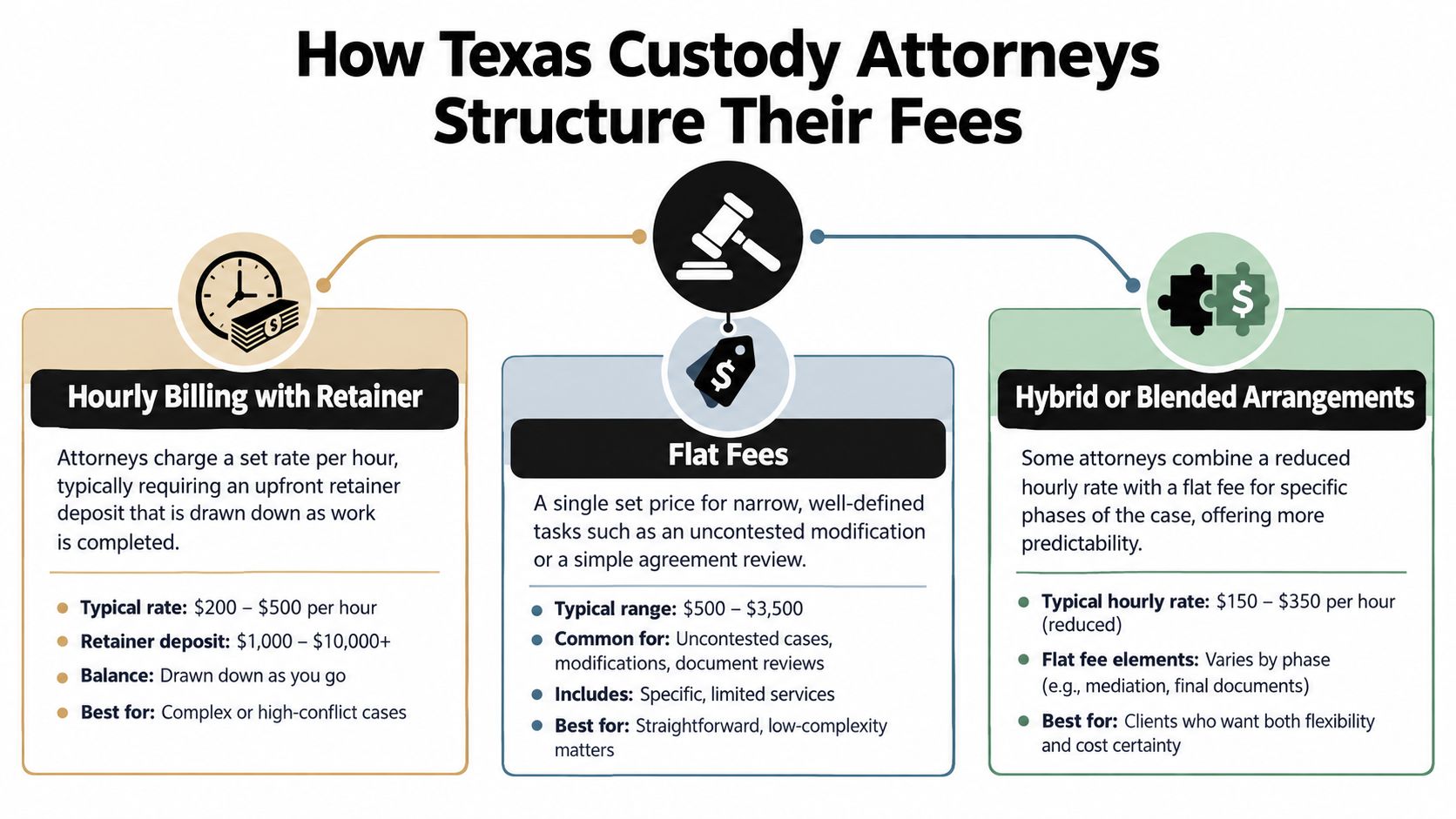
Most Texas custody lawyers use one of three structures. You need to know which one you're signing before you hand over money, because each one puts risk in a different place.
The infographic below lays out the three structures side by side so you can match what a lawyer offers you to what your case needs.
Hourly Billing With a Retainer
Hourly billing works like hiring a plumber by the hour. You watch every turn of the wrench because time is money. The retainer is an advance you deposit into a trust account, and the firm draws from it as work is completed. It is not a cap. It is not the total cost. If your case needs more work than the retainer covers, you'll be asked to replenish it.
Ask how time is billed. Many firms bill in small increments, so a short email still generates a charge. A lawyer with a lower rate who emails constantly and bills every small task can cost you more than a higher-rate lawyer who batches communication and resolves issues in one call.
Flat Fees and Limited Scope Help
A flat fee is a set price for a simple, defined job, like paying a set price for a straightforward installation. It can work well for an uncontested modification or a document review. It's a poor fit for contested work because neither side knows how much fighting is coming.
Limited-scope representation, sometimes called unbundled help, is hiring the plumber only for the hard connections while you handle the rest yourself. You might pay for pleadings, document review, negotiation coaching, or one hearing instead of full representation. That can save real money, but only if the written agreement says exactly what the lawyer will and won't do.
Before you sign anything, your fee agreement should spell out the scope of work, the hourly rate, billing increments, who pays filing fees and service costs, whether unused retainer funds are refundable, and how fee disputes are handled. If a lawyer won't put those terms in writing, don't pay. A clear agreement protects you and the firm, and it gives you a document to measure every invoice against.
What's Actually on a Texas Custody Invoice
Most parents glance at the balance due and never read the lines above it. That's a mistake. Your monthly statement tells you whether your case is being run efficiently or whether routine tasks are draining your retainer.
Attorney Time Versus Case Expenses
Attorney fees cover time. That includes drafting pleadings, reviewing discovery, phone calls, emails, hearing preparation, court appearances, and travel. Case expenses are different. They're costs your case generates with third parties or the court, and they're usually passed through to you on top of attorney time.
Published estimates consistently separate these categories because expenses can include filing fees, service of process, mediation, parenting evaluations, psychological evaluations, guardian ad litem services, and expert testimony, as outlined in Legal Clarity's breakdown of family lawyer rates, retainers, and fees. County-level filing and litigation expenses in Texas can also differ, so your invoice won't look identical to a friend's invoice in another county.
Common Texas Custody Case Expense Lines
| Expense Category | Typical Trigger | Paid By |
|---|---|---|
| Filing fees | Opening the case or filing motions | Usually you, unless the court orders otherwise |
| Service of process | Formally delivering papers to the other parent | Usually you as the filing party |
| Mediation fees | Court-ordered or agreed settlement session | Often split, or as the court orders |
| Deposition transcripts | Sworn testimony taken before trial | The party who notices the deposition, initially |
| Parenting or psychological evaluation | Disputed fitness, mental health, or safety claims | As allocated by the court |
| Expert witness retainer | Specialized testimony your case requires | The party who retains the expert, initially |
How to Read Your Statement Like an Experienced Client
Ask for itemized entries that show the task, the time spent, and the expense category. Privileged details can be redacted without hiding what you paid for. Look for patterns. Are you being billed repeatedly for scheduling and status emails? Is senior attorney time being used for work a paralegal could handle? Are research charges, copies, postage, parking, or mileage showing up without explanation?
Practical rule: If you can't tell from your statement what work moved your case forward that month, ask your lawyer to walk you through it before you replenish the retainer.
You're not being difficult by asking. You're being a responsible client. A well-run custody case produces statements you can follow, and a lawyer who bills transparently should welcome the conversation.
Uncontested vs Contested Custody Cases in Texas
Agreement is the single biggest cost lever in your case. Nothing else comes close.
The comparison below shows how quickly the gap opens once parents stop agreeing and start litigating.
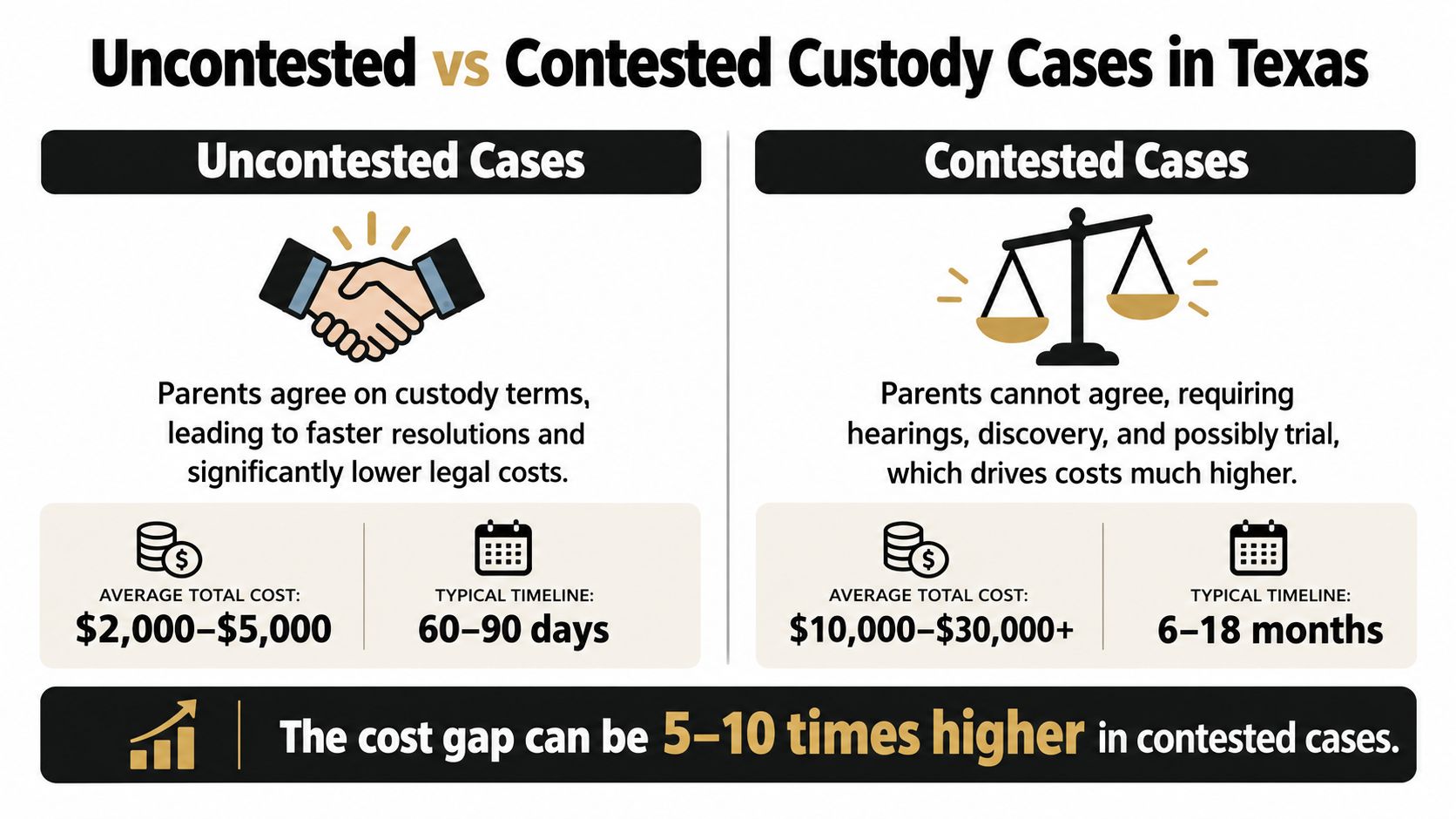
In an uncontested case, you and the other parent agree on conservatorship, possession, and support. Your lawyer drafts or reviews the agreed order, files it, and gets it entered. The work is real, but it's bounded. In a contested case, you're paying for temporary orders hearings, discovery, depositions, expert evidence, trial preparation, and possibly trial itself. Each stage multiplies attorney time.
A separate national estimate reports average attorney representation costs of roughly $21,500 for custody proceedings, with contested matters ranging from about $3,000 to $40,000 depending on complexity. Those aren't fixed tariffs. They're market estimates, and your actual invoices will vary by jurisdiction, lawyer experience, case duration, and whether you can reach agreement. The point isn't the exact figure. The point is the multiplier that hits when negotiation fails.
The video below walks through how contested custody litigation develops, which helps you see where those extra hours come from before you're paying for them.
Watch the gray zone carefully. Many cases start agreed and turn contested when one parent changes position, a grandparent or other third party intervenes, or a relocation dispute surfaces. If your case is drifting that direction, tell your lawyer early and re-budget. Pretending a contested case is still uncontested is how retainers run dry mid-case.
One caution on the cheap route. The Texas Judicial Branch notes that its Supreme Court-approved divorce forms are intended for uncontested divorces without children or real property, as explained on the Texas Judicial Branch page for self-represented litigants. If children, a business, real estate, or retirement accounts are involved, an incomplete order can create enforcement and modification fights later that cost far more than doing it right the first time.
When Texas Law Shifts the Attorney Fees to the Other Side
Parents ask me all the time whether the other side will have to pay their fees. Sometimes. Never count on it when you're budgeting.
The General Rule Under Section 106.002
In a suit affecting the parent-child relationship, Texas Family Code §106.002 gives the court discretion to award only reasonable attorney's fees and expenses. Discretion means the judge decides. It isn't automatic, and it isn't all-or-nothing. The statute also permits the fee judgment to be paid directly to counsel and enforced as a judgment for debt, as explained in the Texas Bar Practice materials on attorney's fees in family law. Even if you win fees at the end, you still owe your own lawyer under your engagement agreement while the case is pending.
If you're the economically weaker parent, ask about temporary fees early. A court can order interim fee help during the case, but it requires a court order and generally depends on demonstrated need, your child's welfare, and the other party's ability to contribute. Waiting until discovery and expert bills have piled up leaves you financing everything alone in the meantime. Our guide on who pays attorney fees in a Texas divorce walks through how judges approach these requests.
When Conduct Changes Who Pays
Two statutes turn behavior into dollars.
- Enforcement under §157.167: If a respondent fails to comply with a possession or access order and the violation is proven, the court must award the movant's reasonable and necessary attorney's fees, court costs, and expenses, which can be enforced through mechanisms available for child support, including contempt, under Texas Family Code §157.167 on FindLaw.
- Frivolous modifications under §156.005: If you file a modification that's found frivolous or designed to harass, fees can be taxed against you even if the custody change is never tried.
Treat any fee award as a possible reimbursement, not a payment plan. Budget as if you'll pay your own lawyer in full, and let a fee award be a recovery, not a lifeline.
Document violations, keep communications, and make sure your evidence supports a nonfrivolous theory before you file. In enforcement and modification cases, your paper trail is quite worth money.
Hidden Costs Most Custody Fee Guides Never Mention
Headline fee estimates stop at your lawyer's rate. Your actual financial exposure doesn't. In high-conflict Texas cases, the professionals around your lawyer can cost as much as your lawyer does.
The checklist below covers the cost layer most parents don't learn about until the first deposit request arrives.

Court-Appointed Professionals Bill Separately
An attorney ad litem or guardian ad litem may receive reasonable fees and expenses set by the court, with payment ordered from one or more parties. A deposit may be required at appointment, and an additional payment can be ordered before the final hearing. Reporting on how these appointments play out across Texas counties is detailed in The Austin Bulldog's investigation of court-appointed representation costs. These fees aren't optional once ordered, and they don't come out of your lawyer's retainer unless your agreement says so.
Beyond ad litems, your case can generate charges for counseling, psychological examinations, drug testing, parenting coordination, mediation, discovery, and transcripts. If safety or credibility is disputed, some parents also evaluate investigative help, which our overview of what a private investigator can do for your Texas child custody case explains in practical terms.
Here's the contrarian point most guides miss. A lower hourly rate doesn't guarantee a lower total bill. A moderately priced lawyer in an expert-heavy case with repeated hearings can produce a far larger invoice than a higher-rate lawyer who settles the same dispute at mediation. When you interview lawyers, don't just ask the rate. Ask which of these expenses are likely in your case, who decides who pays them, when you can challenge or request allocation, and whether the firm has a payment strategy for evaluation and expert costs. High-conflict allegations, domestic violence claims, and disputes over your child's mental health or safety are exactly where these hidden layers appear.
Paying for a Texas Custody Lawyer on a Real Budget
You don't have to choose between full representation and handling everything alone. Texas gives you graduated options, and your job is to match the level of help to the risk in your case.
Start With Low-Cost Entry Points
The Texas courts' Lawyer Referral Information Service offers a 30-minute consultation for $20, and Texas legal-aid and access-and-visitation programs provide referrals, legal information, and, when eligibility requirements are met, brief advice or assistance, as described in the Texas Attorney General publication on access and visitation resources. Availability isn't universal. It varies by income, county, case type, and domestic violence circumstances, so get screened early rather than assuming you qualify or don't.
From there, the ladder looks like this.
- Consultation only: Pay for a strategy session and handle filings yourself. Lowest cost, highest personal responsibility.
- Limited-scope help: Pay for pleadings, document review, mediation coaching, or one hearing. Strong value if your case is narrow and you're organized.
- Full representation: Your lawyer handles strategy, deadlines, discovery, hearings, and trial. Necessary when safety, relocation, or complex property and parenting issues are contested.
Limited-scope help carries a real risk. If you misunderstand what your lawyer is responsible for, miss a deadline, or assume advice includes courtroom advocacy, you can damage your case while trying to save money. Get the scope in writing and calendar every deadline yourself.
Mediation belongs in every budget conversation. As Divorce Mediation in Texas: How It Works explains, why most contested Texas divorces settle in mediation comes down to control and cost. TexasLawHelp notes that parties may mediate before filing, after filing, or before the final decree, and that a binding mediated settlement agreement can control the resolution, per its article on divorce and mediation. Have counsel review any agreement before you sign, especially on possession schedules, relocation, and support.
Finally, build the money plan like you'd build any household plan. These step-by-step budget planning tips from Fintrack can help you map retainer payments against your monthly obligations, and our page on whether family law attorneys take payment plans explains what to ask before you assume financing is available.
Your Next Steps and a Clear Path Forward
Bring the right materials to your first consultation and you'll get honest fee answers instead of guesses.
What to Bring and What to Ask
- Bring: A one-page summary of your facts, any existing orders, recent financial records if support is disputed, and your goals for the parenting plan.
- Ask: The hourly rate, retainer amount, billing increments, who pays expenses, the scope of work, the anticipated timeline, and how the firm handles mediation.
- Avoid: Paying a large retainer without a written fee agreement, accepting a flat fee for contested work, or signing a scope broader than your case needs.
Key takeaway: You can't control everything in a custody case, but you can control your preparation, your communication, and how early you test agreement. That's how informed parents manage child custody lawyer fees as a process instead of reacting to them as a crisis.
If you're facing a custody dispute in Texas and want a clear, honest picture of what your case will cost before you commit, the team at Law Office of Bryan Fagan, PLLC will review your facts, explain your fee options in plain English, and map a strategy that fits your family and your budget. Reach out today to schedule your free consultation and take your next step with confidence.


