 Skip to content

In Texas, court-ordered spousal maintenance is capped at 5 years for marriages lasting 10 to 19 years, 7 years for marriages lasting 20 to 29 years, and 10 years for marriages lasting 30 years or longer. Those are ceilings, not guaranteed payment periods, and a judge must set the shortest reasonable term that allows the recipient to become financially self-supporting.
If you're sitting at your kitchen table with divorce papers nearby, the years you were married may feel like the number that decides your financial future. It matters, but it doesn't decide the whole question. Texas courts look at eligibility, your finances, and how long the recipient reasonably needs support. The same marriage length can lead to different orders when one person can return to work quickly and the other faces a serious disability or long absence from the workforce.
The Honest Answer You Came Here For
Texas Family Code §8.054 puts a ceiling on how long court-ordered maintenance can run, tied to how long you were married. A separate five-year cap can apply to marriages under 10 years when eligibility rests on family violence. What surprises clients is this: the statute hands the judge a maximum, and the judge's real work is choosing the shortest reasonable term.
Here is what that standard looks like in practice. Say a spouse spent years at home raising children while the other built a career, and the marriage ends. The higher earner dreads writing checks for the full cap. The recipient dreads the check stopping before she can stand on her own. The court answers both fears the same way: set a term long enough for the recipient to earn enough to meet minimum reasonable needs, and not a month longer.
So the number on your decree depends on evidence, not just the marriage certificate. Judges weigh work history, education, age, health, childcare duties, and whether retraining is realistic. Two marriages of identical length can produce very different orders for exactly that reason. And the clock starts running at the final decree, not at separation, which matters if your case drags on for months.
Practical rule: Plan around the maximum as a legal ceiling, not a forecast. Build your estimate from the evidence about income, needs, and the recipient's realistic ability to work.
Before you fixate on a number of years, answer two questions. Does your spouse qualify for court-ordered maintenance? And what proof supports the duration being requested? Those answers shape the outcome far more than the statutory bracket alone.
What Texas Calls Alimony and Why the Distinction Matters
Texas law uses spousal maintenance, not “alimony,” for certain payments a court orders after divorce. People use the terms interchangeably in everyday conversation, but the legal distinction matters when you file, negotiate, or ask a judge for relief. A plain-language overview of what alimony means in Texas can help you understand the terminology before discussing your options.
The simplest way to remember the difference is a bridge versus a longer road. Temporary support is a bridge during the divorce case. Post-divorce maintenance is a separate legal road that begins after the final decree, and it's available only when the legal requirements are met.
Temporary support while the divorce is pending
A spouse can ask the court for temporary orders while the case is open. Those orders may address financial support and other immediate needs during the case. The judge considers the circumstances presented at the temporary orders hearing; this support doesn't automatically turn into post-divorce maintenance when the divorce ends.
If you need temporary support, raise the issue early with your lawyer. Bring clear information about income, regular expenses, debts, and who's paying household bills. That gives the court a practical picture of the financial situation while the case is pending.
Post-divorce maintenance after the decree
Court-ordered spousal maintenance is decided as part of the divorce outcome. A judge first considers whether the requesting spouse qualifies under Texas law, then determines whether maintenance is appropriate and, if so, its amount, duration, and payment method under the relevant rules. The order should make the parties' obligations clear.
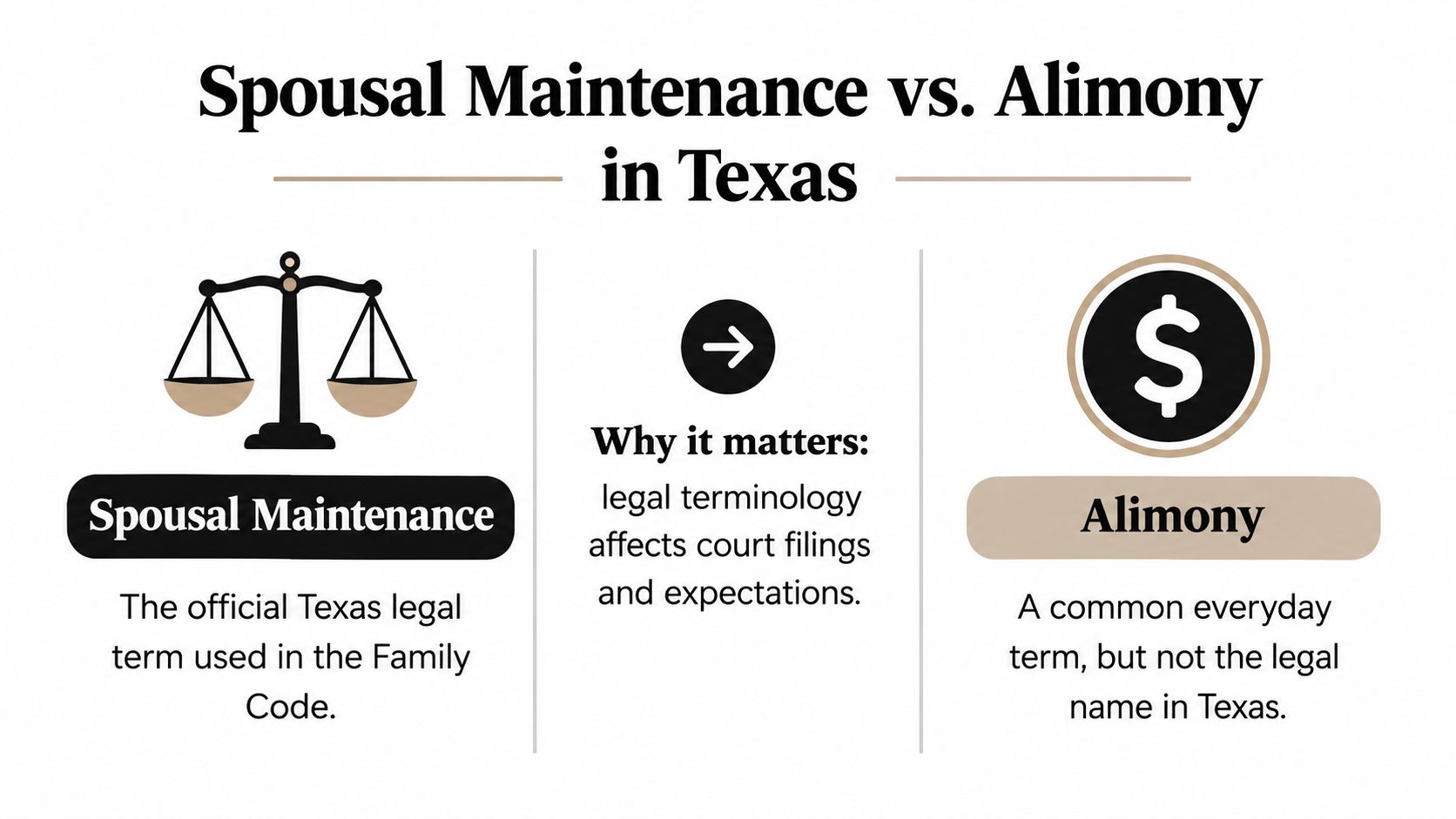
Don't assume that “alimony” means years of payments because one spouse earned more. Temporary support and post-divorce maintenance serve different purposes, follow different stages of the case, and shouldn't be treated as one continuous obligation.
Statutory Time Limits by Marriage Duration in Plain English
The marriage-length limits appear in Texas Family Code §8.054. They set the maximum term for qualifying cases, not a standard award. A judge must choose the shortest period that allows the recipient to meet the legal goal of financial self-support.
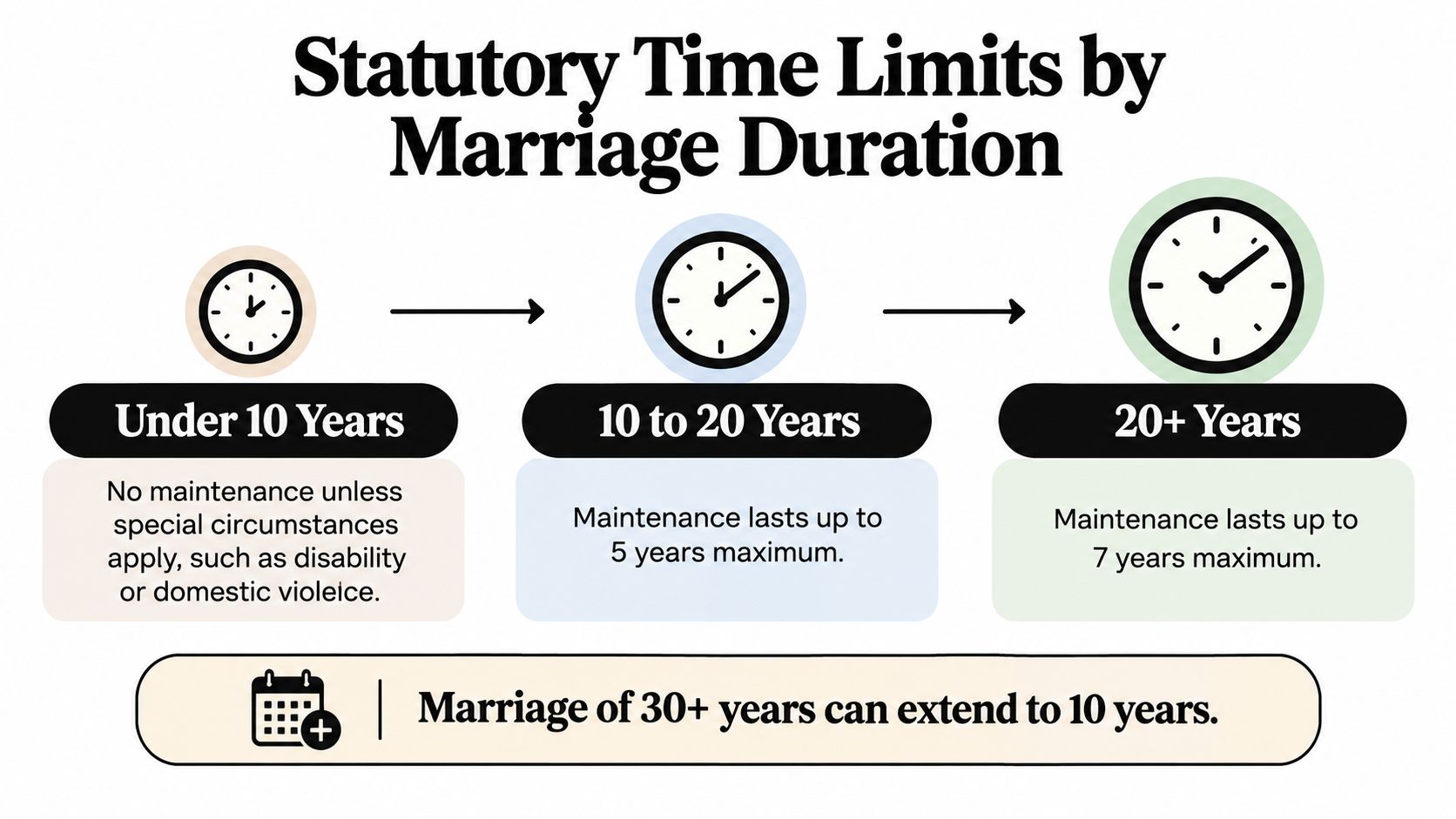
In practice, the statutory ceiling is a starting point for the judge's decision. A spouse with recent work experience, a clear path back to a former field, and modest retraining needs may receive a shorter term than the maximum. For example, a three-year order could fit a case with a seven-year ceiling if the evidence shows that three years gives the recipient a realistic chance to earn enough to meet minimum reasonable needs. That is an illustration, not a promise or a separate rule.
The marriage-length clock begins on the date the marriage legally began and runs until the marriage ends by divorce or death. A long separation does not, by itself, end the marriage or reset that clock.
A recipient's health and work prospects can affect how much time is reasonable. A person with a disability, limited employment options, or serious barriers to returning to work should show how those limits affect the ability to earn income and why a shorter transition period would fall short. Medical records, employment history, and evidence about functional limitations can help explain the request.
The video below provides additional context about Texas alimony and spousal maintenance.
Who Actually Qualifies for Maintenance in Texas
A marriage can fit a duration bracket and still not qualify for maintenance. Texas law generally requires the requesting spouse to show that they'll lack sufficient property, including property awarded in the divorce, to meet minimum reasonable needs and that they meet a legal eligibility pathway. The spousal maintenance eligibility overview is a useful place to review the basic framework.
The pathways the court considers
The common pathway is a marriage lasting at least 10 years, along with evidence that the requesting spouse can't meet minimum reasonable needs through property and income. Other pathways can apply when a spouse has a qualifying disability, when family violence meets the law's requirements, or when the spouse is caring for a child of the marriage with a qualifying disability. These exceptions can change whether a person is eligible, but they don't make the maximum period automatic.
For example, a spouse who can't work because of a qualifying physical or mental disability may have a different claim from someone who needs time to update job skills after years away from work. A parent caring for a child with a qualifying disability may also face work limits that affect the court's assessment. In a family-violence case, the law may permit maintenance for certain marriages under 10 years, subject to its requirements and the separate maximum term.
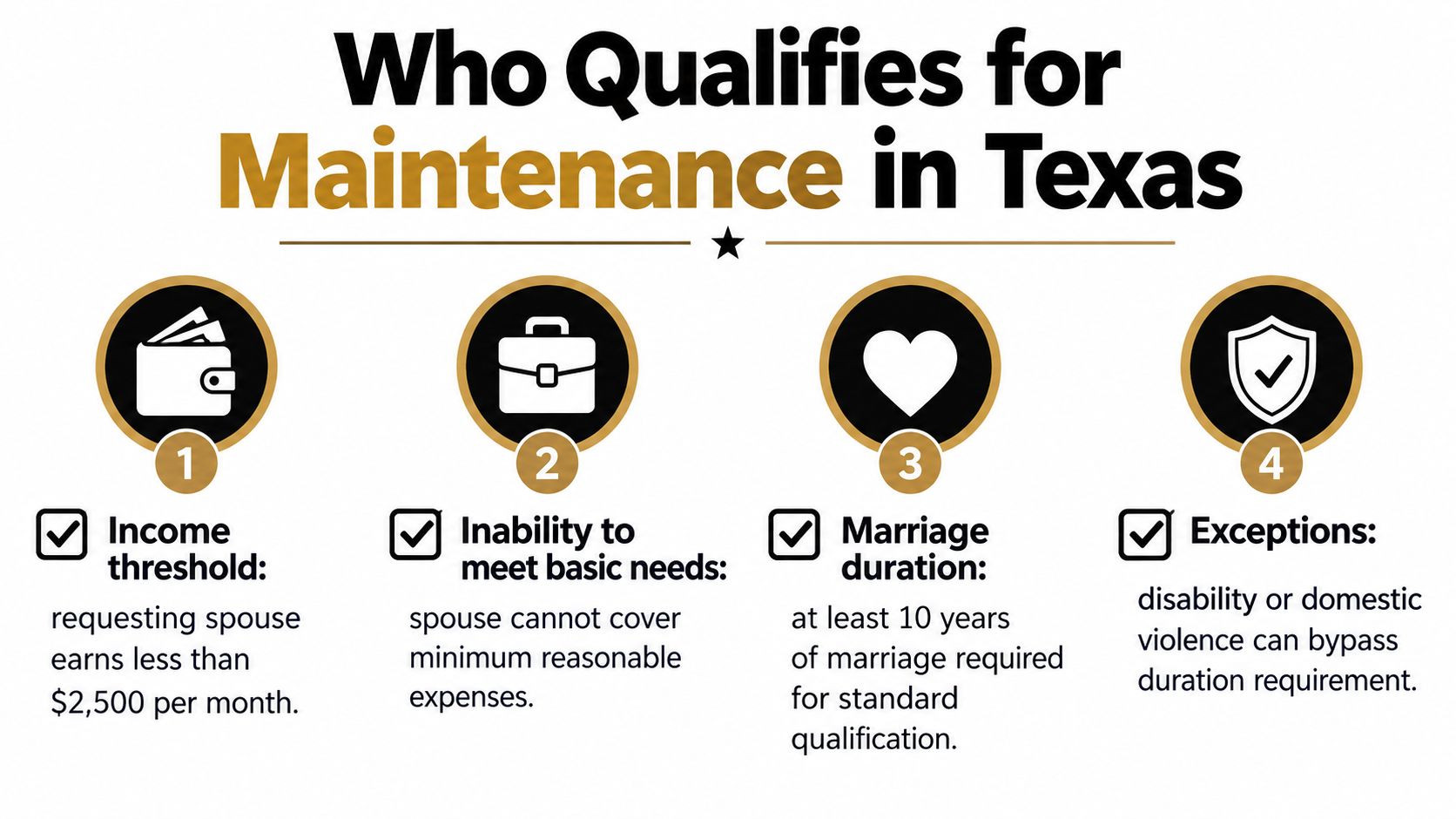
The infographic describes an income threshold, but don't rely on a graphic alone to decide your eligibility. The applicable statutory requirements and your financial evidence control. A lawyer can review your property, income, necessary expenses, work prospects, and the facts behind any claimed exception.
A practical explanation of Spousal Maintenance in a Texas Divorce addresses when Texas courts award post-divorce spousal maintenance. For your case, gather documents that show what you own, what you owe, what you earn, and what it costs to meet reasonable needs. A claim is easier to assess when it's grounded in records rather than assumptions.
Three Texas Marriages Compared on the Duration Timeline
The same rule looks clearer when you apply it to different marriages. The examples below show the statutory ceilings, not guaranteed court outcomes. In every case, the judge still has to assess eligibility and the shortest reasonable duration.
| Marriage Length | Statutory Maximum | Likely Court Outcome | Key Factors That Shorten the Term |
|---|---|---|---|
| 12 years | Up to 5 years | A shorter term may be appropriate if the recipient can return to work or retrain promptly. | Recent work history, marketable skills, good health, and limited childcare barriers. |
| 22 years | Up to 7 years | The court may set a shorter transition period if the recipient can become self-supporting before the ceiling. | Employability, education, income, age, health, and realistic retraining options. |
| 33 years | Up to 10 years | A longer period may be considered, but the maximum still isn't automatic. | Disability, long absence from work, limited job options, and continuing minimum needs. |
A 12-year marriage falls within the bracket capped at 5 years. If the recipient has recent employment experience and can meet reasonable needs after a period of transition, the court may order less than the maximum. The important question isn't just how long the marriage lasted. It's how long support is reasonably needed.
For a 22-year marriage, the ceiling is 7 years. That doesn't mean the payor should budget for 7 years without considering the evidence. If the recipient can return to work with little retraining, the case for a shorter term may be stronger. If health or workforce history creates real barriers, the recipient should document them and explain their effect on earning ability.
A 33-year marriage qualifies for a maximum of 10 years, but even a long marriage doesn't guarantee the full period. A judge may consider disability, education, work experience, and the recipient's ability to meet minimum needs. Long-term support arguments need to connect those facts to why a shorter term won't work.
The most useful planning number is not just the statutory maximum. It's the period you can support with evidence about real needs and realistic earning capacity.
What Ends or Changes an Alimony Order
A maintenance order can end before its scheduled expiration, and some life changes may require a court process rather than a private decision to stop paying. Texas law and Texas Family Code §8.056 address events that can terminate maintenance, including the recipient's remarriage and permanent cohabitation with a romantic partner.

The obligation generally ends when either party dies, when the recipient remarries, or when the recipient permanently lives with a romantic partner, subject to the governing order and legal procedure. Expiration of the ordered term also ends the obligation. Cohabitation may require evidence, and the parties may need a court-recognized process to resolve whether the legal standard has been met.
Changes that may call for court action
Retirement or a major change in income can affect someone's ability to pay, but don't stop sending payments. A payor may need to ask the court to modify the order and show why a change is justified. The recipient may also need to show that minimum reasonable needs continue, particularly when disability is part of the claim.
Texas recognizes circumstances where maintenance can continue while an eligible spouse remains unable to provide minimum reasonable needs because of a qualifying disability, or while caring for a child of the marriage with a qualifying disability. If disability affects the duration or ability to work, medical and functional evidence can help explain the connection.
Don't treat an informal change in someone's living arrangement or finances as permission to ignore a court order. Missed payments can create enforcement problems, so get legal advice before changing what you pay or receive.
What to Do Next and How We Can Walk Through This With You
Take these steps before you agree to a maintenance term:
- Collect the financial records. Gather income information, account statements, debts, regular expenses, and documents that show the recipient's work history or barriers to employment.
- Raise immediate needs early. If support is needed while the divorce is pending, ask your lawyer whether temporary orders are appropriate.
- Prepare for negotiation. In mediation or settlement talks, address the proposed amount and duration, when the payment term begins, and what events may end or change the obligation. For a broader financial checklist, review these divorce financial planning insights.
- Follow the case through to the decree. Texas generally has a 60-day waiting period before a court may grant a divorce, counted from the filing date, with a narrow exception that can apply when the petitioner has an active protective order. Even after that period, the divorce isn't final until the required process is complete and the judge signs the decree, as the Texas State Law Library's guide to finalizing a divorce explains.
You don't need to guess at your timeline alone. Bring your marriage history, financial records, and questions about work, disability, or cohabitation to a free consultation with the Law Office of Bryan Fagan, PLLC.
The Law Office of Bryan Fagan, PLLC helps Texans assess maintenance, prepare for mediation, and address divorce and post-decree family-law issues. To discuss how long support may last in your circumstances, visit Law Office of Bryan Fagan, PLLC to schedule a free consultation.


