 Skip to content

You open the mail box with shaky hands, and there it is, the letter you've been hoping for and dreading at the same time.
You Got the Letter That Your CPS Case Is Closed
Maybe you read it three times in your driveway. The visits, the interviews, the questions from teachers and doctors, the fear every time your phone rang. Now a short letter says the case is closed, and you're not sure whether you can finally breathe or whether you should wait for another knock.
That mix of relief and doubt is normal. For many Texas parents, what happens when a CPS case is closed feels far less clear than the letter suggests. Closed can mean the investigation ended, services ended, or a court case ended, and those are not the same thing.
The Questions Most Parents Ask First
You're probably wondering if closure means CPS believes nothing happened. You're wondering if the record disappears, if a new report can start everything over, and if you still have to follow a safety plan, counseling schedule, or visitation rule someone gave you months ago.
Those questions matter because a wrong assumption can create a new problem. If you stop a court ordered service too soon, you could face trouble in a custody case. If you think your record is gone and it isn't, you could be caught off guard by a background question later.
Start here: Keep the letter, don't throw anything away, and don't assume every instruction from the case ended on the same day.
You deserve a plain English explanation before you make your next move. The sections below walk through what closure legally means in Texas, the different ways a case can close, what happens to records, and which obligations can survive after CPS steps back. You'll also get a practical checklist for documents to gather now, while names, dates, and paperwork are still easy to find.
If your family also has a divorce or custody dispute underway, closure can affect that case too. A CPS file closing doesn't decide conservatorship, possession, or child support under the Texas Family Code. Those decisions belong to the family court, sometimes through mediation and sometimes through a hearing, and you need to keep the two tracks separate in your mind.
What Case Closure Means in Texas CPS
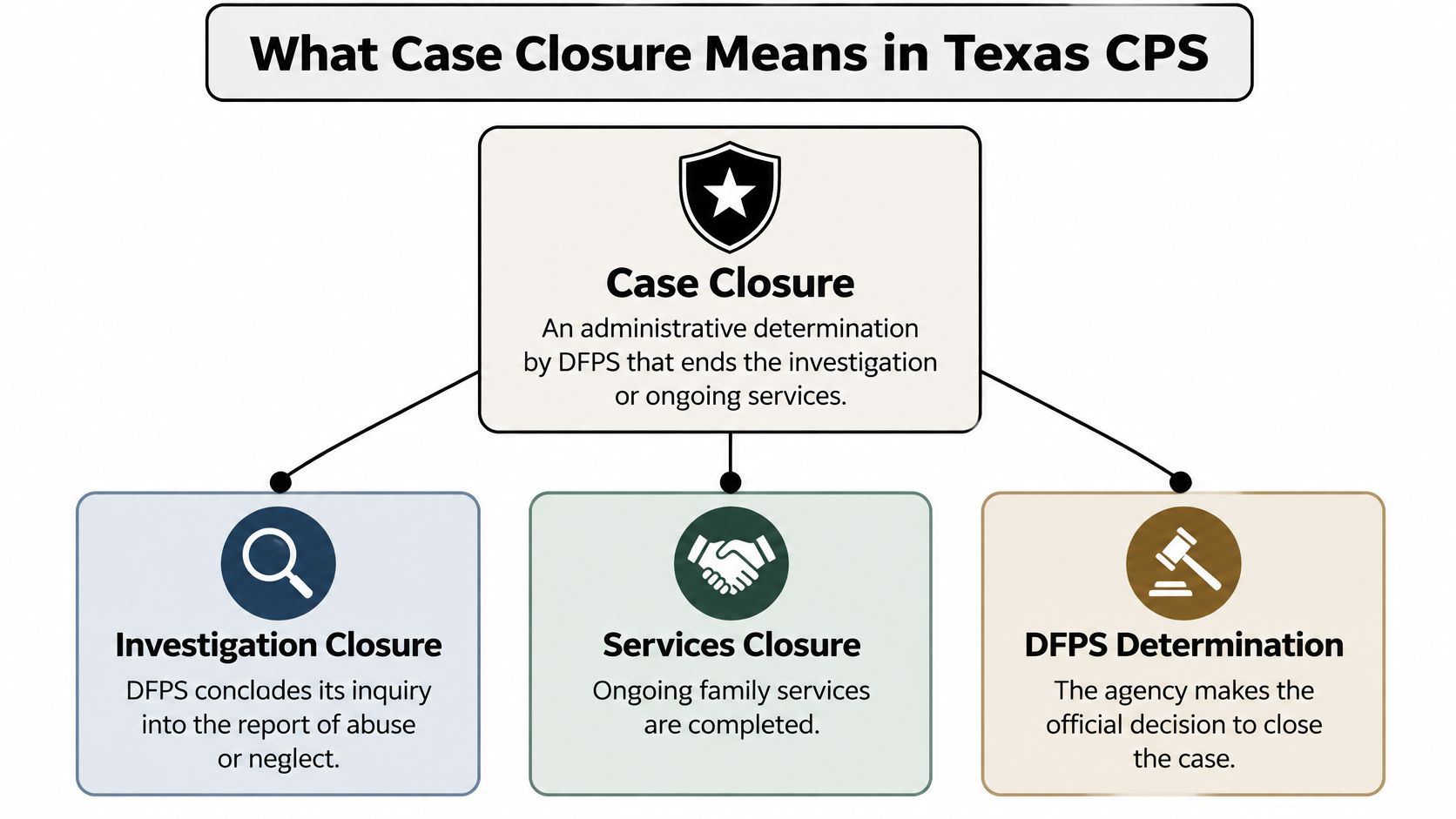
In Texas, closure is best understood as an agency decision, not a judge declaring you innocent. Texas policy describes closing a case as an administrative determination that the investigation or ongoing services are complete, and the stage ends only after required documentation is finished, active service authorizations are terminated, and a supervisor approves closure in the DFPS IMPACT system, as explained in the Texas DFPS CPS handbook on case closure.
That definition matters for you. CPS can close its file because it finished its work, because services helped lower risk, or because it found no significant safety threat right now. Closure doesn't always mean every allegation was disproved in court.
Closure Is Different From a Disposition
Think of it this way. A disposition is CPS's finding on an allegation, such as whether the evidence supports it or rules it out. Closure is the decision to end the active stage of the case. You can have a closed case with different findings underneath it, which is why you should ask for both pieces of information.
- Active case management ends: Routine CPS monitoring and caseworker visits tied to that stage stop.
- Service authorizations end: DFPS paid or DFPS authorized services tied to the open stage are terminated as part of closure.
- The history remains: Ending the stage doesn't erase the agency's historical record of its involvement.
- A future report is still possible: A later concern can be screened as new information, even after this case closes.
Closure ends CPS's active involvement in that stage. It doesn't rewrite history, and it doesn't act as a court order on custody.
For you, the practical question is simple. What exactly did DFPS decide, and what paper proves it? Ask for your closure notice and disposition information in writing, keep proof that you completed services, and review factual details for mistakes. If something looks wrong, address it promptly through the DFPS records process or with legal help rather than hoping it won't matter later.
That careful first step protects you if an employer, a family court, or a future caseworker ever asks what happened. You're not being difficult by asking for clarity. You're building the file you'll wish you had if questions come up again.
Different Ways a CPS Case Can Close
Not all closure letters mean the same thing for your family. Two parents can both hear that their cases are closed, yet one case ended because an allegation was ruled out and the other ended because services reduced risk over time. The reason for closure affects what you should keep, what you should watch for, and how you talk about the case later.
Common Closure Pathways in Texas
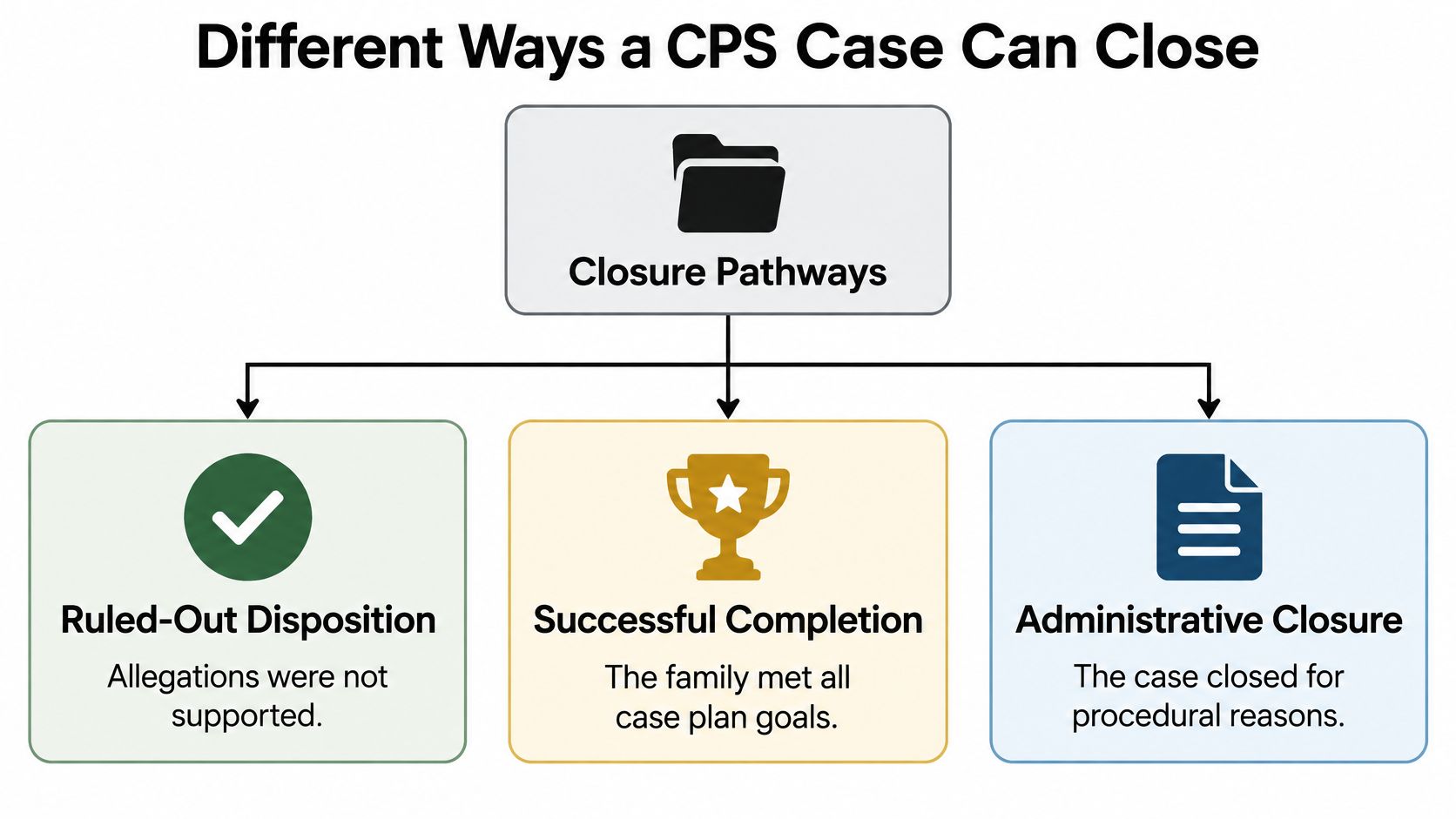
Ruled out or no significant safety threat is the outcome many parents hope for. CPS investigated, gathered information, and decided the evidence didn't support continued involvement. You should still keep the letter because it helps you answer future questions calmly and accurately.
Successful completion of services looks different. You may have finished parenting classes, counseling, substance use treatment, or other family based safety services. Closure here reflects progress, not necessarily a finding that the original concern never existed. Your completion certificates and provider letters are gold. Keep copies outside your home, such as in cloud storage or with a trusted relative.
Family declines services where no safety threat is identified can also lead to closure. That doesn't mean CPS will force help on every family. If the agency doesn't identify a safety threat that justifies continued action, it may close while you use community support on your own.
Unable to locate is more fragile. Closure may follow efforts to find a family, subject to added approval requirements. If you moved during a case and later surface in a custody dispute, don't assume an old address problem was resolved on the merits.
Administrative Closure
Administrative closure has specific grounds. A case may be administratively closed when every allegation meets a qualifying condition, such as DFPS lacking authority to investigate, the allegation having already been investigated, the conduct not meeting the definition of abuse or neglect, or an anonymous report lacking corroborating evidence, as defined in the DFPS glossary on administrative closure. It can also apply when credible information shows the alleged abuse or neglect didn't occur or isn't at risk of occurring.
Those distinctions matter in serious cases too, especially where a parent worries the next step could affect parental rights. If you're unsure how closure interacts with a more severe outcome, our guide to termination of parental rights in Texas explains that separate court process in plain language.
Read your letter for the pathway, not just the word closed. If the letter doesn't state the reason clearly, ask the caseworker or supervisor in writing which closure type and disposition apply to you.
The Closure Process and Timeline in Texas
You may feel like closure happened suddenly, but behind the scenes several people have to finish paperwork before DFPS can end the stage. Understanding that process helps you know whether your case is closed, still waiting on a supervisor, or stuck because more work is needed.
Standard Investigation Timeline
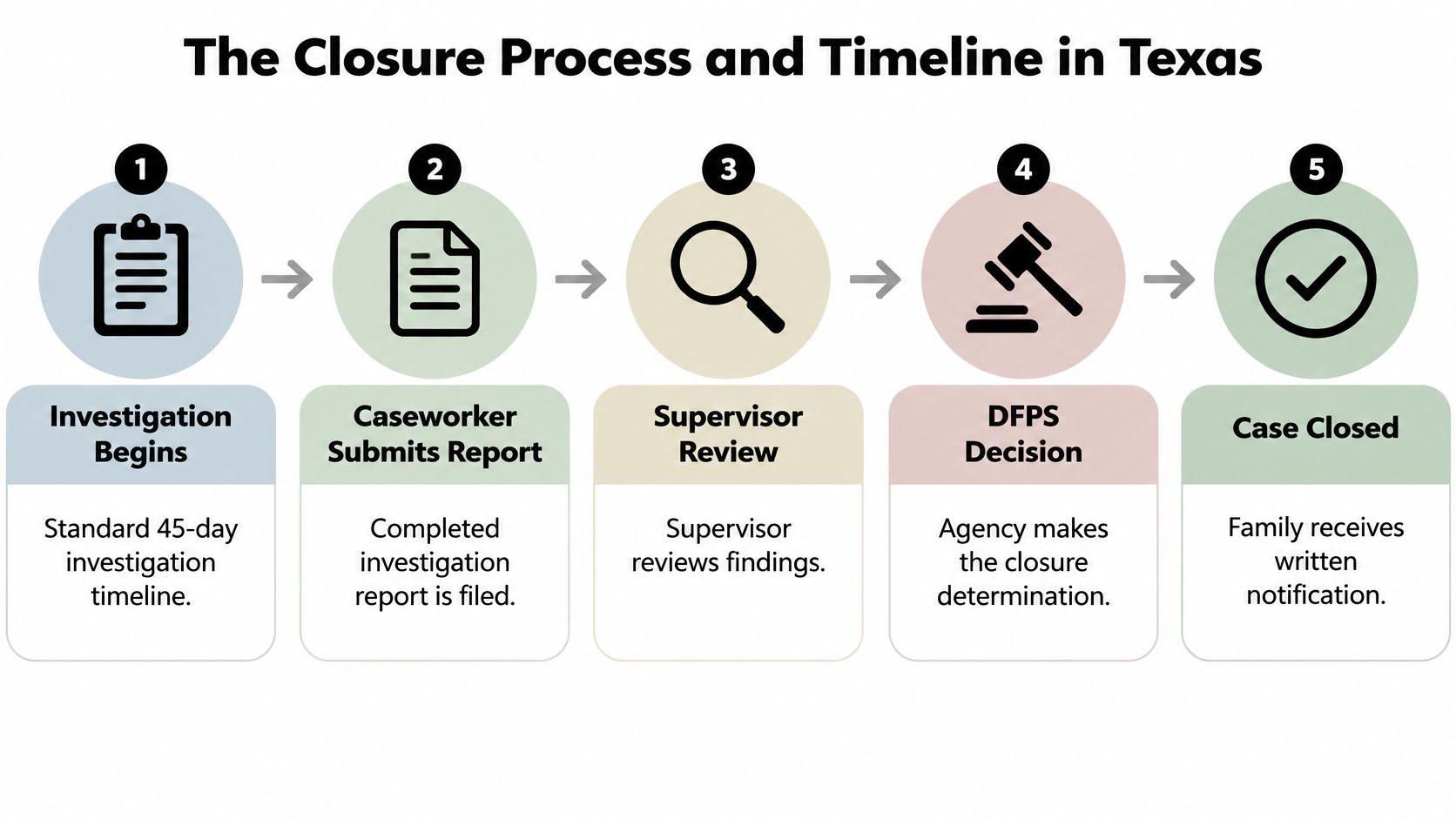
For a standard Texas investigation, the caseworker generally submits the completed investigation to a supervisor for closure within 45 calendar days of intake, and the supervisor must review and approve or return it within five business days, according to the DFPS investigation handbook timeline. If the supervisor approves, the case automatically closes in IMPACT. If the supervisor returns it, the caseworker gets specific added actions to complete first.
That means interviews ending doesn't always mean the file closed that day. Documentation, safety assessments, collateral contacts, and supervisory review may still be moving after your last visit.
- Caseworker finishes the work: Interviews, home observations, and safety and risk assessments are documented.
- Caseworker submits for closure: The completed file goes to a supervisor for review.
- Supervisor decides: Approval closes the case in IMPACT, while a return sends it back for more action.
- You get notice: Keep the written notice with your court and service records.
Alternative Response Timeline
Alternative Response cases can close earlier than the outer deadline when the family no longer needs agency involvement and identified risks have been addressed. DFPS guidance for ordinary Alternative Response cases generally calls for the caseworker to submit the case for closure by day 60 and the supervisor to formally close it by day 70 unless an approved extension applies, with written notice generally provided within 15 calendar days after closure, as described in the DFPS Alternative Response policy guide.
Before that closure, the caseworker must address the reported allegations, make meaningful contact with each verbal child in the home, and observe the children in a developmentally appropriate way. If you haven't received written notice and you believe your case should be closed, politely ask for the status and the expected notice date. Put your request in writing so you have a record.
What Happens to Your CPS Records After Closure
Many parents exhale at closure, then tense up again when they think about the file. Will a future employer see it? Can the other parent use it in a custody case? Can you get it erased? Those are fair questions, and you shouldn't guess at the answers.
Closure doesn't erase the record. DFPS retains closed records for accountability and legal requirements, sends them to records operations within 30 days, and generally calculates retention from the closure date, and people personally involved may request records subject to confidentiality restrictions, as outlined in the DFPS handbook on closed records.
CPS Records After Closure
| Question | Answer |
|---|---|
| Does closure delete my file | No. DFPS keeps a historical record after the active stage ends. |
| Can I request my records | People personally involved may request them, but release is restricted by confidentiality rules. |
| When does retention start | Retention is generally calculated from the closure date, after records go to records operations. |
| What if a fact is wrong | Preserve proof and raise the error promptly through the DFPS records process or a legal channel. |
| Is sealing the same as expungement | No. Sealing limits access, while expungement generally means destruction or removal where the law allows it. |
Sealing, Expungement, and Practical Risk
Don't let anyone sell you a simple promise that every closed CPS record can be wiped away. Texas options depend on the type of case, the finding, any court involvement, and the specific record at issue. A juvenile court record, a DFPS investigation record, and a family court file in a divorce are different records held by different offices.
Protective habit: Build your own clean file now, with your closure letter, service certificates, drug test results if they help you, school records, medical records, and any final court order.
That personal file matters if a record causes trouble later. For example, if you're a teacher, nurse, childcare worker, business owner who works with families, or a parent in a contested custody case, you may need to explain the outcome with documents rather than emotion. The same file helps a lawyer evaluate whether a correction request, sealing effort, or court filing makes sense for you.
Request your records, read them carefully, and note names, dates, and statements that look inaccurate. Don't mark up originals you receive from the agency. Make a separate list of concerns with supporting proof, then get advice before you submit anything that could be misunderstood.
Can a Closed CPS Case Be Reopened
A closure letter can bring relief, but it does not guarantee CPS will never contact your family again. If a new report comes in, the agency may screen it and open a new investigation or service stage. That is different from reopening the stage that already ended.
The image below captures what you're working to protect, ordinary safe time with your child without an agency file hanging over your home.

A New Report Is Not the Same as Reopening
Closure ends the existing stage. Later information may lead to a new screening, investigation, or services stage, and the prior record may inform agency decisions, subject to confidentiality rules and applicable law under Texas administrative rules for child protective services. In plain English, CPS generally evaluates new information rather than restarting the old stage.
A prior file may still matter. A caseworker reviewing a new report may see the earlier concern and how it was resolved. A ruled-out finding with supporting documentation presents a different history from a services closure involving a similar safety concern. Neither outcome determines what CPS will decide later.
Closure also reflects the information and safety concerns at that time. It does not guarantee that circumstances will never change. Keeping stable routines and support in place can help your family maintain progress after CPS involvement ends.
Federal Child Maltreatment 2024 data reports that some families receive services after CPS contact. Postresponse services do not, by themselves, mean the original CPS case remains open. Likewise, closure does not mean a family received no support.
Which Obligations End and Which Can Survive
When a CPS stage closes, active DFPS case management for that stage ends. Other obligations may continue, depending on who imposed them and what authority governs them.
- DFPS safety plan: Ask whether it ended, expired, or was replaced. Request written confirmation if possible.
- Court order: Requirements involving counseling, visitation, placement, drug testing, or conservatorship remain in effect until the court changes or ends them.
- Voluntary services: Services may continue after DFPS closes its case, depending on the arrangement. Court-ordered services remain subject to the order.
- Criminal or probation conditions: These come from a criminal court or supervision authority, not a CPS caseworker.
- Private provider agreements: Counseling or treatment you agreed to with a provider may continue under its terms.
Reunification cases can involve separate decisions about foster care, placement, and court orders. Federal fiscal year 2023 data recorded 184,095 children exiting foster care and 50,193 children exiting to adoption, according to the federal AFCARS dashboard for 2023. Those outcomes show why foster care closure does not mean the same thing for every family. The court paperwork determines which obligations remain in your case.
If your child was removed and you are working to regain custody, read the final court orders carefully. The court process is separate from CPS case closure. Learn more about regaining custody after a CPS removal in Texas.
Families in a divorce may also have separate court orders. Divorce with children in Texas explains how a divorce court addresses custody, support, and parenting time.
The short video below offers an overview to keep in mind as you review your orders.
How You Can Lower Future Risk
You cannot control whether someone makes a report. You can keep clear records of completed services, stable housing, school attendance, medical care, childcare arrangements, and supportive adults in your child's life. If your circumstances have changed, keep dated documents that show what changed.
Follow any court order that remains in effect, even if CPS has stopped visiting. If an order no longer fits your situation, seek a formal modification through the Texas court process or mediation where appropriate. A caseworker's departure does not change a judge's order.
If CPS contacts you again, ask for the worker's name and whether the agency is screening a report or opening a new stage. Stick to facts you know, and get legal advice before signing a new plan or agreeing to a placement you do not understand.
Next Steps for Your Family After Closure
You don't need to do everything in one weekend, but you do need a short checklist while the paperwork is fresh. Closure is a milestone for your family. Protect it with the same care you used to get through the case.
Your First Two Weeks After Closure
Start by reading your closure letter slowly. Highlight the date, the case stage, the disposition if it's listed, and any sentence about services or court orders. If the letter is vague, write down your questions before you call so you don't forget them under stress.
- Gather your core documents: Closure letter, closing summary where available, service completion proof, safety plan copies, and any court dismissal or final order.
- Separate CPS paper from court paper: Put DFPS notices in one folder and signed judge's orders in another.
- Request records if needed: Ask how to obtain your DFPS record and note any confidentiality limits on release.
- Check surviving duties: Review counseling, visitation conditions, placement rules, testing, and support obligations one by one.
- Store copies safely: Keep digital backups and tell one trusted person where they are.
When Legal Help Makes Sense for You
Get advice promptly if your closure letter conflicts with a court order, if your child isn't home yet, if a background check is raising the case, or if the other parent is using the CPS history in a custody fight. The same is true if you face a sudden safety claim and think you may need an emergency custody hearing to protect your child.
Parents, business owners, and families with high value estates often have added pressure because a CPS history can surface alongside property division, conservatorship, and possession disputes. A lawyer can help you present the closure accurately, neither hiding it nor overstating what it means.
You worked hard to reach closure. A clean document file and a clear view of surviving orders help you keep that progress.
Take a breath. Then do the paperwork. That combination gives your family stability now and credibility if anyone questions the past later.
Frequently Asked Questions About CPS Closure
Does a Closed Case Clear Your Name
Not in the broad way many parents hope. Closure means DFPS ended the active stage after its administrative process. Your disposition is the piece that tells you how the allegation itself was resolved, so ask for that information and keep it with your closure letter.
Can You Get the Record Expunged
Maybe, but not automatically and not for every type of record. DFPS records, court records, and any criminal records follow different rules. You need a record specific review before anyone can tell you whether sealing, expungement, or a correction request is available to you.
What Happens if Someone Reports You Again
CPS screens the new information and decides whether a new investigation or services stage is warranted. Your old closed file can inform that review, which is why proof of services, stable routines, and changed circumstances helps you. Don't panic, but don't ignore the contact either.
Does Closure Change Custody or Visitation
No, not by itself. A CPS closure doesn't rewrite a divorce decree, a custody order, or a possession schedule under the Texas Family Code. If a family court order needs to change after closure, you generally need an agreed order, mediation followed by a court approved order, or a judge's decision after a filing and hearing.
Should You Stop Counseling or Services After Closure
Only if you've confirmed the source of the requirement. If a judge ordered it, it survives until the judge changes it. If it was purely a DFPS service authorization, closure may end DFPS payment or monitoring, but continuing voluntarily can still help your family and your credibility in a custody case.
What Is the Most Important Document to Keep
Keep the closure notice and any final court order together. One shows DFPS ended its stage, and the other shows what legal duties, if any, remain in force for you and your child.
If your CPS case just closed and you're still unsure which orders, services, or records issues remain for your family, the Law Office of Bryan Fagan, PLLC can review your closure letter and Texas court orders with you and map out your next steps. Schedule a free consultation today by visiting Law Office of Bryan Fagan, PLLC so you can move forward with clarity and confidence.


