 Skip to content

You may have filed for divorce, or be preparing to file, and still have no idea when life will feel settled. That uncertainty is hard, especially when you're trying to protect your children, home, income, or business at the same time.
A divorce process step by step guide should do more than list forms. In Texas, each court milestone can affect what happens next, and your path may change depending on whether you have children, agree on the terms, face safety concerns, serve in the military, or need to divide a business or substantial assets.
How the Texas Divorce Process Actually Moves
You and your spouse may agree on the terms, yet the divorce is not complete when you sign a paper. The court still has to approve the required orders, and the signed decree must be filed with the clerk. Texas Supreme Court-approved forms show these as separate steps: filing, preparing final paperwork, attending court when required, obtaining the judge's signature, and returning the signed decree to the clerk (Texas Supreme Court-approved divorce forms).
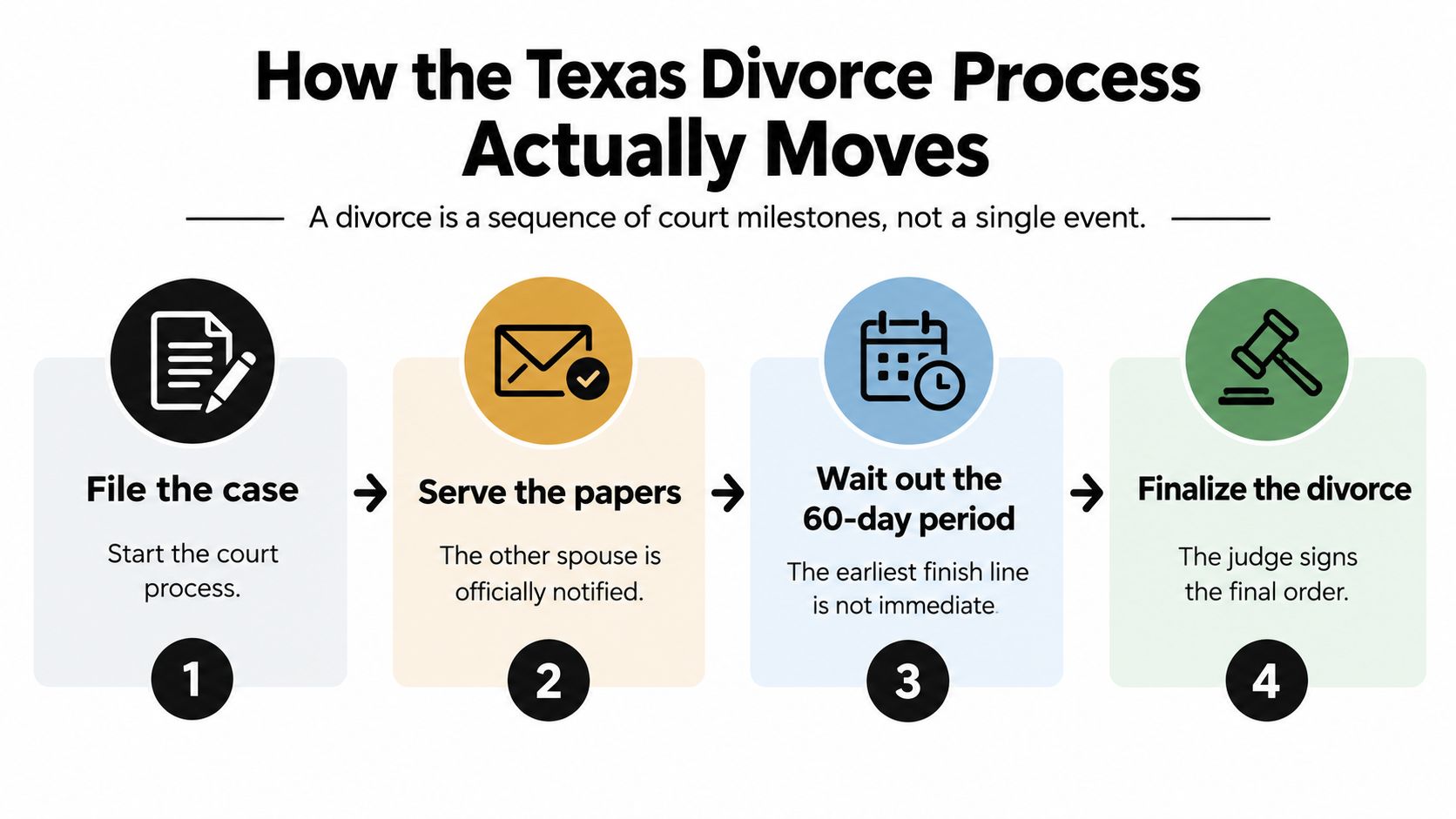
The case moves through milestones
Your case starts when you file an Original Petition for Divorce with the appropriate district or county clerk. Your spouse must receive legal notice, usually through formal service, a signed waiver of service, or an answer filed with the court. Filing opens the case; it does not decide where your children will live, who pays bills during the case, or how you will divide property and debt.
After notice, the case may take different paths. If you and your spouse agree, you can prepare an agreed Final Decree of Divorce for the judge to review and sign. If you disagree about immediate needs, either of you may ask the court for temporary orders. Disputes that remain unresolved can involve financial information exchange, mediation, hearings, or trial. Once the judge signs the decree, it must be filed with the clerk to complete the court record and make its orders enforceable.
Your path depends on the facts
For example, spouses without children who agree about property may have fewer issues to resolve than parents disputing a parenting schedule or spouses who need to value a business. Safety concerns may require protective steps before mediation. Military duty can affect whether a proposed parenting schedule is workable. If your spouse cannot be found or refuses service, the case may need a different procedural route.
These differences help explain why the court's basic milestones do not predict how long your own case will take. A contested parenting issue, a business valuation, or a problem giving notice can add steps. Keep track of the issue holding up agreement, and ask what court action is needed to address it. For forms and filing details, consult the firm's Texas divorce filing guide.
Filing Service and the 60-Day Waiting Period
Before you file, check whether you or your spouse meets Texas's residency rules. One of you generally must have lived in Texas for at least six months and in the county where you file for at least 90 days. You then file the Original Petition for Divorce with the district clerk or county clerk, depending on the court handling the case.
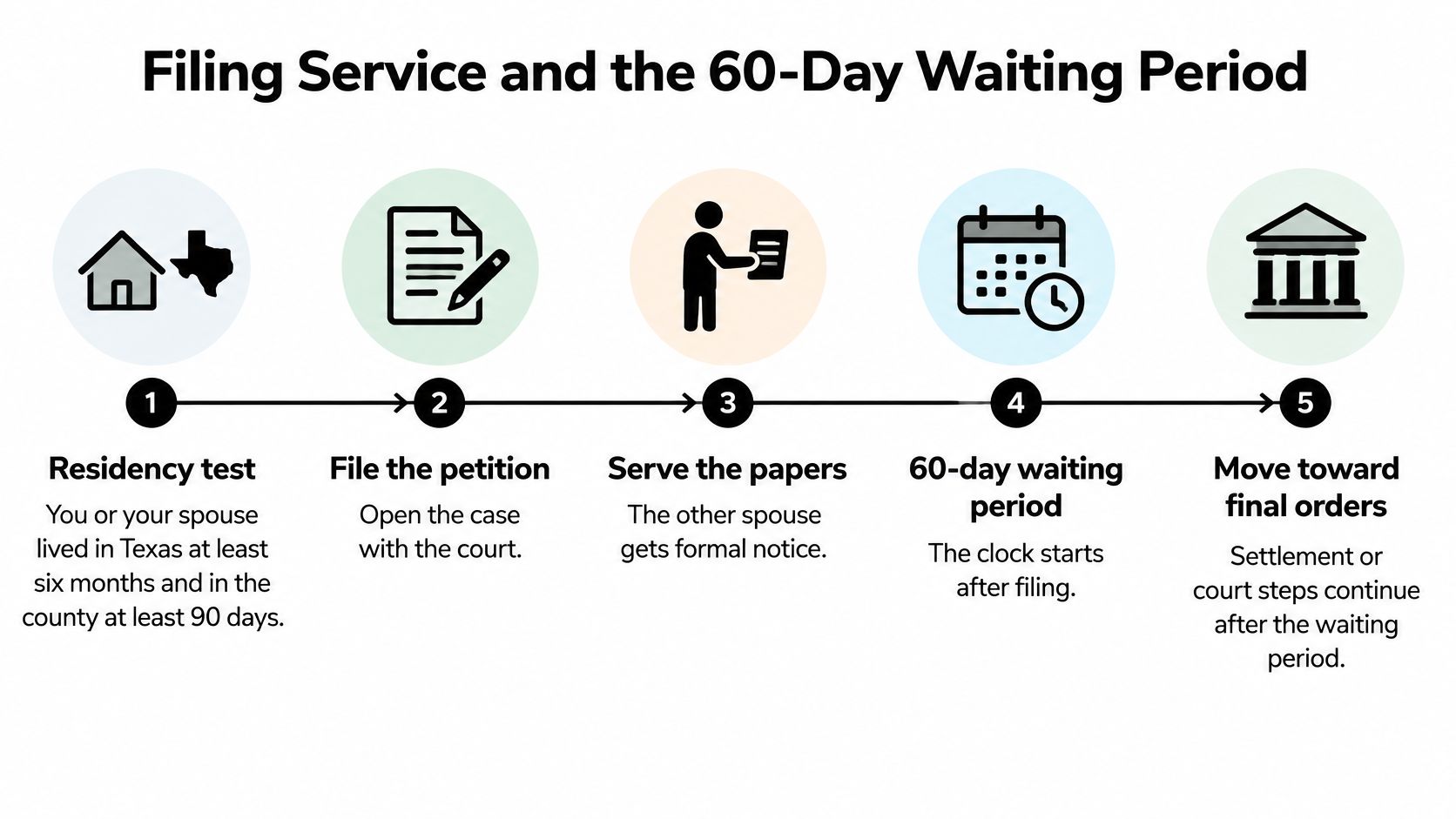
Make sure notice is handled correctly
Your spouse needs legal notice of the case. This may happen through service, a waiver of service, or an answer. Don't assume that sending a copy of the petition yourself satisfies the legal requirements.
If you can't locate your spouse, or your spouse refuses service, contact the clerk or a Texas family lawyer before choosing your next step. Keep a record of attempts to locate or notify your spouse, and ask about the court's procedures for handling your situation. Local rules and court practices can affect how a case proceeds, even though the statewide law remains the same. The Original Petition for Divorce in Texas is the document that opens the case; details in the petition need to fit your circumstances.
Count the waiting period carefully
Texas generally bars the court from granting a divorce before the 60th day after filing. The filing date isn't day one. The next day starts the count, and weekends and holidays are included. If the 60th day falls on a weekend or holiday, finalization ordinarily moves to the next business day (Texas Family Code Section 6.702).
That's the earliest ordinary date, not a promise that your divorce will be finished then. Unresolved parenting, property, support, service, or evidence issues can keep a case going beyond the waiting period. Texas law also recognizes limited family-violence exceptions, including certain qualifying convictions or deferred adjudications, and certain protective or magistrate's emergency protection orders based on family violence during the marriage.
Use the waiting period to collect financial records, list debts, and work on a parenting and money plan. For a factual overview of how agreed cases move through the statutory waiting period, see Uncontested Divorce in Texas: The Faster Path.
Temporary Orders and Emergency Protection
A divorce doesn't immediately settle everyday questions. You may still need a clear plan for the home, bills, parenting time, and access to money while the case is open. Temporary orders give the court a way to set short-term rules until the final decree.

Ask for workable rules while the case is pending
For example, you may need to know who can stay in the home, who pays the mortgage or other bills, and who has the children on school days. A written schedule can prevent a child's school pickup from becoming a repeated argument, while a clear bill arrangement can reduce confusion about payments due before the divorce ends.
A business owner may face a different problem. If both spouses have access to company funds or one still has signing authority, the business may need temporary rules for payroll, inventory, and financial decisions. A temporary restraining order may limit certain spending, transfers, or harassment while the case is pending. The details depend on the order and your situation, so don't assume the court has restricted an action unless an order or applicable rule does so.
For information about short-term financial responsibilities, review temporary orders and what a spouse may have to pay. You can also learn more about temporary orders in a Texas divorce.
Put safety before a settlement meeting
If you fear family violence, ask about emergency relief before sitting in a room with your spouse. TexasLawHelp explains that someone with a documented history of family violence or fear for their safety may object to court-ordered mediation before it occurs (TexasLawHelp's divorce and mediation guidance). Safety concerns aren't something you have to set aside just to move the case forward.
When asking for help, gather any existing orders, records of recent incidents, pay information, a proposed possession schedule, and the bills that must be paid this month. Those details can help the court understand what needs attention now.
Temporary orders don't finish your divorce. They help keep your children, housing, finances, and safety more stable while the case continues.
Children Property and Support Before You Settle
Before you agree to a final decree, separate the questions that can easily get blurred together. Parenting decisions, child support, property division, and transfer paperwork each require different information. A clear agreement needs to address them distinctly.
Parenting time and support are related but separate
Texas courts deciding child-related issues focus on the child's best interest. Conservatorship addresses decision-making rights and responsibilities. Possession and access cover when each parent has the child. Your parenting plan may also need to address geographic limits, school arrangements, holidays, exchanges, and medical decisions.
Child support is a separate calculation, not an automatic equal split of every child-related expense. Texas guidelines start with the paying parent's net resources, which don't always equal take-home pay. The commonly stated guideline percentages are 20 percent for one child, 25 percent for two, 30 percent for three, 35 percent for four, and 40 percent for five; six or more children generally trigger at least 40 percent. These guideline figures and the distinction between net resources and take-home pay are explained in the Texas Family Code, Sections 154.125 and 154.126 (Texas Family Code child-support provisions).
The standard guideline calculation has a statutory monthly-net-resources ceiling. A judge may consider proven needs when resources exceed that ceiling and may deviate from the guidelines in special circumstances. Another household can also affect the calculation. Save pay records, tax returns, benefit information, insurance records, and evidence of children's medical or educational costs.
Classify property before negotiating trades
Start by sorting assets into community, separate, or mixed property. Then identify the value of each asset and the debt tied to it. A home, business, bank account, or retirement plan can have different ownership histories and transfer needs, so don't assume that a rough estimate or informal promise will settle the details.
Business owners and people with substantial assets should gather relevant statements, business ownership records, tax returns, and debt information. Retirement divisions may also need specific transfer paperwork. For parents serving in the military or married to a service member, discuss duty stations and housing when planning possession, travel, and exchanges. A schedule needs to work in real life, not just on paper.
Choosing Agreement Mediation Trial or a Lawyer
Start by asking how much agreement you have and how complicated the financial or parenting issues are. A fully agreed case with simple finances may be suitable for an uncontested path. A missing spouse, disputed parenting plan, business, retirement accounts, or serious conflict can require more preparation and legal structure. Safety concerns call for a safety-focused plan before you decide whether to meet or mediate.
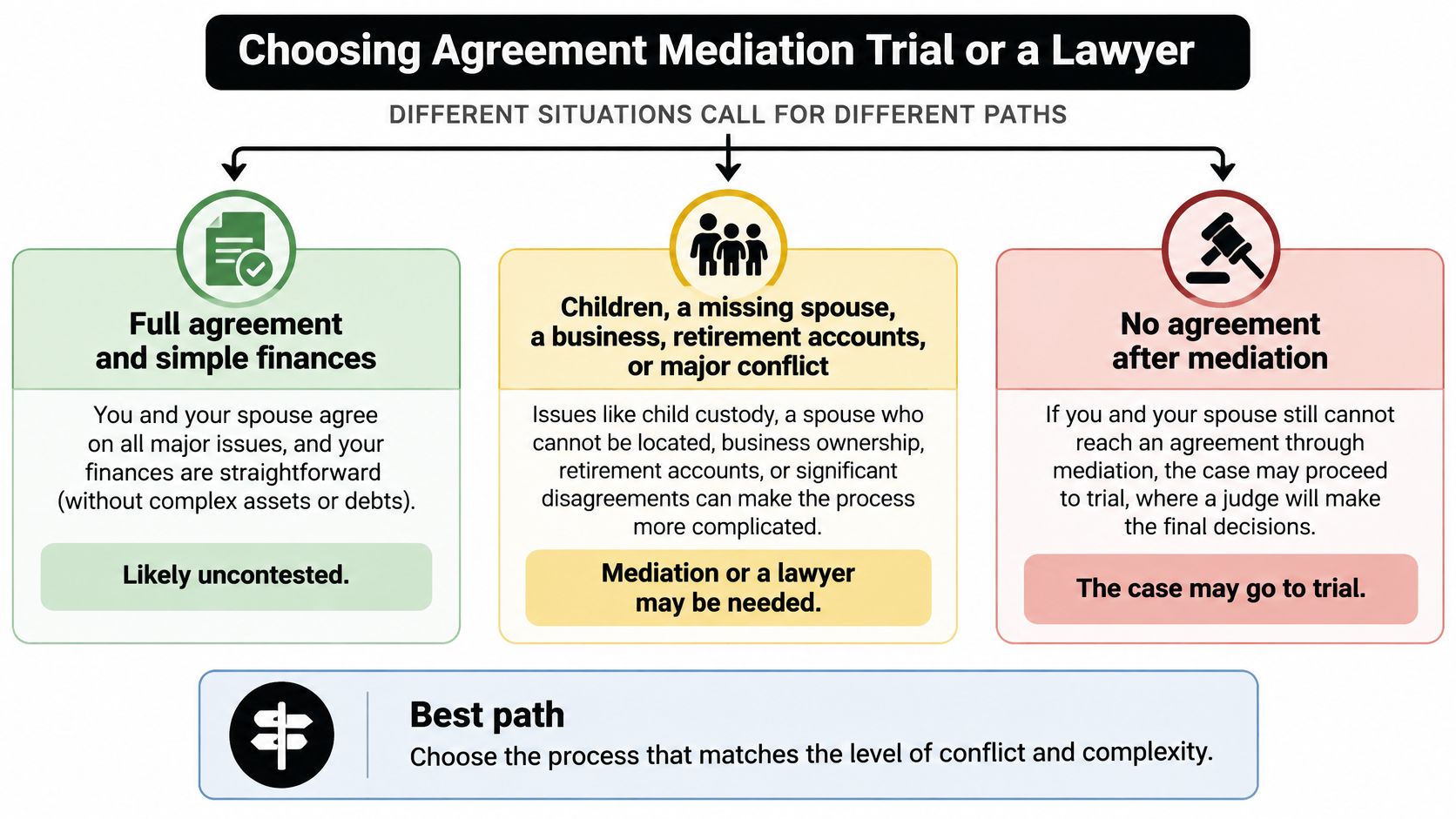
Compare the available paths
Texas Family Code Section 6.602 allows a divorce court to refer parties to mediation, and spouses may choose mediation before or after filing. A mediated settlement agreement can bind you if it meets statutory requirements, including language stating it's not subject to revocation, signatures from both spouses, and a participating attorney's signature when applicable. Mediation is a formal decision point, not merely an informal conversation.
| Path | Best fit | Main risk | Help you may need |
|---|---|---|---|
| Uncontested | You agree on the divorce terms and have relatively simple finances | A missed issue or incomplete paperwork can create problems later | Forms guidance and careful review of the decree |
| Mediation | You have disagreements but are willing to negotiate | Broad terms may leave key details unresolved | Preparation, legal advice, and a specific written agreement |
| Trial | Important issues remain unresolved after other efforts | The court decides disputed issues based on the case presented | Counsel, financial records, witnesses, and hearing preparation |
If you're preparing to mediate, the Texas divorce mediation checklist can help you organize financial and parenting information. Bring a balance sheet, bank and brokerage statements, retirement records, tax returns, business documents, debt statements, insurance details, and a proposed parenting plan. Spell out account numbers, valuation dates, who handles a Qualified Domestic Relations Order (QDRO), transfer steps, deadlines, tax responsibilities, and enforcement terms. Vague wording can leave you fighting over what you thought you had settled.
Choose help that fits the case
Contested cases may require mediation before a final hearing, and a final hearing can require at least 45 days' notice. That timing makes it sensible to plan mediation early enough to leave room for required disclosures and court scheduling.
A DIY approach may fit a low-conflict case where both spouses understand the terms and the paperwork. Parents, service members, and spouses dividing a business or high-value estate may benefit from legal advocacy that accounts for the practical and legal details. The Law Office of Bryan Fagan, PLLC handles contested and uncontested divorce, mediation, military matters, temporary orders, and complex property cases across Houston, Dallas–Fort Worth, Austin, San Antonio, and nearby counties, with in-person and virtual consultations. You can also review the firm's Family Law YouTube video for general information.
Final Decree Prove-Up and Life After Signing
Even when you and your spouse agree, the judge must approve the final orders. In an uncontested case, you may attend a prove-up, where the judge reviews the agreement and confirms the information needed to grant the divorce. The hearing is one part of the process. The written paperwork must also be complete and correctly filed.
Prepare for the court's review
Bring the proposed decree, including its parenting and support provisions. Be ready to show that residency and notice requirements have been met. The judge may look closely at terms involving children or complex property, since each order needs to say clearly what you and your spouse must do.
After the judge signs, make sure the signed Final Decree of Divorce is returned to the clerk and filed. These are separate steps: the judge approves and signs the order, then the clerk adds it to the court record. Filing completes that record and makes the orders enforceable. As noted earlier, the approved forms distinguish between the judge's signature and returning the decree to the clerk. A signed decree that has not been filed leaves the process incomplete.
Put the written orders into practice
Once the decree is filed, follow its written terms rather than relying on memory or informal promises. Check each obligation, due date, and transfer instruction. For example, if the order sets a support arrangement or a date to transfer an account, use those details to guide what you do.
- Accounts and benefits: Update beneficiaries only as the decree permits, and divide accounts according to its dates and terms.
- Support: Start wage withholding or direct payments as the order requires.
- Parenting: Follow the written exchange schedule and add summer and holiday arrangements to your calendar.
- Retirement and military matters: Check that transfer documents and retirement orders match the decree before treating the division as complete.
If income changes, a parent moves, or your former spouse does not follow the order, modification or enforcement may be appropriate. The next steps depend on what changed and what the decree says. Read about what happens after a Texas divorce is final for information on custody, support, and enforcement.
What to Do Next in Your Texas Divorce
You don't need to solve every issue today. Start by identifying what the court needs, what your family needs while the case is pending, and which decisions can wait for an agreement or hearing.
Key takeaway: The petition starts the case, the 60-day waiting period is a minimum, and temporary orders can protect the time between filing and finalization. The court record is complete only after the judge signs the decree and the signed document is filed with the clerk.
Use this checklist to prepare
- Confirm residency: Check that you or your spouse meets the Texas and county residency requirements before filing.
- List the issues: Write down each account, debt, business interest, and your child's regular schedule.
- Save financial records: Keep pay statements, tax returns, benefit information, insurance records, and documents related to property and debts.
- Consider safety first: If you fear family violence, ask about emergency orders and your mediation options before agreeing to meet.
- Choose a path: Decide whether an agreed case is realistic, whether mediation could help, or whether you need a plan for contested issues.
If you're a parent, plan around your child's routine and the separate questions of parenting time and support. If military orders may affect where you live, include duty and housing details in your planning. If you own a business or have a high-value estate, collect records before negotiating a division that may be difficult to undo.
The firm's online library, Family Law YouTube channel, and DIY Divorce eCourse offer learning tools for Texans. A consultation can help you sort out the next filing, temporary-order request, or settlement step for your county, especially when children, safety, military service, or complex property are involved. The Law Office of Bryan Fagan, PLLC offers free consultations in person or virtually. You don't have to guess the sequence alone.
If you're facing divorce, custody questions, or a complicated property division, the Law Office of Bryan Fagan, PLLC can help you understand your options and plan your next court step. Visit Law Office of Bryan Fagan, PLLC to schedule a free consultation, in person or virtually.


