 Skip to content

You want your child's name to match the family life they know, but you're worried about what the court will require.
A child name change in Texas involves more than choosing a name and updating school paperwork. You'll need to identify the right court, address notice to the other parent, and explain why the change helps your child. You don't have to solve every issue before asking for help, but you should understand the process before filing.
Who Can File for a Child Name Change in Texas
You may want your child to share your surname after divorce or feel more connected to your blended family. Before preparing paperwork, check whether you're legally entitled to bring the case.
Under Texas Family Code §45.001, a parent, managing conservator, or guardian may petition to change a child's legal name, generally in the county where the child lives. Being a stepparent, grandparent, or another caring relative doesn't, by itself, put you in one of those roles.
For example, if you're a mother who remarried and wants your son to use his stepfather's surname, you can file as a parent. Your marriage explains the situation, but you'll still need to explain why the requested change serves your son.
Check your legal role and existing orders
A managing conservator is someone with court-assigned rights and responsibilities concerning a child. If you're unsure what authority you have, review your actual court order rather than relying on your family's informal arrangements. The firm's guide to Texas child custody laws offers related context.
Guardianship rules also depend on the state. If your family arrangements cross state lines, Miles Hansford Law Firm's resource on understanding minor guardianship in Georgia can help you identify questions about a Georgia arrangement, but it doesn't replace Texas filing requirements.
If you already have a divorce or custody case, locate those papers before filing. Your petition must disclose whether a court has continuing, exclusive jurisdiction under Texas Family Code Chapter 155, meaning an existing court has ongoing authority over the child's case.
Your pre-filing self-check
- Your authority: Are you a parent, managing conservator, or guardian?
- Your filing location: Does your child live in the county where you plan to file?
- Your existing case: Is there a divorce, custody, or other order the court needs to know about?
Filing starts the request. It doesn't approve it. You'll need a judge's signed order to complete the court-ordered legal change.
Consent, Notice and Serving the Other Parent
Consent and Notice by Situation
| Situation | Child's Written Consent | Notice to the Other Parent | What the Judge Reviews |
|---|---|---|---|
| Both parents agree, child under 10 | Not required by the age-10 rule | Filing and any required service still apply | Best interest of the child |
| Both parents agree, child 10 or older | Required in writing | Filing and any required service still apply | Consent packet and best interest |
| Other parent objects | Required if child is 10 or older | Must be served so the parent can respond | Contested best-interest hearing |
| Other parent cannot be located | Required if child is 10 or older | Extra steps may apply; ask the clerk what the county expects | Best interest, with proof required notice steps were followed |
| Parent's rights were terminated | Required if child is 10 or older | That parent need not be served | Best interest of the child |
| Child subject to sex-offender registration | Required if child is 10 or older | Depends on the case; confirm applicable requirements | Best interest, public interest, and proof of notice to local law enforcement |
The consent and citation requirements come from Texas Family Code Chapter 45. Disagreement and missing consent aren't the same problem. A parent who objects can respond and contest your request; a parent you can't find still creates a notice issue that must be addressed.
Citation means formal legal notice of the case. Service is the process of delivering that notice in a legally recognized way. Every parent whose rights haven't been terminated, along with any applicable managing conservator or guardian, must be accounted for.
When notice raises safety or practical concerns
If your situation involves domestic violence, estrangement, incarceration, military deployment, or unknown whereabouts, talk with a lawyer before arranging service. Ask how notice should be handled, whether your address needs protection, and what evidence the court will require concerning an absent parent.
Don't assume a clerk can approve an alternative notice method. Ask the clerk about local procedures, then get legal advice about any court authorization your circumstances may require.
For a related divorce case, Serving Divorce Papers in Texas explains how the other spouse is served and the deadline to answer. Don't assume those instructions supply every requirement for a separate child-name-change case.
Your marriage, divorce, or personal name change doesn't automatically change your child's legal name.
Using the preferred name without completing the legal process may feel easier, but mismatched records can create problems with schools, passports, and later custody disputes.
If you and the other parent disagree, ask whether mediation is available through your county or existing family case. Consider it as a way to discuss the dispute before a contested hearing, not as a replacement for required notice or judicial approval.
Before filing, answer this question: Who must sign or receive notice, and what proof will the judge need if someone objects or can't be located?
How to File a Child Name Change in Texas, Step by Step
If you are ready to file, use these steps to prepare the case and understand what the clerk and judge will review. The Texas State Law Library's child name-change guide explains the petition, consent, service, hearing requirements, and how county procedures can differ.
Prepare and submit your case
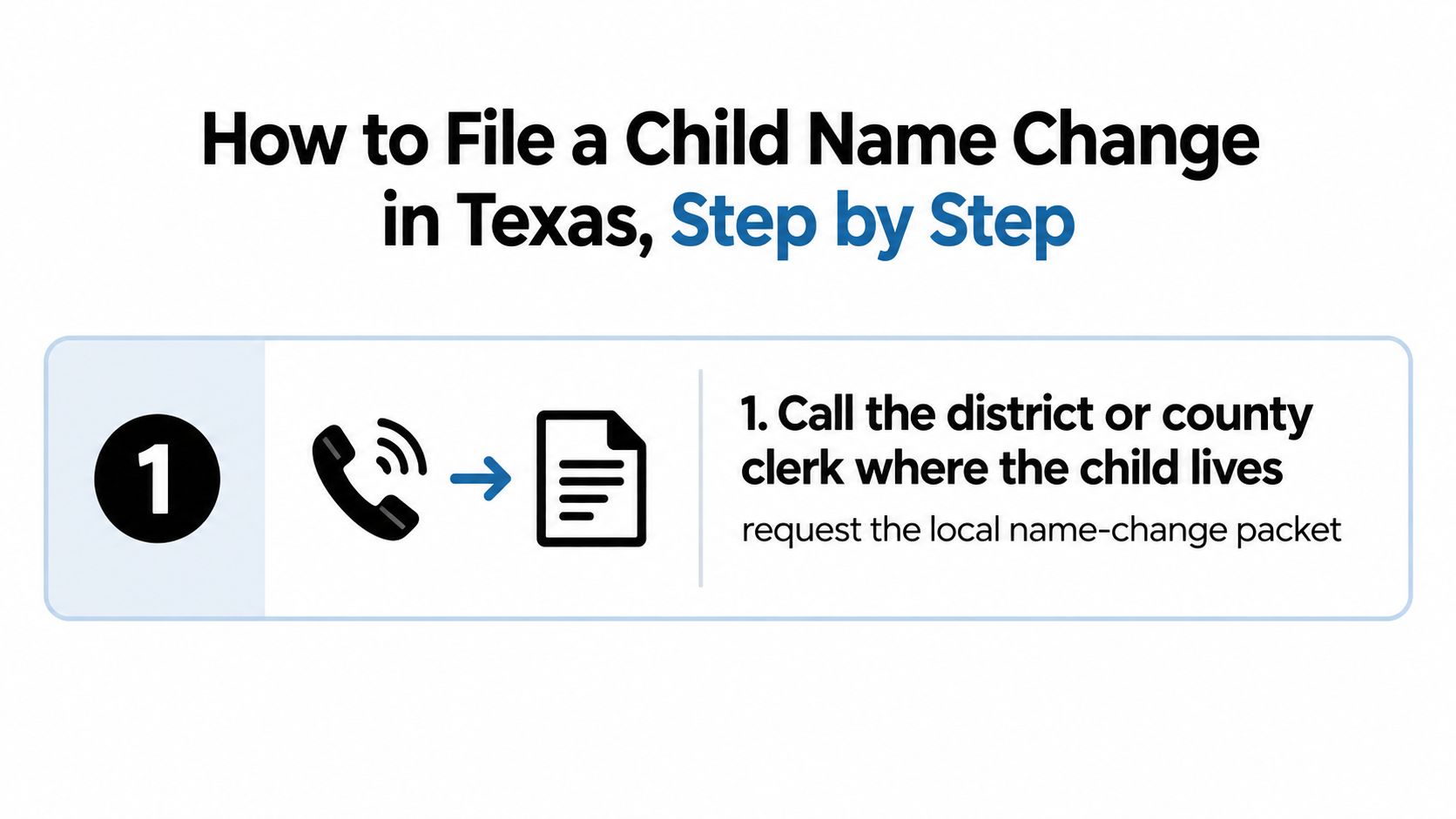
Check the local filing procedure. Contact the district or county clerk's office where your child lives. Ask which office accepts the case, which packet to use, what the filing fee is, and how to request a hearing. Local procedures can shape where and how you submit the paperwork.
Find any existing divorce or custody case. Gather the court name, case number, and relevant orders. The judge needs to know whether another court has continuing, exclusive jurisdiction over your child's case.
Prepare a verified petition. State your child's current name and residence, the requested name, your reason, relevant jurisdiction information, and whether your child is subject to sex-offender registration. “Verified” means you formally confirm that the petition's factual statements are true.
Include the child's written consent when required. Follow the age-based rule in the consent table and use the county's form. This gives the court the required written agreement.
Pay the filing fee or apply for an inability-to-pay waiver. Follow the clerk's instructions for the fee or application.
Complete the required notice and disclosures. Identify each person who must receive notice, including any non-consenting parent whose rights have not been terminated and any applicable managing conservator or guardian. Parental agreement does not remove filing requirements. Follow the procedure that applies to your case.
Request a hearing or confirm the uncontested process. Ask whether you must appear in person, whether remote appearances are available, and which documents the judge expects to review. If you are coordinating a custody case, the guide on how to file for custody can help you identify related preparation questions. A custody filing does not automatically include a name-change request.
What to gather before contacting the clerk
Gather the records first, then confirm which ones the court requires you to file:
- Identity records: Your child's birth certificate and the exact spelling of the current and requested names.
- Parent information: Each parent's name and last known address. Flag safety concerns for your lawyer.
- Existing orders: Copies of custody, support, guardianship, or other relevant orders.
- Case paperwork: The completed petition, any required consent, fee or waiver documents, and a proposed order if the local packet requests one.
Keep copies of what you submit and note any instructions about documents the judge will review. If you are divorcing, ask your lawyer how to coordinate the name-change request with the divorce case, including its filing, notice, temporary arrangements, information exchange, settlement or mediation, and final decree. If you own a business or have a high-value estate, list those financial questions separately so they do not distract from the evidence about your child.
What the Judge Decides at the Hearing
The judge decides whether the requested name serves your child's best interest. That is the controlling standard under Texas Family Code §45.004.
If your child is subject to sex-offender registration under Chapter 62, the judge must also find that the change serves the public interest. You must provide proof that your child notified the appropriate local law-enforcement authority.

Build an explanation around your child
Give the judge a clear picture of your child's daily life. Explain whether the requested name would bring consistency to school, medical care, and family life. Be prepared to discuss your child's relationships with each parent and any stepparent, along with your child's own views.
These topics help you prepare; they are not a fixed statutory checklist or a promise of approval. If your child already uses the requested name informally, describe when and why that began. The judge still needs to decide whether a legal change serves your child's best interest.
For example, you might explain that your child feels confused when adults use different surnames, then give specific experiences you have observed. Keep the explanation centered on your child's needs. Focus on what your child gains from the change.
Practical rule: Connect the requested name to your child's welfare with specific, honest examples.
Adult resentment can distract from the judge's decision. A request that appears intended to erase the other parent's role may raise concerns, so discuss those concerns with your lawyer before the hearing. For more context, read about the best-interest standard in Texas custody decisions.
Prepare for the hearing itself
Your county may hold the hearing in person or virtually. Confirm the format and document-submission instructions directly with the court.
- Organize your papers: Keep the petition, service documents, consent, and existing orders easy to find.
- Prepare a short explanation: Connect the requested name to your child's welfare.
- Be ready early: Review courtroom directions or remote-access instructions before the hearing.
- Answer directly: Respond to the judge's questions without arguing with the other parent.
If the judge approves the request, ask the clerk how to obtain certified copies of the signed order. If an existing custody order creates a conflict, get advice about custody and enforcement instead of interpreting the orders yourself.
Updating Birth Records and Other Documents After the Order
Once the judge signs the order, the birth certificate is often the first record to address. Under Texas Family Code Chapter 108, the clerk sends a certified order and identifying details to vital statistics, including the child's current and former names, birth information, court, and docket number. The central file is generally confidential.
Parentage cases have a related rule. Under Texas Family Code §160.636, a court deciding parentage may order a name change for good cause. If the ordered name differs from the birth certificate, the court must direct that an amended birth record be issued.
Distinguish a correction from a legal change
For a child under one year old, adding or correcting a first or middle name generally does not require supporting documents under Texas administrative guidance. After the child's first birthday, records such as hospital, baptismal, or school documents, an SSA Numident, or a certified court order may be needed.
A limited birth-record correction follows a different process than a contested name change. Confirm which procedure applies before submitting an amendment application.
Records to Update After the Court Order
| Record | Who Updates It | What to Bring |
|---|---|---|
| Texas birth certificate | Vital-statistics unit, after the clerk sends the order | Certified court order and current birth record |
| Social Security record | Social Security Administration | Form SS-5, certified court order, and proof of the new name |
| U.S. passport | U.S. Department of State | Certified court order showing the new name and any existing passport |
| School records | School district registrar | Certified court order and updated birth certificate |
| Medical and insurance records | Doctor's office and health plan | Certified court order or updated birth certificate |
Use this table as a preparation list, not as a complete application checklist for each agency. Requirements can differ. Check current forms, identity-document rules, and submission instructions with each office before sending original or certified records.
A practical order is to update the birth certificate, Social Security record, passport, then school and medical records. Request several certified copies, keep agency confirmations together, and note which office received each document.
Check whether your parenting plan or support order also refers to the former name and needs attention. If you are handling other tasks after a divorce, After Your Texas Divorce Is Final: Next Steps explains what to address after the decree is signed.
Decide Your Next Step Before You File
Before filing, consider what you will need to do after the court process. Updating records takes separate follow-up with each office, so keep the certified order and track where you send it.
A useful final question is whether you can explain the change in terms of your child's day-to-day life. For example, consider how the requested name would affect school or medical records. Keep the explanation specific and focused on your child.
If you are unsure how to handle a missing parent, an objection, or a safety concern, pause before filing and get legal advice. These issues can affect how notice is handled and what the court needs to decide. Resolve the concern first rather than guessing at the next step.
Key Takeaway
Before filing, list the records you will need to update and confirm the right court process for your situation.
Bring existing court orders, the proposed name, and any concerns about contacting the other parent to a consultation. The lawyer can help identify the next practical step and what information to gather.
You can schedule a free consultation with Law Office of Bryan Fagan, PLLC to discuss your child's name change, parental notice, and related divorce or custody concerns. In-person and virtual consultations are available for families in Houston, Dallas–Fort Worth, Austin, San Antonio, and surrounding Texas counties.


